What Is Nitrogen Deposition? How It Affects Plant Growth and Photosynthesis

Dr. Vijayalaxmi Kinhal


July 22, 2026 at 9:22 pm | Updated July 22, 2026 at 9:22 pm | 10 min read
- Nitrogen (N) deposition from air pollutants such as nitrogen oxides and ammonia has been increasing for over a century, with no signs of a halt.
- N-deposition effects on growth, leaf traits, and physiological processes are species-specific and are influenced by other environmental factors.
- Positive effects occur as long as N deposition is moderate; higher doses, especially above critical levels, are detrimental for plant health and growth.
Nitrogen deposition has risen three to fivefold over the past century and is expected to double current levels (mid-2020s) by 2050. The increased nitrogen deposition from anthropogenic sources has become one of the major global environmental challenges of our time. Many terrestrial ecosystems are nitrogen-limited and are sensitive to any change in the nutrient’s level. This article covers some of the changes that nitrogen deposition causes in above-ground vegetative traits in terrestrial ecosystems.
Nitrogen Deposition
Nitrogen (N) deposition has increased since the Industrial Revolution due to the ever-increasing combustion of fossil fuels for energy generation and vehicles, and due to N fixation from the air by the Haber-Bosch process for manufacturing nitrogenous fertilizers for food production. N is added as common pollutants, ammonia and nitrogen oxides, as dry deposition or mixed in precipitation as wet deposition. Globally, N-deposition rates are still increasing. Even in Europe, where N-deposition rates have been decreasing since the 1980s, they are still 2 to 4 times higher than in 1900.
The additional N inputs alter soil physical properties like temperature, moisture, and acidity. Also, N deposition leads to N fertilization and soil acidity. At higher concentrations, it causes nutrient imbalances and nitrate leaching, which can affect groundwater quality. Forests have the highest N-deposition rates because of higher interception by their larger canopy.
Subscribe to receive our monthly round-up of articles.
Nitrogen is the most abundant element in the atmosphere, making up 78% of air, but it cannot be used in this form by plants. Plants can use N only when it is present in compounds such as nitrates, ammonium, and/or organic amino acids. Trace amounts of N can be absorbed directly from the air as nitric oxide and nitrogen dioxide. The proportions and patterns of uptake of organic and inorganic nitrogen compounds can vary by species, enabling plants to coexist without competition.
N is the element most required by plants, as it is part of vital biomolecules such as nucleic acids in DNA, chlorophyll, which is necessary for photosynthesis, amino acids, and proteins. Therefore, nitrogen compounds converted into usable forms by soil microbes are the nutrients most absorbed and are rapidly depleted. Hence, N can be less and become the limiting factor in many natural ecosystems. Agriculture that involves intensive, repeated cultivation of the land always needs to supplement N through additional sources.
Since N is usually limiting, many of the effects of the N-deposition are positive. However, effects can also be detrimental to plants, especially when the N concentrations are high. Plant traits indicate its response to environmental change and are therefore used to estimate the effect of N-deposition on plants. N-deposition has been found to change above-ground plant morphology, physiology, and biochemical traits.
N-Deposition Changes Plant Biochemistry
N-deposition can change soil nutrient availability and affect plant nutrition. These effects are moderated by the soil-microbe complex, annual temperatures, precipitation, climate, and intensity and duration of nitrogen addition.
Among the major nutrients, N-deposition increases the availability of soil N and P, thereby increasing their uptake by plants. Both higher and lower plants have higher nitrogen in their stem and leaves. It also changes the ratio of nitrogen to other crucial elements, such as phosphorus (P) and carbon (C) in the plant. A meta-analysis showed that the N:P ratio increased by 14.98% in leaves, higher than the increase in roots (13.29%). The C:N ratio is reduced by 6.49% in leaves and 9.02% in roots.
The enhanced N levels in leaves can reduce metabolite levels and increase the plant’s susceptibility to pests that can be damaging for forests. Non-native species in grasslands have more leaf N than native species, so native species numbers and abundance reduce over time. It also favors the dominance of grasses and annual forbs and the decline of legumes.
Foliar deposition of N can affect the uptake and transport within plants of cations, including potassium, sodium, magnesium, and calcium, and of anions, including chloride and nitrate.
N-deposition increases the formation of organic nitrogenous compounds, such as amino acids (arginine, asparagine, glutamic acid, and glutamine), and organic acids (oxaloacetic acid and citric acid).
N-deposition can alter polyamine levels in chloroplasts and the photosynthetic apparatus, but studies differ on the nature of these changes. While many studies report reduced putrescine (Put) concentrations, others find that spermidine (Spd) and spermine (Spm) levels may increase or remain unchanged.
The increase in N uptake benefits N-limited ecosystems, such as temperate and boreal forests, thereby increasing their productivity. The beneficial effects occur when N deposition rates are low.
The biomass gains are higher in C4 plants than in C3 plants.
Morphology Effects of N Deposition
Higher soil N levels reduce plant investment in roots and direct it to shoot growth, increasing vegetative biomass and thereby the shoot-to-root ratio. In addition to the overall increase in biomass, some of the above-ground plant traits affected by N deposition include specific leaf area (SLA), leaf mass, and plant growth parameters.
SLA: Many studies, including a meta-analysis covering diverse plant habits (tree, shrub, forb, grass, fern, moss, and lichen) across terrestrial ecosystems, agree that higher N-deposition increases SLA. Plants that have a naturally low SLA and leaf nitrogen levels increase their biomass from N-deposition. Plants with an exploitative plant strategy and high SLA and leaf N content benefit only until leaf nitrogen levels are below a threshold of 6.23 g m−2.
Leaf area: The leaf area per plant increases with higher N-deposition rates. Plants with existing high leaf area can benefit more from N-deposition, as they have more photosynthetic area to start with.
Leaf area index: Leaf area index (LAI) increases due to N enrichment, for example by 10.3% in 61 woody species from temperate and subtropical forests.
Plant growth: Plant growth is usually limited by low soil N levels. So, when soil N levels increase, plant growth improves. The increased biomass allocation to shoots (away from roots) due to N deposition is distributed among organs such as stems (bole and bark), leaves, and branches, thereby maximizing plant growth and size. Shoot biomass increased by 67-3% across plant habit and ecosystems, and leaf and stem biomass increased by 33.2% and 37.2%, respectively, due to N-deposition.
Acidity effects: N increases soil acidity. Lower rates of N-deposition are associated with positive effects on biomass, leaf area, and specific leaf area. However, higher N-deposition rates lead to foliar damage and physiological disorders due to acidity. Wet N-deposition can also result in acid rain. Acid rain lowers foliar N levels and reduces chlorophyll content, causing leaf yellowing, browning, necrotic spots, and foliage loss. Acid rain also reduces leaf cuticle thickness and leaf area. This changes canopy traits, reduces plants’ capacity for photosynthesis, and makes them susceptible to freezing.
The leaf trait responses within a species can vary as much as those between species.
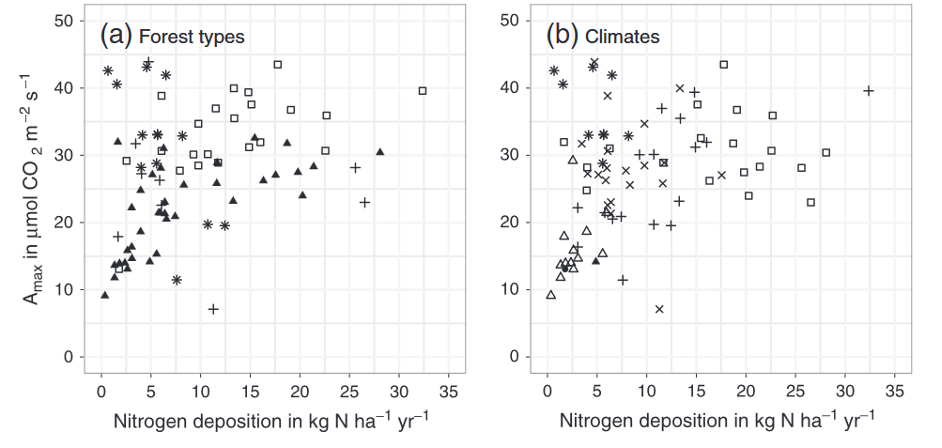
Figure 1: 2 Maximum rates of canopy photosynthesis (Amax) against N deposition (n = 80), marked with (a) different forest types on the left; deciduous broadleaf (DBF, open square), evergreen broadleaf (EBF, asterisk), evergreen needleleaf (ENF, solid triange) and mixed forest (MF, plus), and marked with (b) different climate zones on the right; arctic (solid circle), boreal (open triangle), dry (solid triangle), subtropical-Mediterranean (plus), temperate-continental (cross), temperate (open square), and tropical (asterisk),” Fleischer et al. (2013). (Image credits: doi:10.1002/gbc.20026).
N-Deposition Changes Plant Physiology
Moderate N-deposition can be beneficial for plant physiology. It changes antioxidant enzyme activity, photosynthesis, stomatal conductance, and transpiration.
Antioxidant Enzymes: Some studies show that N-deposition reduces the activities of antioxidant enzymes, such as catalase, superoxide dismutase, peroxidase, and ascorbate peroxidase, that remove reactive oxygen species (ROS) causing oxidative stress in plants. The lower activity levels of these enzymes suggest that N-deposition reduces ROS accumulation that could otherwise threaten cellular membrane stability. N-deposition can also lower leaf malondialdehyde (MDA) content, which causes membrane lipid peroxidation and oxidative stress in leaves. However, other studies found that antioxidant levels can rise due to moderate N deposition, possibly due to species-specific responses.
N deposition also increases the concentration and activity of other enzymes in the leaves, such as glutamic oxalacetic transaminase and glutamic pyruvic transaminase.
Photosynthesis: Nitrogen enrichment increases leaf area, leaf photosynthetic rate, and thereby also canopy photosynthesis capacity. A study of 80 FLUXNET forest sites found that in evergreen needleleaf forests, the photosynthetic rate increases up to a critical load of ~8 kg N ha–1 yr–1, beyond which it plateaus, see Figure 1. Deciduous broad-leaved forests in temperate regions are not sensitive to N addition.
Global meta-analyses show an increase in photosynthesis due to N deposition, but the average rate of increase varies with scale (leaf vs. canopy photosynthesis), by the forests and ecosystems covered, and by the regions investigated. So, a 12.6% increase in canopy photosynthesis is seen in 320 species, while the average leaf photosynthesis rate for 61 woody species from temperate and subtropical forests is 16.1%.
Another global meta-analysis of 300 species showed that N-deposition increases photosynthetic rate per unit area and improves other photosynthesis-related traits. However, the improvement in photosynthesis was species-specific in many ecosystems due to their intrinsic properties. Hence, there was a significant increase seen in C3 temperate grasses in Mongolia. Generally, photosynthetic rates of forbs were reduced, but those of grasses were increased due to N deposition. N enrichment leads to higher photosynthesis in N-limited ecosystems, especially of N-sensitive species.
Stomatal conductance: Many studies show that N-deposition increases stomatal conductance, including the global meta-analysis of 320 plant species that showed an increase by 7.5%. However, other studies on only woody species show no effect on stomatal conductance and transpiration rates.
Transpiration: N-deposition has varied effects on transpiration rate. Some studies found increases; for example, the global meta-analysis of 320 species recorded a 10.5% increase in rate. However, the study on 61 woody species found no change.
However, most studies show that plant water use efficiency increases, though average rates will vary with each study.
Hydraulic conductance: N-deposition can enlarge vessel diameter and increase hydraulic conductance of water from the soil to the shoot, for example by 6.7% in 61 woody species in temperate and subtropical forests.
Tools for N-Deposition Research
The research findings so far clearly show that the response of plants to N-deposition varies with species, climate, region, and N increase intensity and duration. The subject is complex, as nitrogen uptake and use by plants is interlinked with several other nutrients and many processes. Hence the continuing research on the subject across the globe. Scientists working on this subject will need robust, non-destructive, precise tools for rapid on-site data collection and analysis. CID Bio-Science offers the tools necessary for the N-deposition studies as listed below:
- CI-110 Plant Canopy Imager to estimate canopy traits including LAI.
- CI-202 Portable Laser Leaf Area Meter and CI-203 Handheld Laser Leaf Area Meter for measuring leaf area.
- CI-340 Handheld Photosynthesis System for estimating photosynthesis, stomatal conductance, and transpiration simultaneously. It can also measure chloropyhll fluorescence in combination with the CI-510CF Module.
Contact CID Bio-Science, a trusted plant science instrument supplier for over 30 years, for your research needs.
Sources
Azevedo, L. B., van Zelm, R., Hendriks, A. J., Bobbink, R., & Huijbregts, M. A. (2013). Global assessment of the effects of terrestrial acidification on plant species richness. Environmental pollution, 174, 10-15.
Borer, E. T., & Stevens, C. J. (2022). Nitrogen deposition and climate: an integrated synthesis. Trends in Ecology & Evolution, 37(6), 541-552.
Chen, Y., Li, P., Luo, Y., Wang, L., Peng, Y., Li, T., … & Peng, C. (2025). Nitrogen Deposition Significantly Altered the Climatic Sensitivity of Vegetation Phenology. Journal of Plant Ecology, rtaf195.
CTAHR. (n.d.). Nitrogen. Retrieved from https://www.ctahr.hawaii.edu/mauisoil/c_nutrients01.aspx
Du, B., Kiese, R., Butterbach-Bahl, K., Dirnböck, T., & Rennnenberg, H. (2025). Consequences of nitrogen deposition and soil acidification in European forest ecosystems and mitigation approaches. Forest Ecology and Management, 580, 122523.
Feng, H., Guo, J., Peng, C., Kneeshaw, D., Roberge, G., Pan, C., … & Wang, W. (2023). Nitrogen addition promotes terrestrial plants to allocate more biomass to aboveground organs: A global meta‐analysis. Global Change Biology, 29(14), 3970-3989. DOI: 10.1111/gcb.16731
Fleischer, K., Rebel, K. T., van der Molen, M. K. et al. (2013). The contribution of nitrogen deposition to the photosynthetic capacity of forests, Global Biogeochem. Cycles, 27, 187–199, doi:10.1002/gbc.20026.
He, K., Huang, Y., Qi, Y., Sheng, Z., & Chen, H. (2021). Effects of nitrogen addition on vegetation and soil and its linkages to plant diversity and productivity in a semi-arid steppe. Science of the Total Environment, 778, 146299.
Hu, Y., Peuke, A. D., Zhao, X., Yan, J., & Li, C. (2019). Effects of simulated atmospheric nitrogen deposition on foliar chemistry and physiology of hybrid poplar seedlings. Plant Physiology and Biochemistry, 143, 94-108.
Jiang, X., Wang, X., Qiao, Y., Cao, Y., Jiao, Y., Yang, A., … & Fu, S. (2024). Atmospheric nitrogen deposition affects forest plant and soil system carbon: nitrogen: phosphorus stoichiometric flexibility: A meta-analysis. Forest Ecosystems, 11, 100192.
Khan, A., Sun, J., Zarif, N., Khan, K., Jamil, M. A., Yang, L., … & Rewald, B. (2020). Effects of increased N deposition on leaf functional traits of four contrasting tree species in northeast China. Plants, 9(9), 1231.
Liang, X., Zhang, T., Lu, X., Ellsworth, D. S., BassiriRad, H., You, C., Wang, D., He, P., Deng, Q., Liu, H., Mo, J., & Ye, Q. (2020). Global response patterns of plant photosynthesis to nitrogen addition: A meta-analysis. Global change biology, 26(6), 3585–3600. https://doi.org/10.1111/gcb.15071
Liu, L., Xia, Y., Sun, K., Sun, R., Xu, Z., & Zhang, F. (2025). Coordination of plant functional traits under nitrogen deposition with phosphorus addition in a desert steppe ecosystem. Plant Physiology and Biochemistry, 223, 109813.
Luo, Y., El‐Madany, T., Ma, X., Nair, R., Jung, M., Weber, U., … & Migliavacca, M. (2020). Nutrients and water availability constrain the seasonality of vegetation activity in a Mediterranean ecosystem. Global Change Biology, 26(8), 4379-4400.
Phoenix, G. K., Emmett, B. A., Britton, A. J., Caporn, S. J., Dise, N. B., Helliwell, R., … & Power, S. A. (2012). Impacts of atmospheric nitrogen deposition: responses of multiple plant and soil parameters across contrasting ecosystems in long‐term field experiments. Global Change Biology, 18(4), 1197-1215.
Shi, X. M., Qi, J. H., Liu, A. X., Zakari, S., & Song, L. (2023). Leaf phenotypic plasticity coupled with integration facilitates the adaptation of plants to enhanced N deposition. Environmental Pollution, 327, 121570.
Stevens, C. J., David, T. I., & Storkey, J. (2018). Atmospheric nitrogen deposition in terrestrial ecosystems: Its impact on plant communities and consequences across trophic levels. Functional Ecology, 32(7), 1757-1769.
Wang, J., Wang, X., Peñuelas, J. et al. (2025). Nitrogen deposition favors later leaf senescence in woody species. Nat Commun 16, 3668 (2025). https://doi.org/10.1038/s41467-025-59000-0
Xin, X., Nepal, J., de Oliveria, J.B., …Maryam, H. (2025, Nov 26). Managing soil N for productivity and sustainability: Understanding gains and losses. Retrieved from https://www.sciencesocieties.org/publications/csa-news/2025/december/managing-soil-N-productivity-sustainability
Yuan, X., Hu, X., Gun, S., Qu, L., Yan, Y., & Agathokleous, E. (2025). Ozone and nitrogen deposition effects on plant physiology and growth vary among tree species, not plant functional types. Ecosystem Health and Sustainability, 11, 0348.
Zhang, R., Wu, J., Li, Q., Hänninen, H., Peng, C., Yao, H., … & Ying, Y. (2017). Nitrogen deposition enhances photosynthesis in Moso bamboo but increases susceptibility to other stress factors. Frontiers in Plant Science, 8, 1975.
Zhang, H., Li, W., Adams, H. D., Wang, A., Wu, J., Jin, C., Guan, D., & Yuan, F. (2018). Responses of Woody Plant Functional Traits to Nitrogen Addition: A Meta-Analysis of Leaf Economics, Gas Exchange, and Hydraulic Traits. Frontiers in plant science, 9, 683. https://doi.org/10.3389/fpls.2018.00683
Zhou, M., Yan, G., Xing, Y., Chen, F., Zhang, X., Wang, J., … & Liu, T. (2019). Nitrogen deposition and decreased precipitation does not change total nitrogen uptake in a temperate forest. Science of the Total Environment, 651, 32-41.
Zhang, Y., Zhang, Q., Yang, W., Zhang, Y., Wang, N., Fan, P., You, C., Yu, L., Gao, Q., Wang, H., Zheng, P., & Wang, R. (2023). Response mechanisms of 3 typical plants nitrogen and phosphorus nutrient cycling to nitrogen deposition in temperate meadow grasslands. Frontiers in plant science, 14, 1140080. https://doi.org/10.3389/
Related Products
Most Popular Articles
- Transpiration in Plants: Its Importance and Applications
- Leaf Area – How & Why Measuring Leaf Area…
- How to Analyze Photosynthesis in Plants: Methods and Tools
- Plant Respiration: Its Importance and Applications
- The Forest Canopy: Structure, Roles & Measurement
- Stomatal Conductance: Functions, Measurement, and…
- Forest & Plant Canopy Analysis – Tools…
- Root Respiration: Importance and Applications
- 50 Best Universities for Plant Science
- The Importance of Leaf Area Index (LAI) in…