What Is Nitrogen Deposition and How Does It Affect Plants and Biodiversity?


Dr. Vijayalaxmi Kinhal


June 2, 2026 at 7:06 pm | Updated June 2, 2026 at 7:06 pm | 9 min read
- Air pollutants, nitrogen oxides, and ammonia, are leading to increased nitrogen deposition on soil and water.
- Increased nitrogen deposition is changing soil properties through nitrogen enrichment and acidification.
- As a result of soil changes and acid rain, plants’ biochemistry, physiology, and morphology are changing.
- Loss of species and a shift in species composition are negatively impacting biodiversity and resources for higher trophic levels.
In addition to climate change and land-use change, another major global change occurring is nitrogen deposition, in the form of ammonia and nitrogen oxides. The contribution by anthropogenic activities to nitrogen has increased from 15% to 60% since the 1850s. The nitrogen deposition affects vegetation at the individual, species, and community levels but does not receive the same attention as climate change. In this article, you can learn about nitrogen deposition and its effects on vegetation.
Deposition of Nitrogen Compounds
Nitrogen is a key element for life, and is part of biochemical compounds in plants and animals, such as amino acids and proteins. The nitrogen cycle is one of Earth’s vital biogeochemical cycles. However, for several decades, atmospheric nitrogen levels have increased due to anthropogenic activities, altering the nitrogen cycle (see Figure 1).
Nitrogen in the air is inert and constitutes 78% of the air; the deposition that occurs is of reactive nitrogen compounds, such as ammonia (NH3) and nitrogen oxides (NOx), common air pollutants. These compounds are emitted by agriculture and the burning of fossil fuels in vehicles and industries. The Haber–Bosch process and nitrogen fixation in agriculture account for 80% of the anthropogenic addition. The remaining 20% of anthropogenic nitrogen emissions comes from internal combustion engines and industry.
Subscribe to receive our monthly round-up of articles.
Nitrogen compounds are deposited in rain as wet deposition, while the remainder sinks into soil and water due to gravity as dry deposition. Ammonia reacts with water or air to form ammonium. Two-thirds of nitrogen deposition occurs as ammonia and ammonium compounds (NH3 and NH4+) and the remaining one-third occurs as nitrogen oxides.
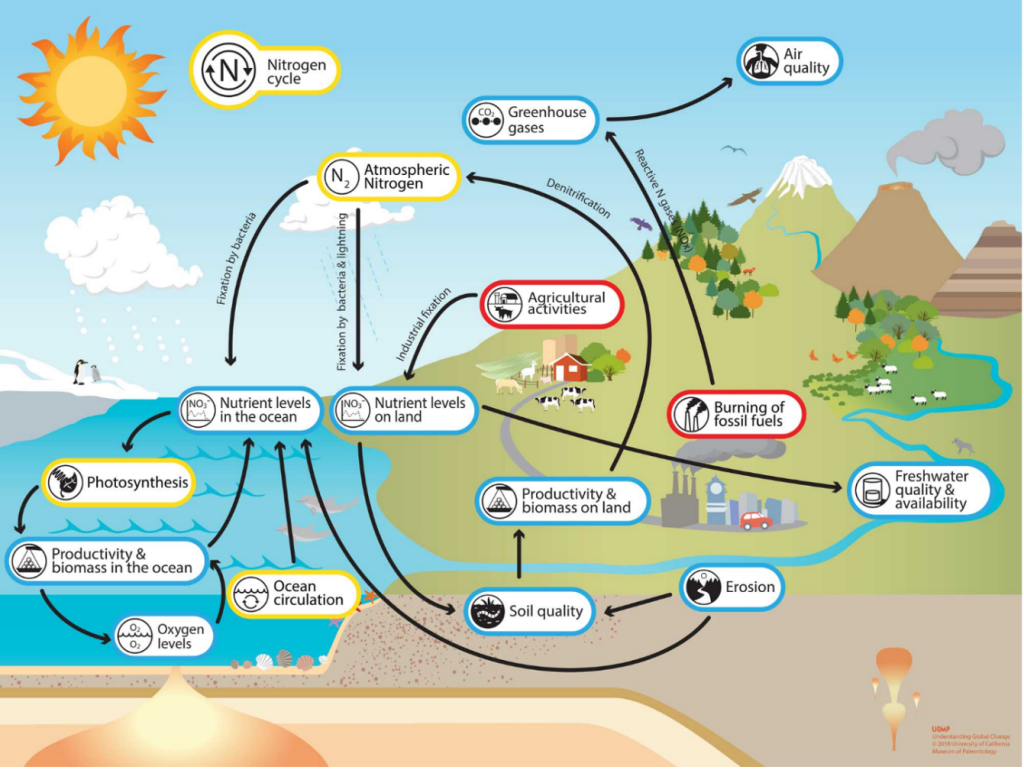
Figure 1: “Processes and phenomena related to the nitrogen cycle,” University of California Museum of Paleontology. (Image credits: https://ugc.berkeley.edu/background-content/nitrogen/)
Nitrogen Deposition Patterns Across Time and Space
The rate of deposition depends on the nature of the nitrogen compound, distance from the source, and the roughness of the surface where nitrogen is deposited. In the Netherlands, most nitrogen deposition occurs close to the source and is highest in built-up areas and dense forests, followed by perennial crops, arable land, and grasslands; the least deposition occurs over water.
Nitrogen deposition is correlated with population and country-level GDP. The highest nitrogen depositions occur in parts of Asia, North America, and Europe, as shown in Figure 2a. Initially, nitrogen deposition was highest in North America, but currently developing countries in low- to mid-latitudes are the new hotspots.
Annual atmospheric deposition of nitrogen doubled between 1900 and 2000, from 1.9 to 3.8 Tg N in 2000. Nitrogen deposition rates peaked in 2015 and have stabilized since; see Figure 2b.
In 2020, nitrogen deposition was 7.0 kg N ha−1 yr−1, and the annual global total was 92.7 Tg N, which is approximately 84% of global agricultural nitrogen production.
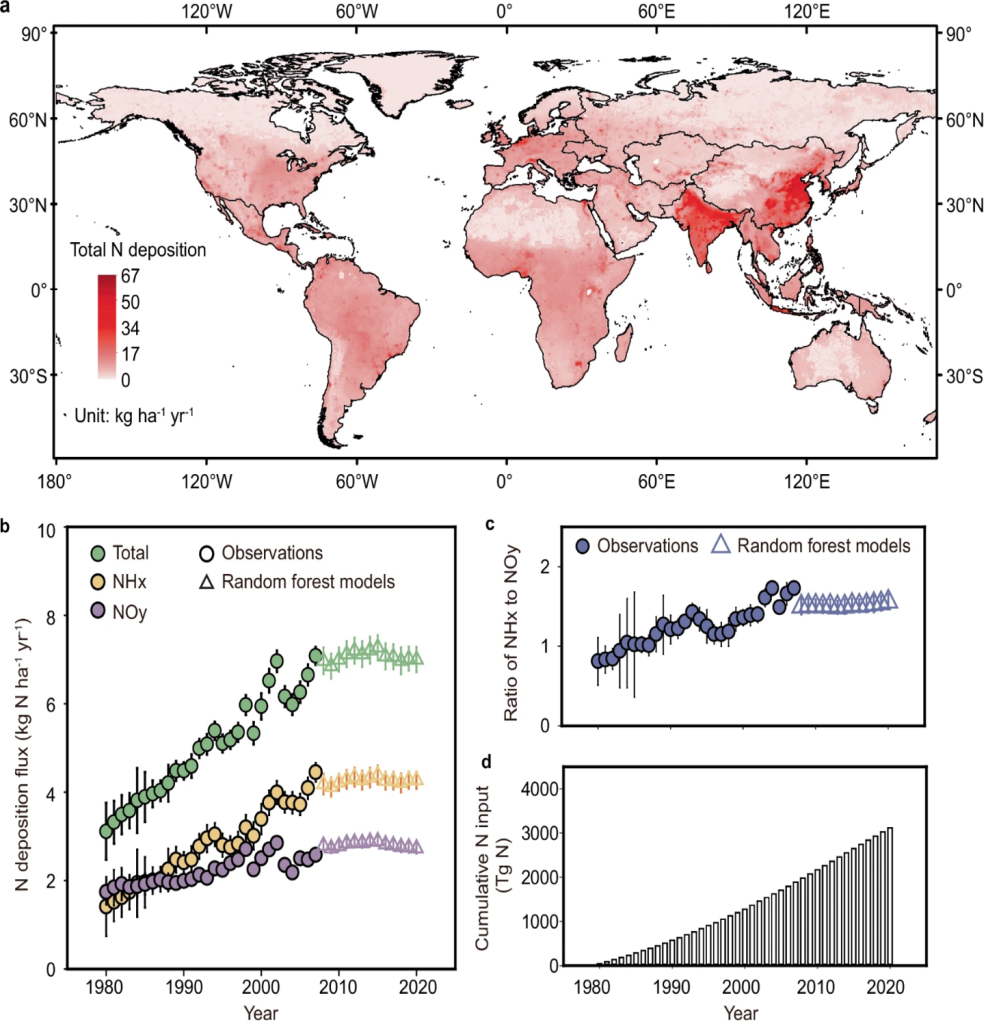
Figure 2: “Spatio–temporal patterns of global terrestrial deposition. a) Spatial distribution of total N deposition in 2020. b) Temporal dynamics of total, NHx (ammonium), and NOy (nitrate) deposition from 1980 to 2020; the circles are direct observations; the triangles are estimated from a random forest model. Different colors represent different N deposition components. c) Temporal dynamics of ratio of NHx to NOy deposition from 1980 to 2020. d) Cumulative N deposition input from 1980 to 2020,” Zhu et al. 2025. (Image credits: https://www.nature.com/articles/s41467-024-55606-y)
Critical Load
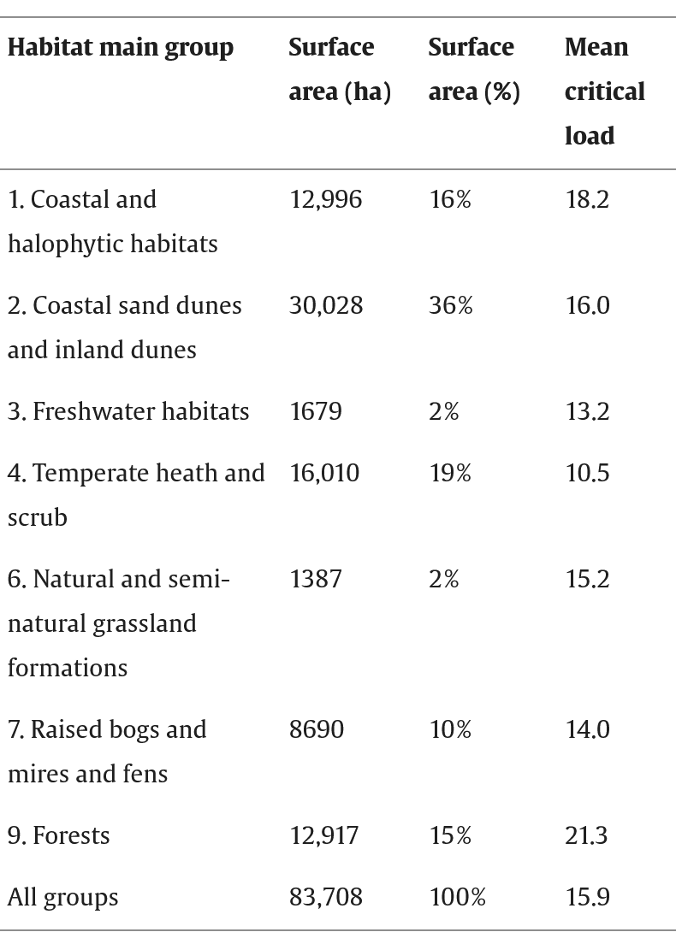
The effect of nitrogen deposition is measured by the critical load (CL). The critical load is defined as the amount of any pollutant deposited or the level of exposure below which there is no significant detrimental long-term ecological impact, according to present knowledge. The critical load for nitrogen deposition in terrestrial ecosystems was estimated at 10–20 kg N ha−1 yr−1. Critical loads can also be calculated for a specific country, habitat, and species; see Table 1. For example, in the Netherlands, the average critical load for nine major habitat types is 15.9 kg N ha-1 y-1, but the average for forests is 21.3 kg N ha-1 y-1, as shown in Table 1.
Table 1: “Habitat main groups occurring in The Netherlands, together with their surface area, mean critical load over their constituent types,” Dobben et al. 2025. (Adapted from https://www.sciencedirect.com/science/article/pii/S0048969725008381)
However, a 2024 Dutch study found that certain habitats were suffering even when the nitrogen deposition was below CL. For example, dry sand health’s CL was estimated to be 15 kg N ha/y, but habitat decline began at 4 kg N ha/y, suggesting that revisions were necessary to lower previously calculated CLs, according to Wamelink et al. 2024. Industries and farmers would also have to further reduce their nitrogen deposition to prevent ecological impacts from their emissions.
Recurring and excessive nitrogen deposition can have adverse biogeochemical effects that, in turn, affect plants, species, and communities, which are discussed below.
Biogeochemical Effects of Nitrogen Deposition
The adverse biogeochemical effects include eutrophication, soil and water acidification, and reduced soil buffering capacity.
Eutrophication
Eutrophication or nitrogen (N) enrichment is the most common effect of nitrogen deposition in terrestrial ecosystems. Low to moderate nitrogen deposition can promote plant growth, crop productivity, biomass, and carbon sinks, as nitrogen is a major plant nutrient but is generally low in most ecosystems. Higher nitrogen deposition leads to greater N mineralization and nitrification, thereby converting the element into available forms for plants and microbes.
However, higher nitrogen deposition increases all the processes in the nitrogen cycle, including N losses. Fertilizers like urea and manure applied close to the surface are converted to ammonia gas, which escapes into the air when the soil is warm, moist, or alkaline, in a process called ammonia volatilization. More denitrification produces more nitric and nitrous oxides, both of which are polluting gases. Higher nitrification leads to increased nitrate leaching. The compounds produced far exceed the amounts required by plants and microbes, causing further biochemical changes, such as reducing the availability of other plant nutrients.
Eutrophication of freshwater and ocean ecosystems increases algal growth, reducing dissolved oxygen levels and killing fish and other aquatic species.
Carbon Cycle
Nitrogen is coupled with carbon cycling. Higher N increases carbon dioxide uptake, albeit only to a small extent, and only marginally mitigates climate change.
Another effect on the carbon cycle results from a shift in biomass allocation among plant organs. Plants store a significant portion of their biomass in roots. Due to increased N availability, plants increase their shoot-to-root ratio. As a result, the above-ground carbon pool increases at the expense of underground carbon sinks, with negative impacts on long-term carbon sequestration and the carbon cycle.
Soil and Water Acidification
Pollutants such as nitrogen oxides (NOx) react with oxygen, water vapor, and other chemicals to form nitric acid, which contributes to acid rain. Winds can carry acidic compounds in the air over hundreds of kilometers and deposit them as acid rain, contaminating soil and water and entering runoff. Soil acidification also occurs when nitrogen inputs to soil increase, increasing nitrification.
Acid rain affects both terrestrial and aquatic ecosystems. Acid rain reduces calcium and magnesium levels and increases aluminum levels, thereby increasing acidity. Increased water acidity is harmful to aquatic animal species, too.
Nitric acid at ground level leads to the formation of ozone, which is harmful to people, and increases the chemical weathering of rocks.
Soil Buffering Capacity
Some soils can counter acidity through their carbonate content or cation exchange capacity. Soil buffering capacity is related to the soil pH range of 4.5 to 7.5. Soils have base cations such as calcium and magnesium, which are used to neutralize the acidity. However, as nitrogen deposition increases, nitrate leaching increases, leading to the leaching of base cations and the dissolution and release of aluminum, which causes acidity.
The biogeochemical alterations, in turn, alter vital plant traits and productivity, and cause species losses and community shifts.
Plant Effects of Nitrogen Deposition
Responses at the individual plant level occur through changes in plant traits, direct toxicity, and indirect effects on soil properties.
Changes in plant traits: Nitrogen deposition alters plant biochemistry, physiology, and morphology. Nitrogen deposition increases the uptake of nitrogen compounds by plants, leading to higher nitrogen concentrations in the tissues of both lower and higher plants. Higher leaf nitrogen levels make the plant more susceptible to herbivory. Other changes in plant biochemistry are variations in the concentrations of amino acids, enzymes, and photosynthetic pigments. Due to increased soil N, plants reduce root growth and invest more in vegetative growth, thereby increasing the shoot-to-root ratio.
Foliar litter in areas of high nitrogen deposition also has higher N content.
Direct toxicity: Direct toxicity to plants from gases and aerosols occurs in areas with high deposition concentrations, usually of ammonia, near large sources. Toxicity disrupts electron transport in leaf chloroplasts, causing leaf yellowing, reduced root growth, and necrosis. N accumulation in soil can also cause poor shoot and root development, affecting overall growth.
The effects are influenced by many abiotic factors and are species-specific. For example, critical levels are 3 μg/m3 for higher plants and only 1 μg/m3 for lichens and bryophytes.
Acid rain reduces leaf nutrient content, leaving them yellow and dead. Acid rain reduces chlorophyll content, photosynthetic rate, and stomatal conductance. It also leaches vital essential nutrients like calcium and magnesium, harming the foliage and plant growth. Acid rains also change morphological features by reducing leaf area and cuticle thickness. This changes canopy traits and reduces plants’ ability to absorb sunlight, making them vulnerable to freezing temperatures. Also, acid rain increases levels of toxic elements, such as aluminum, that make it difficult for plants to absorb water and harm plant growth.
Species-Level Effects of Nitrogen Deposition
Nitrogen deposition affects species through their manuring and acidification effects. The increased N encourages faster and more growth. As a result, some species, like tall-stemmed sting nettles, grass, and brambles, grow taller. It increases the disadvantages already faced by smaller plants in the community, such as marsh gentian or marsh grass, which receive less light than before due to overgrown neighbors and eventually die.
Also, some species are more sensitive to soil acidity due to cation reduction and increased aluminum levels, which harm their growth and survival.
Species that are more nutrient-hungry will thrive, and slow-growing species tolerant of low nutrient levels, such as Campanula rotundifolia, will perish, as they lose their competitive advantage. Higher N deposition makes many species more sensitive to extremes like drought, frost, and wind.
Community Level Effects of Nitrogen Deposition
Changes in soil pH and nutrient chemistry will gradually alter the species pool, favoring those that can survive extreme conditions. In addition to species loss, community changes occur because enriched soils also support the growth and spread of invasive species. Loss of species and compositional changes due to shifting populations reduce biodiversity, a major concern associated with increased nitrogen deposition. The reduction in species makes a community less diverse, lowering its quality. For example, in the UK, around 30% of species have been lost due to increased nitrogen deposition.
However, some habitats are more sensitive to the effects of nitrogen deposition on communities. Species loss was highest in moist subtropical forests due to acidity, and deserts were the least affected.
Changes in plant growth, chemistry, and phenology, as well as species composition, also have cascading effects on higher trophic levels, including insects, pollinators, and large herbivores. It changes food chemistry for herbivores, prey availability, access to nesting sites, and microclimates. The number of plants pollinated by large bees has decreased due to reduced nectar availability and a lack of larger flowers to support the bee populations.
Studying Nitrogen Deposition Effects
The wide range of effects of nitrogen deposition makes their research challenging. Having precise instructions for on-site data collection and analysis can make scientists’ tasks easier. CID Bioscience supplies a range of precision scientific tools useful for this research topic.
- The CI-340 Handheld Photosynthesis System for measuring photosynthesis and stomatal conductance.
- The CI-110 Plant Canopy Imager for canopy analysis.
- The CI-202 Portable Laser Leaf Area Meter and CI-203 Handheld Laser Leaf Area Meter for leaf area measurements.
- The CI-710s SpectraVue Leaf Spectrometer for changes in pigments.
- The CI-600 In-Situ Root Imager and CI-602 Narrow Gauge Root Imager for root studies.
The tools come with data logging and transfer capacity, are small and portable, and are suitable for use in fields, forests, greenhouses, and laboratories.
Contact us to find out more about our range of scientific tools for your nitrogen deposition research needs.
Sources
Azevedo, L. B., van Zelm, R., Hendriks, A. J., Bobbink, R., & Huijbregts, M. A. (2013). Global assessment of the effects of terrestrial acidification on plant species richness. Environmental pollution, 174, 10-15.
Bakker, W., Morel, T., Ozinga, W., Scheper, J., & Vergeer, P. (2024). The relative importance of nitrogen deposition and climate change in driving plant diversity decline in roadside grasslands. Science of the Total Environment, 955, 176962.
Cai, J., Luo, W., Liu, H., Feng, X., Zhang, Y., Wang, R., … & Jiang, Y. (2017). Precipitation-mediated responses of soil acid buffering capacity to long-term nitrogen addition in a semi-arid grassland. Atmospheric Environment, 170, 312-318.
Chen, H., Li, D., Gurmesa, G. A., Yu, G., Li, L., Zhang, W., … & Mo, J. (2015). Effects of nitrogen deposition on carbon cycle in terrestrial ecosystems of China: A meta-analysis. Environmental Pollution, 206, 352-360.
EPA. (2026, Feb 19). Effects of Acid Rain. Retrieved from https://www.epa.gov/acidrain/effects-acid-rain
Nunez, C. (2025, Aug 14). What is acid rain? Retrieved from https://www.nationalgeographic.com/environment/article/acid-rain
Pardo, Linda H., Mark E. Fenn,…..and Robin L. Dennis. (2011). Effects of nitrogen deposition and empirical nitrogen critical loads for ecoregions of the United States. Ecological Applications 21:3049–3082. http://dx.doi.org/10.1890/10-2341.1
Statistics Netherlands. (n.d.). Deposition of nitrogen compounds. Retrieved from https://www.cbs.nl/en-gb/dossier/nitrogen/deposition-of-nitrogen-compounds
Stevens, C. J., David, T. I., & Storkey, J. (2018). Atmospheric nitrogen deposition in terrestrial ecosystems: Its impact on plant communities and consequences across trophic levels. Functional Ecology, 32(7), 1757-1769.
Wamelink, G. W. W., Goedhart, P. W., Roelofsen, H. D., Bobbink, R., Posch, M., van Dobben, H. F., … & Peterka, T. (2024). A novel method to estimate the response of habitat types to nitrogen deposition. Environmental Pollution, 349, 123844.
Yaffar, D., Lugli, L. F., Wong, M. Y., Norby, R. J., Addo‐Danso, S. D., Arnaud, M., … & Cusack, D. F. (2024). Tropical root responses to global changes: a synthesis. Global Change Biology, 30(7), e17420.
Zhang, Q., Li, Y., Wang, M., Wang, K., Meng, F., Liu, L., … & Zhang, F. (2021). Atmospheric nitrogen deposition: A review of quantification methods and its spatial pattern derived from the global monitoring networks. Ecotoxicology and Environmental Safety, 216, 112180.
Zhu, J., Jia, Y., Yu, G. et al. (2025). Changing patterns of global nitrogen deposition driven by socio-economic development. Nat Commun 16, 46 https://doi.org/10.1038/s41467-024-55606-y
Related Products
Most Popular Articles
- Transpiration in Plants: Its Importance and Applications
- Leaf Area – How & Why Measuring Leaf Area…
- How to Analyze Photosynthesis in Plants: Methods and Tools
- Plant Respiration: Its Importance and Applications
- The Forest Canopy: Structure, Roles & Measurement
- Stomatal Conductance: Functions, Measurement, and…
- Forest & Plant Canopy Analysis – Tools…
- Root Respiration: Importance and Applications
- 50 Best Universities for Plant Science
- The Importance of Leaf Area Index (LAI) in…