How Does Climate Change Affect Plant Phenology?

Dr. Vijayalaxmi Kinhal


August 19, 2026 at 9:11 pm | Updated August 19, 2026 at 9:11 pm | 9 min read
- Plant phenology is a sensitive indicator of global changes such as climate change and nitrogen deposition.
- Climate change is responsible for earlier spring phenology (leaf out and flowering) but has less effect on fruiting and the end of the autumn season.
- Nitrogen deposition delays most phenological phases, such as spring phenology, fruiting, and the end of the season globally, except for flowering, which occurs early in natural grasslands and forests.
- A combination of in situ and satellite observations is necessary to identify phenological shifts.
Plant activity is aligned with seasonal environmental changes. Observable shifts in the timing or phenology of leaf out, flowering, fruiting, and the end of the season present compelling evidence of the effects of major global changes on species and ecosystems. Phenological shifts are observed at multiple scales, from individuals and communities to landscapes, through in situ and satellite image studies. Phenological shifts need to be studied because they can strongly affect community and ecosystem functioning by altering carbon fluxes, the rates of flowering and fruiting, and the quantity and quality of agricultural and horticultural production. Trophic mismatch between flowering and pollinator activity, and fruiting and seed dispersal can affect plant and animal population regeneration in natural ecosystems. This article summarizes some of the major trends and drivers that scientists have identified in phenological shifts due to climate change and nitrogen deposition, the major global changes.
Climate Change-Induced Phenology Shifts
Climate change drivers include rising temperatures, carbon dioxide levels, and alterations in precipitation, all of which can have individual effects or interact to influence phenology. Notable shifts due to climate change have occurred in spring and autumn, as well as in reproductive phenology. Shifts in leaf-out and leaf-fall have been observed in situ and in satellite observations at various scales; see Figure 1.
Spring phenology
Climate warming has advanced leaf-out, or spring phenology, according to in situ and satellite observations. The positive effects can be strengthened by increased precipitation, as it counteracts desiccation caused by warming.
Subscribe to receive our monthly round-up of articles.
In situ phenological observations recorded since 1969 show that spring starts 3 days earlier per decade, and by 1998 it was 8 days earlier in Europe. While the shifts have been lower in North America, with an advance of only 0.5 days per decade since 1965, the shift in leaf-out was the greatest in East Asia, namely China, where springs started 5.5 days earlier per decade.
Several studies of satellite observations of the start of season based on vegetative indices exist. They all agree that spring starts earlier now, though they differ on the exact number of days, partly because the time periods studied differ. In the previous three decades, spring started seven days earlier in Eurasia and eight days earlier in North America between 1982 and 1997. Between 1982 and 2001, the start of the season was earlier by 10.6 days in Europe, 9.3 days in North America, and 7 days in East Asia.
The spring advance trend has decelerated since the 2000s due to a warming hiatus, or slowdown in warming, in most parts of the globe. Spring still begins earlier, but the rate of advance is slower. Scientists are not certain whether these weakening trends are short-term. Globally, surface temperatures have increased by 0.28°C per decade over the last 30 years, causing spring to advance by 2.3 to 5.1 days per decade.
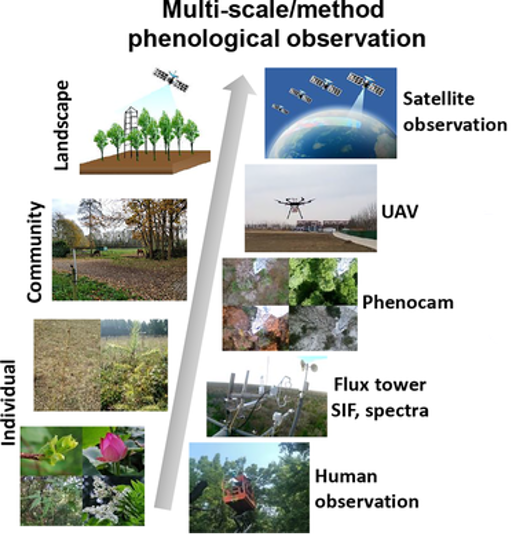
Figure 1: A sketch map showing the observation of plant phenological data at different scales. Adapted from Piao et al. (2019). (Image credits: DOI: 10.1111/gcb.14619)
Autumn phenology
In situ observations show that climate change is delaying the end of the season, though the impact is weaker than on spring phenology, especially in Europe. Between 1982 and 2011, leaf fall was delayed in Europe by only 0.1 days per decade, with stronger effects in China, where last autumn dates were delayed by 2.6 days per decade, and in the USA by 2.4 to 3.6 days per decade.
Satellite data examined by many studies show a delay of the end of autumn by 1.2 to 6.1 days per decade in the USA, Eurasia, and temperate China. The average for the Northern Hemisphere between 1982 and 2011 was a 1.8-day delay in the end of autumn in 65% of the area, but an earlier end of autumn in 35% of the area.
Drivers and mechanisms of leaf phenology changes
The impact of climate change on phenology operates through various mechanisms and is influenced by many interacting factors.
Temperature: Warmer temperatures result in earlier springs and later autumns. However, plants are more responsive to daytime warming than to nighttime warming at the species and ecosystem scales. So nighttime warming, which has become more common in recent decades, has varying effects on species. Also, higher winter temperatures lead to insufficient chilling, which can delay leaf opening by making plants insensitive to spring warming.
Photoperiod: Climate change does not alter photoperiodism, which regulates leaf senescence through the shortening of the day length from summer to autumn. The longer nights start bud set and leaf senescence. Hence, leaf fall, which is determined by photoperiodism, is less influenced by warmer temperatures, and Europe continues to have the same end-of-season date for autumn. The effect of photoperiodism on spring leaf out is not yet clear.
Water availability: Water availability fluctuates with temperature due to climate change. However, their effects on phenology are far less than those of temperature. At higher altitudes, snow melts earlier due to stronger solar radiation, lowering soil temperatures. Melting snow percolates into the partially frozen ground, increasing soil water content and promoting root activity even though air temperatures are still cold, advancing spring phenology, especially for grass and shrubs.
CO2: Elevated CO2 along with high temperatures in autumn causes lower stomatal conductance, reducing water vapor loss and extending the growing season in boreal forests.
Reproductive phenology
Reproductive phenology includes the plant stages from flower initiation to fruit maturation. The reproductive season length determines the time plants invest in reproduction and the resources allocated to seeds and fruits. Fewer studies have examined the effects of climate change on reproductive phenology than on leaf phenology.
We do know that warming results in early flowering and fruiting of cultivated grain and fruit species, including apple, peach, and cereals. A national-level study in China covering 102 woody species between 1980 and 2002 confirms these trends in forests; see Figure 2.
Warming accelerates reproductive development in plants; however, the rate is species-specific, so changes in reproductive season length vary among species. The date of flowering is advanced more than the date of fruiting, because they are determined by different processes.
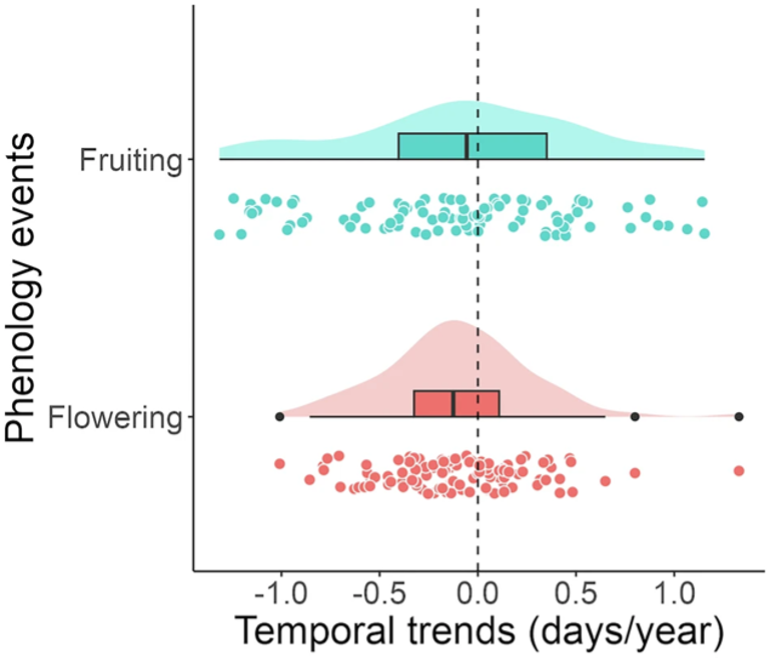
Figure 2: “Species-specific temporal trends of flowering and fruiting of 102 woody plant species in China during 1980–2008,” Ji et al. (2026). (Image credits: https://www.nature.com/articles/s43247-026-03374-6/figures/1)
Flowering mechanisms and drivers: Flowering follows a chilling-forcing pathway. Species-specific chilling during winter dormancy is followed by spring forcing, in which warmer temperatures prompt leaves and buds to open. Higher air temperatures accumulate more warmth, resulting in earlier spring forcing of flowering. In some cases, insufficient winter chilling can weaken advance or even delay flowering. In other species, though winter chilling is reduced due to higher temperatures, it is compensated by a stronger spring forcing, resulting in advancing flowering. Since climate change does not alter photoperiods, only species with weak photoperiodism will start flowering in response to increased warmth and not species with strong photoperiodism.
Fruiting drivers: Fruiting is influenced by flowering date and climatic conditions, which can limit phenological shifts. The climatic conditions influencing fruiting are temperature and accumulated forcing. Higher temperatures accelerate reproductive development, but accumulated forcing extends the reproductive season, allowing more time for fruit maturation. Woody species vary in their responses to warming and exhibit different phenological shifts.
Early flowering can be affected by spring frosts, but early fruiting can reduce exposure to early autumn frosts. Increased precipitation can also change the length of the reproductive season by increasing or decreasing it. For example, higher precipitation can advance flowering dates by increasing soil water availability and providing better growth conditions.
Nitrogen Deposition Induced Phenology Shifts
Increasing global nitrogen deposition due to air pollution has intensified phenological shifts driven by climate change. The shifts depend on the ecosystem and specific phenological phase, according to findings from many in situ and satellite studies.
According to a 2025 meta-analysis by He et al. of in situ studies, most phenological phases are delayed, except for flowering in natural grasslands and forests; see Figure 3. The phenological phases that are delayed are
- Spring phenology or budding by 4.15 days
- Xylem growth by 8.5 days
- Fruiting by 0.21 days
- Fruit maturation by 3.3 days
- Leaf discoloration by 1.5 days
- Senescence by 4 days
- End of season or leaf fall by 4.95 days
In contrast, flowering occurs 0.18 days earlier in natural grasslands and forests; see Figure 3.
Ecosystems that vary in functioning respond differently to nitrogen deposition. Temperature, precipitation, and nitrogen deposition have less influence on species in grasslands and farmlands, but have a strong impact on trees and plants in forests. Also, while flowering is advanced by 1.45 days in forests, all phenological phases are delayed in grasslands and farmlands. These differences can be explained by the drivers and mechanisms of phenology.
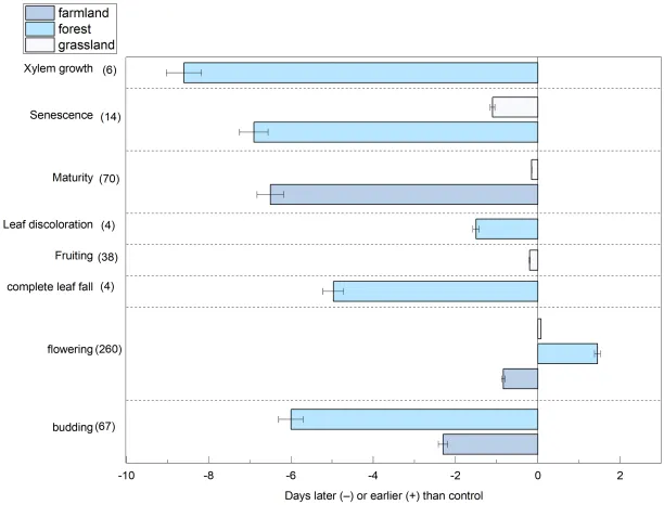
Figure 3: “The effects of nitrogen addition on budding, flowering, complete leaf fall, fruiting, leaf discoloration, maturity, senescence and xylem growth phenology in three ecosystems, the sample size is indicated in parentheses,” He et al. (2026). (Image credits:
https://www.frontiersin.org/journals/plant-science/articles/10.3389/fpls.2025.1632357/)
Drivers and mechanisms of nitrogen deposition shift in phenology
Nitrogen (N) is the most important nutrient necessary for plant growth and is a limiting factor in most ecosystems. Therefore, increased availability of the element due to nitrogen deposition has a profound impact on leaf and reproductive phenology. The nitrogen deposition increases soil N availability and uptake by trees and plants, improving leaf concentrations of the element. As a result, chlorophyll formation increases, leading to more photosynthesis and carbohydrate accumulation, promoting growth and development processes. However, excessive N suppresses the production of cytokinins and increases abscisic acid accumulation, delaying leaf out. Moreover, large trees allocate resources to morphological construction, including xylem, rather than to growth, explaining the marked delay in forests compared with farmland in spring phenology. Shrubs and small trees in the same region use early leaf out to take advantage of the open canopy.
Higher photosynthesis increases the production of crucial signaling hormones like gibberellins and auxins that trigger flowering. Increased biomass accumulation, however, extends the growing season and delays fruiting, maturation, and senescence. Moreover, N addition delays autumn phenology in small trees via physiological mechanisms, such as increased chlorophyll and suppression of anthocyanin production and leaf senescence.
These effects are moderated by temperature and precipitation.
Precipitation: Rainfall alone can advance spring phenology. Increased N deposition interacts with precipitation and water availability in complex ways, delaying autumn coloration and leaf fall in both small and large trees. However, the interaction of rain and N deposition advances leaf coloration in shrubs. Rainfall had a more significant effect on N deposition in forests, followed by farmlands and, least, grasslands. Increased precipitation also delays leaf senescence and the end of the season. In arid, semi-arid, and sub-humid regions, increased rainfall did not alter responses to nitrogen deposition.
Temperature: The N deposition-temperature interaction was highest in forests compared to grasslands and farmlands. In addition, changes in nitrogen use efficiency, shifts in root-shoot allocation, and increased phenological susceptibility of plants and trees to temperature in forests. Grasslands and farmlands, which have a more open canopy and a shallow root system than forests, are more influenced by short-term environmental factors such as moisture and light.
Biodiversity: In ecosystems with higher biodiversity, the impact of N deposition is lower, as seen in fewer shifts in phenology in grasslands compared to farmlands. The complementary nutrient use of nitrogen by the various species buffers the effects of N addition. The interaction of temperature and N deposition had fewer effects in grasslands than farmlands, as the varying functional plant groups respond differently- early-flowering species are more sensitive to temperature shifts than late-flowering species.
These findings show a complex interaction of global changes with species-specific plant morphology and physiology, as well as other environmental factors.
Measuring Leaf Phenology Shifts
The number of phenological metrics tracked requires many types of observations and tools for in situ studies. Changes in leaf phenology, such as leaf out and leaf fall, can be monitored by changes in canopy cover, while autumn leaf color changes can be studied using leaf spectrometers. CID BioScience Inc offers devices such as CI-110 Plant Canopy Imager for canopy cover studies of all plant types and ecosystems from farmland to forests. The CI-710s SpectraVue Leaf Spectrometer, with preloaded vegetative indices, can analyze leaf spectra to track and quantify autumn leaf coloration.
Contact us to find out more about our precision, portable tools for in situ phenological studies.
Sources
Cleland, E. E., Chuine, I., Menzel, A., Mooney, H. A., & Schwartz, M. D. (2007). Shifting plant phenology in response to global change. Trends in ecology & evolution, 22(7), 357-365.
Ji, G., Peng, Y., Li, X. et al. (2026). Climate warming advances flowering and fruiting but drives divergent changes in reproductive season length. Commun Earth Environ 7, 424. https://doi.org/10.1038/s43247-026-03374-6
He, Y., Zhou, T., Mao, J., Li, M., Sun, R., Liu, C., … & Fu, S. (2025). Nitrogen addition substantially affects plant phenology in terrestrial ecosystems: a meta-analysis. Frontiers in Plant Science, 16, 1632357.
He, Y., Li, W., Qin, Y., Su, Y., Wang, J., Wang, X., … & Fu, S. (2026). Interactive canopy nitrogen and water additions delay phenology in a warm-temperate forest. Journal of Advanced Research.
Liu, Q., Fu, Y.H., Zhu, Z., Liu, Y., Liu, Z., Huang, M., Janssens, I.A. and Piao, S. (2016), Delayed autumn phenology in the Northern Hemisphere is related to change in both climate and spring phenology. Glob Change Biol, 22: 3702-3711. https://doi.org/10.1111/gcb.13311
Piao, S., Liu, Q., Chen, A., Janssens, I. A., Fu, Y., Dai, J., … & Zhu, X. (2019). Plant phenology and global climate change: Current progresses and challenges. Global change biology, 25(6), 1922-1940.
Wang, X., Wu, C., Zhang, X., Li, Z., Liu, Z., Gonsamo, A., & Ge, Q. (2020). Satellite-observed decrease in the sensitivity of spring phenology to climate change under high nitrogen deposition. Environmental Research Letters, 15(9), 094055.
Related Products
Most Popular Articles
- Transpiration in Plants: Its Importance and Applications
- Leaf Area – How & Why Measuring Leaf Area…
- How to Analyze Photosynthesis in Plants: Methods and Tools
- Plant Respiration: Its Importance and Applications
- The Forest Canopy: Structure, Roles & Measurement
- Stomatal Conductance: Functions, Measurement, and…
- Forest & Plant Canopy Analysis – Tools…
- Root Respiration: Importance and Applications
- 50 Best Universities for Plant Science
- The Importance of Leaf Area Index (LAI) in…