How Do mixed-species systems Improve Root Growth, Soil Health, and Crop Yields?

Dr. Vijayalaxmi Kinhal


June 15, 2026 at 6:48 pm | Updated June 15, 2026 at 6:48 pm | 10 min read
- Root systems in monoculture and mixed species systems create very different soil environments that influence resource availability and microbial interactions.
- Root plasticity allows plants to respond to neighbors by varying traits such as distribution, rooting depth, root biomass, root length density, average diameter, and fine root production.
- Yield, yield stability, resource-use efficiency, land-use efficiency, and soil fertility are improved in mixed-species systems.
Although it is well known that species diversity positively influences above-ground plant productivity, its effects on below-ground productivity remain unestablished. It is partly due to methodological constraints in studying root systems. However, the growing recognition of the role of underground dynamics and new technologies has led to an increasing number of studies on the influence of species diversity on root systems. This article examines studies that explore whether root dynamics and morphology in mixed-species systems differ from those in monocultures in forestry and agriculture.
Defining Monoculture and Mixed Species Systems
Monoculture refers to growing a single species continuously over seasons on a large area in agriculture or forestry. These systems are aimed at increasing production but require intensive management and lead to soil degradation and environmental pollution due to excessive chemical use.
Mixed-species systems use more than two species across large areas and over seasons through rotation to increase the number of ecological niches and interactions, thereby diversifying output and reducing chemical pollution of soil, water, and air.
Subscribe to receive our monthly round-up of articles.
Plant functional traits are related to their ability to colonize, grow, survive, and reproduce. Since a significant portion of plant biomass is underground, differences in root systems and their dynamics are expected between single- and multi-species systems.
Studies show that much of the difference in underground functioning arises from increased variations of root traits resulting from species mixing. Thus, the mixed-species community has a wider range of rooting depths, root system architecture, foraging capacities, and interactions between plants and soil microflora than monocultures with plants with similar root systems, foraging ranges, and interactions.
Moreover, scientists have discovered differences in the expression of root traits between monoculture and multispecies systems, due to phenotypic plasticity.
Resource Utilization by Monoculture and Mixed Species Systems
Monoculture agricultural crops and forestry trees have roots growing to the same depth, competing for nutrients and water in a common space, while resources at other depths remain underutilized and leach into groundwater or are lost through topsoil erosion and runoff.
Mixed-species systems result in greater resource uptake and productivity. Resource availability increases due to complementarity effects, due to niches and facilitation, resource differentiation, and microbial interactions, as discussed below.
Niche differentiation
In mixed systems, diverse species produce complementarity effects, primarily due to space and temporal niche differentiation. As the number of species surges, the complementarity effects also increase. Mixed-species systems have root systems with varying depths and architectures that explore different soil niches for nutrients and water, creating complementarity effects. Besides differences in space, the various species might have peak nutrient needs at different times, so competition and nutrient stress are avoided. Thus, the same amount of available resources is partitioned and better utilized across species, allowing for coexistence.
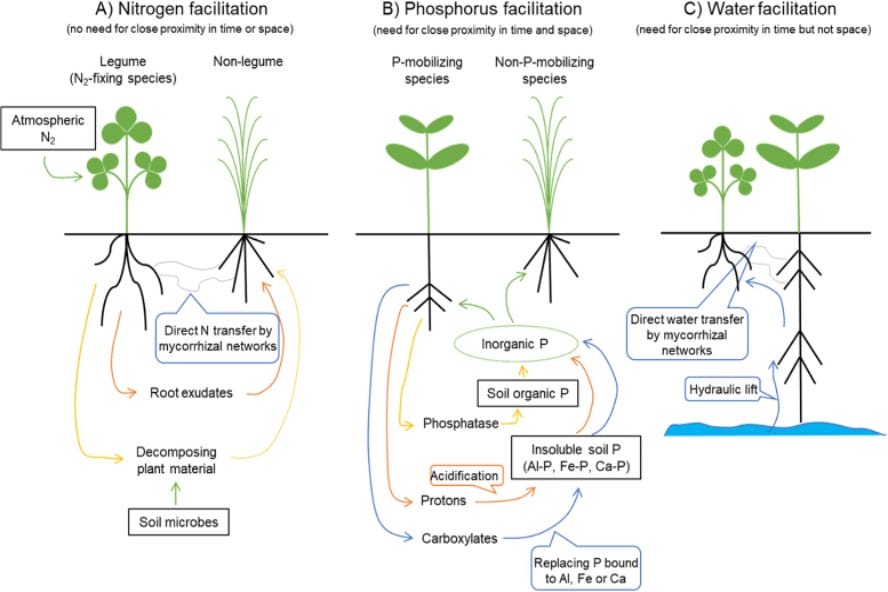
Figure 1: “Interspecific facilitation of nitrogen (N), phosphorus, (P) and water acquisition,” Homulle et al. (2022). (Image credits: https://doi.org/10.1007/s11104-021-05165-8)
Facilitation
Plants and trees in mixed-species systems experience less nutrient stress, partly due to facilitation via nutrient mobilization and resource redistribution; see Figure 1.
Mobilization of nutrients: The use of companion species, such as nitrogen-fixing legumes, can help mitigate nutrient stress by fixing nitrogen, thereby benefiting neighboring plants through root exudates and mycorrhizal transfer. Moreover, when the legume roots and nodules decompose, the fixed nitrogen becomes available to neighboring plants.
Plants growing in close proximity to species that can mobilize inorganic phosphorus (P) by secreting phosphatases, carboxylates, or acids, which can then be used by P‐mobilizing and non‐P‐mobilizing species. For example, faba beans release organic acids and mobilize inorganic P, improving P uptake and resulting in over-yielding in companion maize crops.
Interspecific facilitation can also improve iron and zinc availability in intercropping systems, for example, in sorghum and guava, wheat and chickpea, and maize and guava systems.
Safety-net hypothesis: The so-called safety-net hypothesis stipulates that the deep roots, including those of trees, can tap into leached nutrients and pull them up. The nutrients are added to the topsoil as leaf and twig litter, which can, in time, benefit shallow-rooted companion plants. Agroforestry expansion is recommended to fix the leaky nitrogen cycle in agriculture. Growing deep-rooted cover crops during fallows is another way to use leached nutrients from the preceding season. Similarly, water in lower soil depths can also be brought up to the upper soil layers through hydraulic redistribution, benefiting shallow-rooted annual crops.
Resource differentiation
Though the same set of resources, such as light, nutrients, and water, is used by plants, the amounts and types of each nutrient preferred can differ among species, allowing for coexistence. For example, all plants need nitrogen, but some use it as nitrates, while others use it as ammonium or atmospheric nitrogen. Also, some plants need more nitrogen than others.
Microbial interactions
One of the most important interactions is the common mycorrhiza network, which helps transfer nitrogen, phosphorus, and water between neighboring plants. The root exudates from plants attract species-specific mycorrhizal fungi. Mycorrhizae have differing capacities to mobilize nutrients. So, the greater the mycorrhizal diversity, the more nutrients and their abundance are available in the soil.
Soil Diseases in Monoculture and Mixed Species Systems
Mixed-species systems also reduce pathogenic pressures compared with monoculture soils by lowering host density, exerting direct inhibition, and increasing microbial diversity.
Host plant density and barriers
In mixed-species systems, plants of the same species that are hosts to specific pathogens have a lower density in the stand, and the distance between individuals is greater, making it more difficult for pathogens and pests to reach the next host. Moreover, the non-host species in between act as a physical barrier, slowing the spread of pathogens and pests. In monocultures, the roots of the same species are densely packed, allowing pathogens and parasites to spread quickly.
Direct Inhibition by neighbors
Mixed species benefit from plants that release toxins or deterrents against one or more soil-borne pathogens or parasites through their exudates, which suppress these harmful organisms in the soil by inhibiting spore germination or mycelial growth. Any susceptible species growing in close proximity will benefit from the pathogen and parasite-free soil environment. Since root exudates do not travel far from the source, proximity is crucial for interspecific protection to occur. For example, marigold (Tagetes spp.) controls plant-parasitic nematodes that attack roots. This protection is lacking in monocultures.
Microbial diversity
Plants have a species-specific effect on microbes through the root exudates they produce. Intercropping alters exudate composition, diversifying and increasing the abundance of the microbial community. Hence, more plant species also means higher microbial diversity in the soil. Mixing of root exudates from diverse species also dilutes chemicals that could attract pathogens.
Also, greater diversity and more root systems in a mixed system create more sites for interactions with microflora. For example, intercropping cucumber with garlic increases soil bacterial and actinomycete abundance and reduces fungal abundance. A more diverse microbial community increases the likelihood that some of its members are antagonistic to plant pathogens. Even competition for resources among microbes will reduce pathogen abundance, so pathogen pressures in mixed systems are lower than in monocultures, leading to lower disease incidence.
Stress Reduction
The abiotic stress that plants experience can also be ameliorated by mixed species rather than in monocultures. Stress reduction by roots in mixed-species systems has been reported in arid, waterlogged, and saline soils; see Figure 2.
Aridity: Hydraulic redistribution of water by deep-rooted plants and trees from moister, deeper soil layers to drier, upper soils can be crucial for the survival of annuals with shorter root systems in arid regions. For example, in Africa, the biomass of millet intercropped with native woody shrubs is 900% higher than that of crops grown as monocultures.
Also, deep-rooted pigeon pea can redistribute water to benefit shallow-rooted millets. Greater canopy cover by legumes can reduce soil evaporation, thereby reducing soil water losses.
Salinity: Intercropping with halophytes, whose roots can accumulate metals and salts, can enable companion crops to grow in contaminated or saline soils that would otherwise be unsuitable for food production.
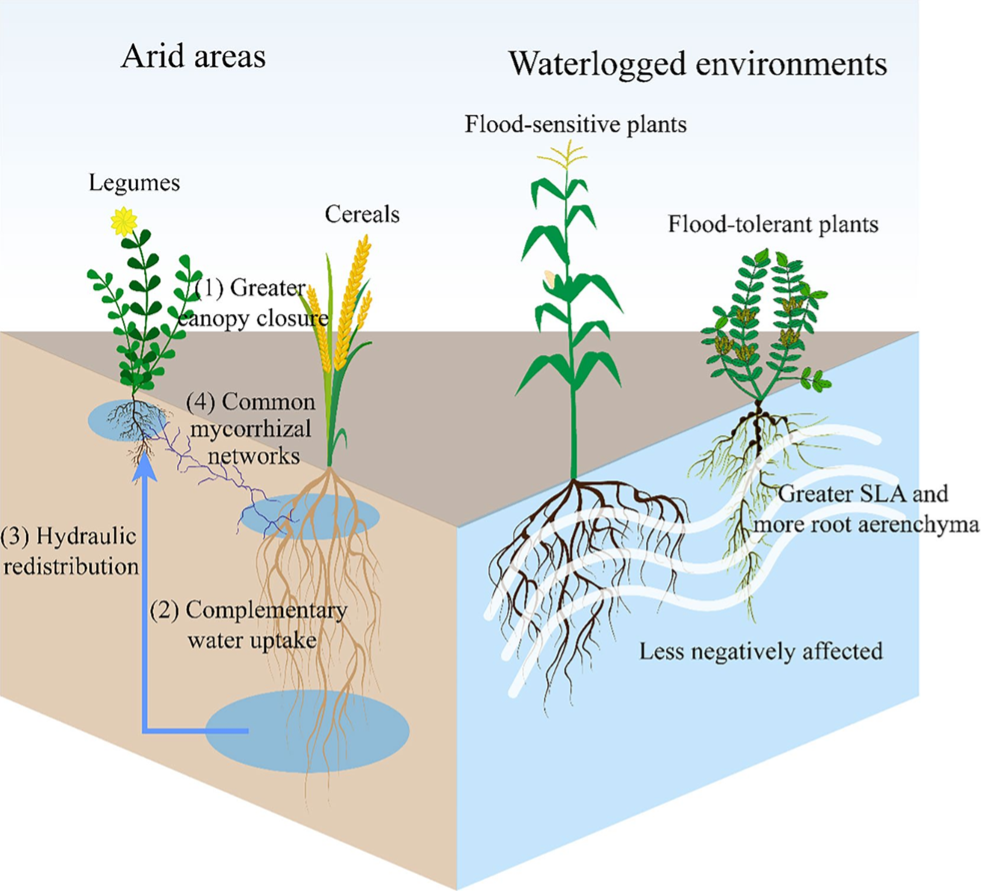
Figure 2: “Diversified cropping systems with complementary root growth strategies can ameliorate water stress in arid areas (left panel) or reduce negative effects in waterlogged environments (right panel), “Zhang et al. (2024). (Image credits: https://link.springer.com/article/10.1007/s11104-023-06464-y)
Waterlogging: Mixed-species systems perform better in waterlogged areas than monocultures due to complementarity between flood-tolerant and susceptible plant species. Some species have more root aerenchyma, which helps them grow in wetter, waterlogged conditions. Their water uptake reduces waterlogging, making conditions more suitable for companion species to grow. These effects will, however, depend on species and growth stage.
Productivity
Intercropping increases absolute crop yields, even in intensive farming systems, due to increased water and nutrient uptake, efficient resource partitioning, and facilitation, resulting in greater productivity, lower pollution, and lower disease incidence. For example, maize grown as an intercrop yields four times as much as in monoculture.
Mixing species also improves land utilization efficiency, soil quality, and yield stability while reducing dependence on fertilizers.
Differences in Root Systems
Root plasticity allows species to respond to differences in abiotic and biotic factors in their environments. Since the soil environment and interspecific interactions differ markedly between monoculture and mixed-species soils, root trait expression also changes. The effects of companion plants can be moderated by the amount of available nitrogen and soil water.
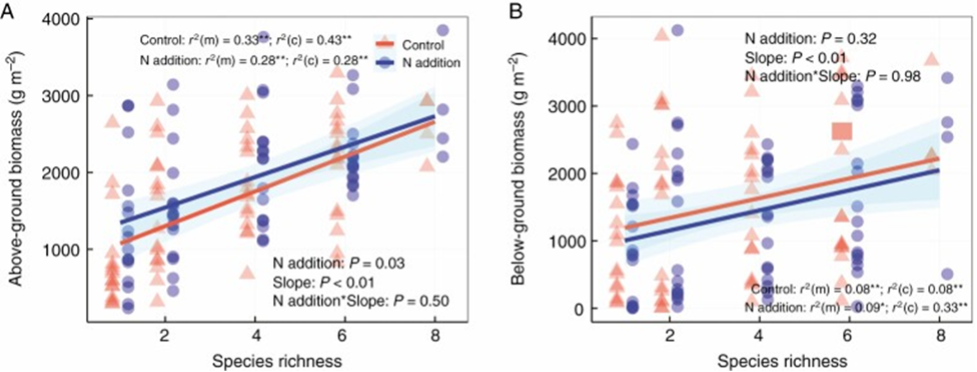
Figure 3.: “Relationship between species richness and (A) above-ground and (B) below-ground biomass. Control, orange points and lines; nitrogen addition, blue points and lines,” Wang et al. Wang (2023). (Image credits: https://pmc.ncbi.nlm.nih.gov/articles/PMC10332393/)
More root biomass
As the number of species in a system increases, the root biomass of component species has been shown to increase, see Figure 3. Systems with species mixtures had 28.4% higher fine-root biomass and 44.8% higher annual production than monocultures, according to a meta-analysis of 48 studies. Root growth is stimulated and improved by heterospecific root neighbors.
Root distribution
The root distribution can vary to accommodate the presence of neighbors of the same or different species. When the neighbor is a plant of another species, the roots change their distribution pattern. They can try to avoid the neighbor’s root system or grow towards each other (aggregation).
Avoidance: For example, roots of faba beans in monoculture did not change their vertical or horizontal distribution, but when grown with wheat, some faba cultivars showed greater horizontal spread, while others grew roots deeper than wheat. In another experiment, wheat exhibited reduced lateral spread due to N fertilization, whereas its companion maize showed no change.
Aggregation: Maize and alfalfa grown as intercrops increased root growth in the topsoil compared to monocrops. The two species grew roots laterally towards each other, intermingled their roots, and showed higher P accumulation driven by alfalfa and more yields. Alfalfa had 60% more root dry mass, 1.5-fold higher P uptake, and 2-fold higher yield.
Root length density
Changes in root length density (RLD) have been observed in intercrops, improving soil exploration for resources, as shown in the examples below:
- In maize-faba intercropping, both crops increased RLD and yield compared with monocrops.
- In another case, wheat had 1.5 to 2 times as many roots at all depths as in monocrops, resulting in 1.5-fold higher nitrogen uptake, whereas maize, which had more RLD in upper soils, showed no benefit in the same system.
- Proso millet and ming bean intercrops had a higher RLD in the upper soil and greater lateral growth compared to monocrops of the two species to increase water uptake, yield, and biomass accumulation
Rooting depth
Plasticity in rooting depth reduces competition for resources among mixed species. For example, in walnut and wheat agroforestry, walnut grew deeper roots than in walnut monocultures. The number of fine roots was also higher in intercrops in the upper 50 cm of soil. It allowed walnuts to avoid competition for water by accessing water tables that were unavailable to wheat.
Root diameter and volume
The roots of a plant have varying diameters. Wider roots are required for transporting water and nutrients and for storage, while fine roots are involved in absorbing them. A change in the average width indicates an alteration in nutrient uptake capacity. A smaller average root diameter indicates more absorptive roots. Intercropped root systems have a smaller average root width than the same species grown as monocrops. For example,
- In a walnut-wheat agroforestry system, both species had lower average root width than in monocultures, but still had lower yields.
- In poplar and alfalfa intercrops, poplar increased the average root diameter, and alfalfa had a lower root diameter without a change in either’s root volume.
- Peanuts showed no difference in width, and millet had a lower average diameter when grown together than as a monocrop, but both species had 50-60% higher root volume and a twofold increase in biomass.
Fine roots
Fine roots have a diameter of less than 2mm and are involved in resource absorption. In tree-alley cropping, the trees had fine roots growing in deeper soils, and the annuals had fine roots in shallower soils, compared to monocrops of each species. This trend has been observed in various systems; for example, when apple is grown with soybean or peanuts, the annuals inhibited fine-root growth in the 0-60 cm depth by 25-35%, but not in deeper soil layers. Annual fine-root development was affected across all soil depths.
When artichoke is grown with a living mulch, it has more root mycorrhizae than when grown alone.
Altogether, the varied root systems and their interactions also improve soil structure, fertility, and underground carbon sinks, and reduce soil erosion.
Tools To Study Root Systems
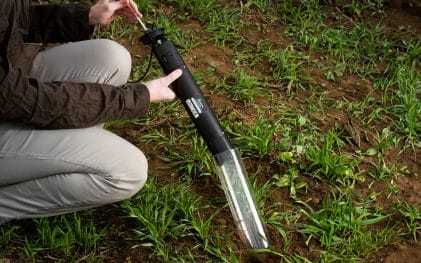
Some of the technological advances that make studying underground root systems possible through non-destructive means include minirhizotron systems, which enable time-series observations over seasons and years. It involves installing transparent root tubes, usually around 1 meter deep, and allowing the root system to grow and establish around the tubes. A high-resolution camera is then used inside the tubes to absorb root traits at targeted depths, without disturbing root systems. CID BioScience Inc offers two miniaturized cameras: CI-600 In-Situ Root Imager and CI-602 Narrow Gauge Root Imager, as well as suitable root tubes for the minizhizotron systems.
Contact us to learn more about our imagers for your root-system studies.
Sources
Homulle, Z., George, T. S., & Karley, A. J. (2022). Root traits with team benefits: understanding belowground interactions in intercropping systems. Plant and Soil, 471(1), 1-26. https://doi.org/10.1007/s11104-021-05165-8
Kuebbing, S. E., Classen, A. T., Sanders, N. J., & Simberloff, D. (2015). Above‐and below‐ground effects of plant diversity depend on species origin: an experimental test with multiple invaders. New Phytologist, 208(3), 727-735.
Li, HR., Zhang, XY., He, KL. et al. Differential responses of root and leaf-associated microbiota to continuous monocultures. Environmental Microbiome 20, 13 (2025). https://doi.org/10.1186/s40793-025-00675-9
Liu, C. L. C., Kuchma, O., & Krutovsky, K. V. (2018). Mixed-species versus monocultures in plantation forestry: Development, benefits, ecosystem services and perspectives for the future. Global Ecology and conservation, 15, e00419.
Ma, Z., & Chen, H. Y. (2016). Effects of species diversity on fine root productivity in diverse ecosystems: A global meta‐analysis. Global Ecology and Biogeography, 25(11), 1387-1396
Suter, M., Huguenin-Elie, O. & Lüscher, A. (2021). Multispecies for multifunctions: combining four complementary species enhances multifunctionality of sown grassland. Sci Rep 11, 3835. https://doi.org/10.1038/s41598-021-82162-y
Wang, C., Hou, Y., Hu, Y., Zheng, R., & Li, X. (2023). Plant diversity increases above-and below-ground biomass by regulating multidimensional functional trait characteristics. Annals of Botany, 131(6), 1001-1010.
Yang, Y., Reilly, E. C., Jungers, J. M., Chen, J., & Smith, T. M. (2019). Climate benefits of increasing plant diversity in perennial bioenergy crops. One Earth, 1(4), 434-445.
Zhang, WP., Surigaoge, S., Yang, H. et al. (2024). Diversified cropping systems with complementary root growth strategies improve crop adaptation to and remediation of hostile soils. Plant Soil 502, 7–30. https://doi.org/10.1007/s11104-023-06464-y
Related Products
Most Popular Articles
- Transpiration in Plants: Its Importance and Applications
- Leaf Area – How & Why Measuring Leaf Area…
- How to Analyze Photosynthesis in Plants: Methods and Tools
- Plant Respiration: Its Importance and Applications
- The Forest Canopy: Structure, Roles & Measurement
- Stomatal Conductance: Functions, Measurement, and…
- Forest & Plant Canopy Analysis – Tools…
- Root Respiration: Importance and Applications
- 50 Best Universities for Plant Science
- The Importance of Leaf Area Index (LAI) in…
Related Reading