How Does Nitrogen Deposition Affect Plant Roots?

Dr. Vijayalaxmi Kinhal


October 21, 2026 at 7:48 pm | Updated October 21, 2026 at 7:48 pm | 7 min read
- Nitrogen deposition significantly alters root traits across ecosystems and climate zones.
- Meta-analyses show a global trend, with trait-specific changes in root biomass, the root:shoot ratio, fine-root parameters, and mycorrhizal associations.
- However, variations from global trends exist by ecosystem, functional plant type, and climate.
- Some nitrogen deposition effects on crucial traits, such as root architecture and anatomy, remain unstudied.
Roots influence belowground processes, contribute to soil carbon, and support plant growth, health, and productivity. Therefore, studying root responses to major global changes is necessary. Increased nitrogen deposition from pollution can affect plants both positively and negatively. This article summarizes key findings from studies and meta-analyses on how root traits change in response to nitrogen deposition.
How Nitrogen Deposition Can Affect Plants
Air pollutants from burning fossil fuels and the excessive use of nitrogenous fertilizers have increased nitrogen (N) deposition worldwide. The rate of increase varies by country, and some regions, such as Europe, are beginning to show declines. Some of the changes due to N-deposition on the growing environment of plants are listed below:
- Eutrophication, or increased soil nitrogen availability.
- Changes in soil acidity due to wet N-deposition.
- Changes in other nutrient availability, including reduced phosphorus, calcium, and magnesium, and increased toxins like aluminum.
N-deposition rates also matter, with higher levels increasing the chance of negative impacts. Moreover, N-deposition effects depend on existing ecosystem nitrogen levels, other nutrients, temperature, rainfall, and drought. These interacting factors produce varying responses across plant functional types. Therefore, scientists have relied on meta-analyses to identify global trends in morphological and functional root traits, and interactions with mycorrhizal fungi.
Subscribe to receive our monthly round-up of articles.
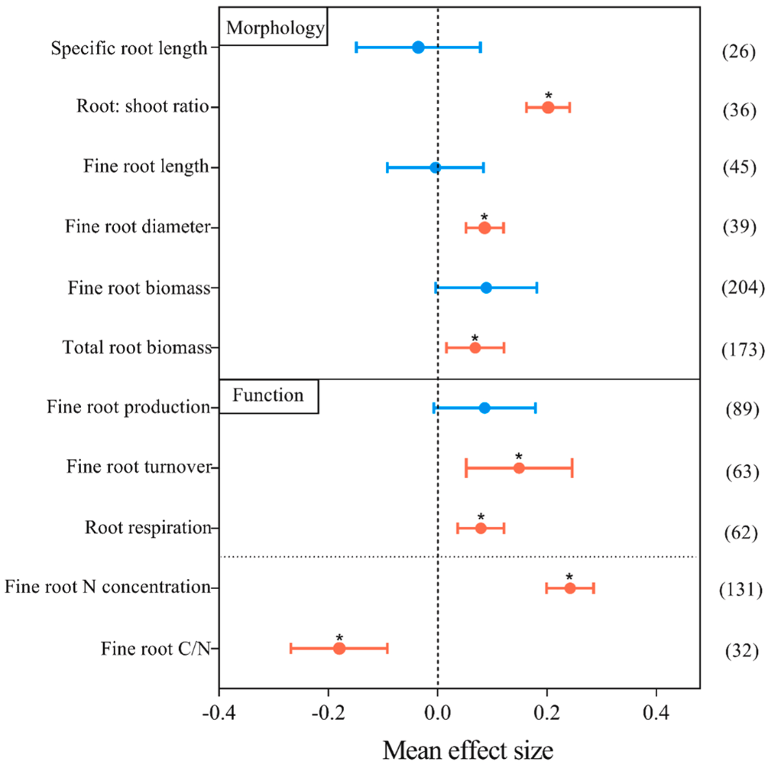
Figure 1: “Global mean effect sizes of simulated increase in N deposition on plant root traits,” Gao, et al. (2023). (Image credits: 10.1016/j.gecco.2023.e02443)
Morphological Root Traits
Studies of N deposition on morphological root traits commonly examine biomass and root: shoot ratio, root length, diameter, and root density.
All meta-analyses show that N deposition changes root traits globally; see Figure 1. However, differences exist by plant type (woody or herbaceous; angiosperm or gymnosperm), ecosystem (forest types or grassland), climate (annual temperature, precipitation), and location (latitude and longitude); see Figure 2.
N deposition effects are as follows:
Root: shoot ratio: According to Gao et al. (2023), additional N increases the root:shoot ratio by 38.36% globally, but Liu et al. (2015) reported a −10.7% decrease.
A study of angiosperm and gymnosperm woody plants’ responses found both groups had reduced root: shoot ratios of –32.4% and –12.9%, respectively, due to N addition.
Total root biomass: Total root biomass increased by 13.23%. According to Liu et al. (2015), fine root biomass decreased by 12.8% and coarse root biomass increased by 56.6%. Root biomass increases depend on available N, precipitation, and temperature. Gao et al. (2023) found that root biomass increases by 55.37% in grasslands but not in forests.
Fine root production and biomass: Many studies and meta-analyses agree that fine root production increases but not the biomass, except Guo et al (2025). They found an 8.5% global increase in fine root biomass; woody plants do not increase fine root biomass, but herbs do, by 71.3%.
Fine root length: Fine root length was shorter with short-term N addition but longer with long-term N addition.
Fine root tissue density (RTD): Guo et al. (2025) found an overall 11.9% increase in fine root RTD.
Fine root specific root length (SRL): N deposition increased SRL globally by 1.5% and was greatest in herbs by 67-8%, according to Guo et al. (2025).
Fine root length density (RLD): RLD increased by 84.6% globally, driven by an 88.0% increase in herbs (Guo et al., 2025). However, RLD was 7.9% lower in woody plants. RLD increased by 9.6% in conifers (gymnosperms) and decreased by 50.2% in angiosperms.
Many studies, including Liu et al. (2015), have found that larger-root morphological traits, such as specific root length and root tissue density, do not change with N deposition. These changes are restricted to fine roots.
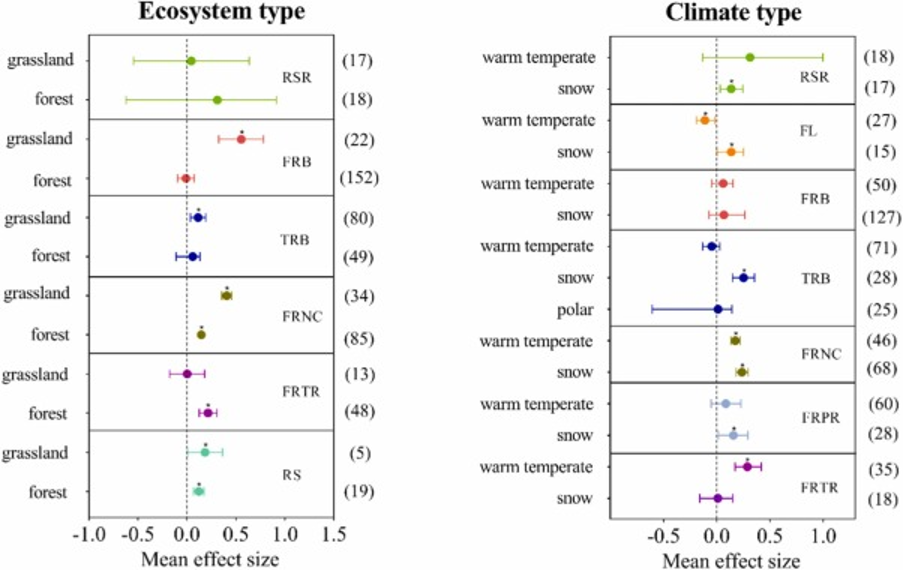
Figure 2: “Effect of N addition on RSR: root: shoot ratio, FL: fine root length, FRB: fine root biomass, TRB: total root biomass, FRNC: fine root N concentration, FRPR: fine root production, FRTR: fine root turnover rate, RS: root respiration denoted by different colors, for all the ecosystems (grassland, forest) and the five types of climate (equatorial, arid, warm temperature, snow and polar climates). The number in parentheses represents the sample size for each variable. Differences are indicated by significance at p < 0.01 (*),” Gao, et al. (2023). (Image credits: 10.1016/j.gecco.2023.e02443)
Functional Root Traits
Functional root traits studied for N deposition effects include fine root turnover, root nitrogen, the carbon:nitrogen (C:N) ratio, and root respiration.
Fine roots
Fine root production and turnover account for 21-33% of net primary production and are crucial for carbon and nitrogen cycling and soil carbon sinks.
Fine root turnover: Fine root production increases only in fine root turnover, not in fine root biomass. Gao et al. (2023) reported the highest turnover rate in forests (21.6%), with the most in cold climates. As annual temperature and precipitation increase, fine root turnover also increases.
Root C: N ratio: N deposition reduced the C: N ratio in angiosperms and gymnosperms by -32.4% and -12.9%, respectively. Gao et al. (2023) also reported a global decrease of -8.23%, and Liu et al. (2015) found a -13.5% reduction in the C: N ratio. This occurs because nitrogen content in root tissue increases with higher soil nitrogen availability, while carbon remains unchanged, so the C:N ratio decreases. Liu et al. (2015), Gao et al. (2023), and Guo et al. (2025) reported increases in fine-root nitrogen of 17.6%, 16.3%, and 13.2%, respectively.
Root respiration: All meta-analyses agree that increased fine-root N boosts root respiration because more energy is generated to fix nitrogen in tissues.
Guo et al. (2025) found that herbs adopt an acquisitive and explorative strategy by increasing fine root biomass, specific root length, root length density, nitrogen, and respiration. Woody species, by contrast, focused on exploitation, increasing only root tissue density, nitrogen, and respiration while reducing root length.
Mycorrhizal Associations
Plants use fine roots and mycorrhizal associations to acquire nutrients. Plants are associated with two types of mycorrhizal fungi. Arbuscular mycorrhizae (AM) associate with most plants, including crops and warm tropical forests, while ectomycorrhizae (EM) associate mainly with cooler boreal and temperate forests.
Mycorrhizal associations and fine roots are considered antagonistic, as mycorrhizal associations occur more with thick roots, whereas thin roots rely on increased growth for nutrient uptake. According to a meta-analysis of 112 studies worldwide (Ma et al. 2021), continuous N deposition for two years or an acute high load totaling >140 kg ha−1 y−1 increased tree reliance on fine roots, and both AM and EM trees allocated less energy to mycorrhizal symbioses and shifted to fine roots for nutrient uptake.
AM trees showed greater growth from N deposition than EM trees because their nutrient-acquisition strategies differ. AM trees that normally rely on fine roots to absorb mineral forms of N benefited more from N deposition because fine roots turn over faster. Moreover, AM plants can absorb more phosphorus because they have higher acid phosphatase activity than EM plants.
EM plants typically do not use fine roots for nutrient acquisition, so increased turnover benefits them less than AM plants.
Moreover, Guo et al. (2025), in a global meta-analysis of 138 experiments, found that across woody and herbaceous plants, EM trees that usually rely on mycorrhizal symbioses in nutrient-poor soils to absorb organic forms of nitrogen are at a disadvantage because mycorrhizal symbiosis is reduced by 32.7%, and colonized root length is 18.7% lower.
Research Tools
Studies and meta-analyses agree on most global trends in changes due to N deposition. The extent of reported changes varies because study parameters differ. However, some scientists have noted insufficient replication across sites with similar conditions, such as fertility and elevation. Moreover, root traits such as anatomy and architecture remain understudied because of their complexity.
However, standard minirhizotron systems are increasingly used and can help in root studies. These systems consist of transparent root tubes installed in the soil near plants and trees. Root imagers record traits through scans that capture a 360-degree view of roots growing around the tubes. CID Bio-Science Inc. offers root tubes and two cameras: the CI-600 In-Situ Root Imager and CI-602 Narrow Gauge Root Imager to study morphology (length, width, area, and volume), architecture (root branching), and function (production and turnover). These robust field tools support nondestructive short- and long-term studies.
Contact us to find out more about CID Bio-Science Inc. minirhizotron systems for your root studies.
Sources
Galloway, J.N., Dentener, F.J., Capone, D.G., Boyer, E.W., Howarth, R.W.,
Seitzinger, S.P., Asner, G.P., Cleveland, C., Green, P., Holland, E., 2004. Nitrogen
cycles: past, present, and future. Biogeochemistry 70, 153e226.
Gao, W., Chen, D., Hu, X., Fang, X., Li, Q., Huang, Q., … & Liu, L. (2023). Nitrogen deposition drives the intricate changes of fine root traits. Global Ecology and Conservation, 43, e02443.
Guo, H., Zhao, Y., Zheng, B., Huang, Y., Chen, X., & Wang, L. (2026). Shifts in plant nutrient acquisition strategies under nitrogen addition: a global meta-analysis. Plant and Soil, 520(1), 829-839.
Li, W., Jin, C., Guan, D., Wang, Q., Wang, A., Yuan, F., & Wu, J. (2015). The effects of simulated nitrogen deposition on plant root traits: a meta-analysis. Soil Biology and Biochemistry, 82, 112-118.
Ma, X., Zhu, B., Nie, Y., Liu, Y., & Kuzyakov, Y. (2021). Root and mycorrhizal strategies for nutrient acquisition in forests under nitrogen deposition: a meta-analysis. Soil Biology and Biochemistry, 163, 108418.
Nadelhoffer, K. J. (2000). The potential effects of nitrogen deposition on fine-root production in forest ecosystems. New Phytologist, 147(1), 131–139. doi:10.1046/j.1469-8137.2000.00677.x
Rasse, D.P., 2002. Nitrogen deposition and atmospheric CO2 interactions on fine
root dynamics in temperate forests: a theoretical model analysis. Global Change
Biology 8, 486e503.
Schulte‐Uebbing, L., & de Vries, W. (2018). Global‐scale impacts of nitrogen deposition on tree carbon sequestration in tropical, temperate, and boreal forests: A meta‐analysis. Global Change Biology, 24(2), e416-e431.
Smithwick, E. A., Eissenstat, D. M., Lovett, G. M., Bowden, R. D., Rustad, L. E., & Driscoll, C. T. (2013). Root stress and nitrogen deposition: consequences and research priorities. New Phytologist, 197(3), 712-719.
Yaffar, D., Lugli, L. F., Wong, M. Y., Norby, R. J., Addo‐Danso, S. D., Arnaud, M., … & Cusack, D. F. (2024). Tropical root responses to global changes: a synthesis. Global Change Biology, 30(7), e17420.
Zhang, Q., Fan, Z., Wang, Z., Tian, Q., & Yang, F. (2026). Different functional trait responses of fine roots to nitrogen deposition in angiosperm and gymnosperm woody plants. Forest Ecology and Management, 615, 123802.
Related Products
Most Popular Articles
- Transpiration in Plants: Its Importance and Applications
- Leaf Area – How & Why Measuring Leaf Area…
- How to Analyze Photosynthesis in Plants: Methods and Tools
- Plant Respiration: Its Importance and Applications
- The Forest Canopy: Structure, Roles & Measurement
- Stomatal Conductance: Functions, Measurement, and…
- Forest & Plant Canopy Analysis – Tools…
- Root Respiration: Importance and Applications
- 50 Best Universities for Plant Science
- The Importance of Leaf Area Index (LAI) in…