7 Spectral Leaf Metrics You Should Know (and their instrument requirements)


Scott Trimble

June 18, 2026 at 5:14 pm | Updated June 18, 2026 at 5:14 pm | 5 min read
Understanding spectral leaf metrics is now central to plant phenotyping, crop management, and stress physiology. As spectral leaf metrics become more integrated into field workflows, researchers need tools that move beyond theory and deliver reliable measurements under real conditions. Whether you are tracking nutrient status, quantifying canopy structure, or linking pigment shifts to gas exchange, the right instrumentation determines the quality of your conclusions.
Below are seven essential spectral leaf metrics, what they tell you biologically, and the instrument requirements needed to measure them accurately in the field or lab.
#01 NDVI: Normalized Difference Vegetation Index
NDVI remains one of the most widely used spectral leaf metrics. It leverages the contrast between red and near infrared reflectance to estimate vegetation vigor and chlorophyll content.
Subscribe to receive our monthly round-up of articles.
NDVI is calculated using reflectance values from red and NIR wavelengths. Healthy leaves absorb red light strongly due to chlorophyll and reflect NIR because of internal leaf structure. A higher NDVI generally indicates healthier, more photosynthetically active tissue.
Instrument requirements:
- Spectral coverage that includes red and NIR bands
- Accurate reflectance measurement
- Stable detector with low noise
- Field portability for in situ measurements
The CI-710s SpectraVue Leaf Spectrometer meets these requirements with a wavelength range of 360 to 1100 nm, covering visible and NIR regions . It simultaneously measures reflectance, transmittance, and absorbance, allowing direct NDVI calculation in real time. Because the instrument includes onboard software and a touchscreen interface, researchers can compute vegetation indices immediately in the field rather than post-processing later.
#02 PRI: Photochemical Reflectance Index
PRI is sensitive to changes in xanthophyll cycle pigments and provides insight into short-term photosynthetic efficiency and stress response.
Unlike NDVI, PRI responds rapidly to changes in light use efficiency. It is particularly useful for detecting stress before visible symptoms appear. Researchers studying drought, heat, or nutrient stress rely on PRI to monitor photochemical dynamics.
Instrument requirements:
- High spectral resolution in narrow visible bands
- Precise reflectance measurement
- Stable light source and detector response
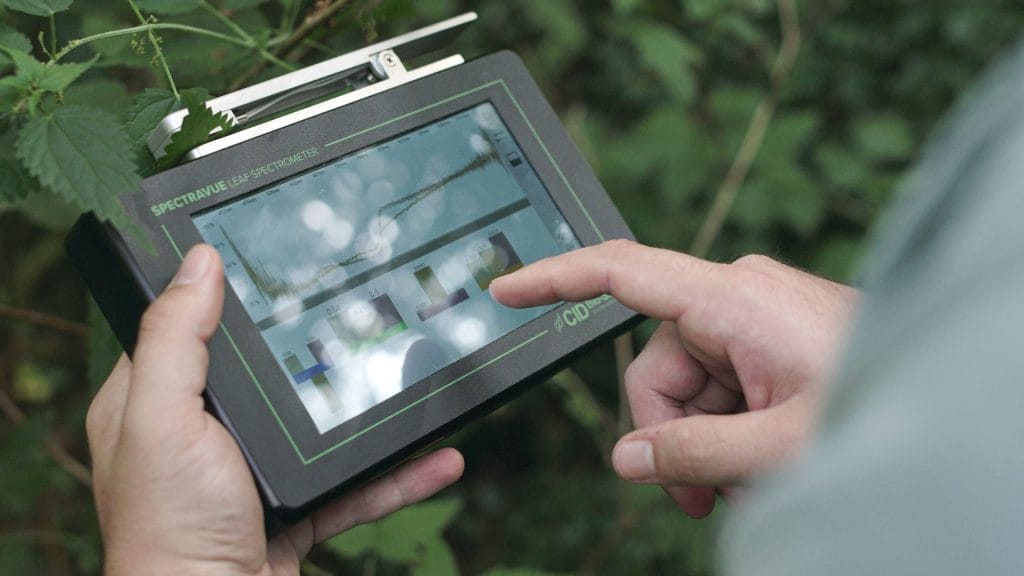
With optical resolution of 2.4 nm and high dynamic range, the CI-710s allows fine discrimination between narrow wavelength bands required for PRI. This resolution supports subtle pigment-related shifts that broader multispectral devices may miss.
#03 Chlorophyll Content Indices
Chlorophyll indices use ratios of reflectance or absorbance in specific visible bands to estimate total chlorophyll concentration. These indices are foundational spectral leaf metrics for agronomy and physiology research.
Chlorophyll concentration directly links to nitrogen status and photosynthetic capacity. Accurate chlorophyll indices support fertilizer trials, genotype screening, and stress evaluation.
Instrument requirements:
- Visible wavelength coverage
- Absorbance and reflectance modes
- Reliable calibration and low stray light
The SpectraVue measures reflectance, transmittance, and absorbance simultaneously across the visible spectrum. Its corrected linearity greater than 99.8 percent ensures consistent quantitative pigment estimation. For researchers developing custom chlorophyll indices, access to raw spectra enables chemometric approaches such as PLS modeling.
#04 Anthocyanin and Pigment Ratios
Anthocyanins accumulate during stress, senescence, and certain developmental stages. Spectral leaf metrics targeting anthocyanin absorption bands allow non-destructive pigment quantification.
These indices are especially relevant in stress physiology, high light exposure studies, and breeding programs focused on stress tolerance traits.
Instrument requirements:
- Broad visible spectral range
- Fine wavelength increment
- Stable signal to noise ratio
The CI-710s provides wavelength increments as fine as 0.55 to 0.7 nm, supporting precise pigment band detection. Its signal-to-noise ratio and low dark noise help maintain accuracy when measuring subtle pigment changes in field conditions.
#05 Leaf Area Index: Structural Spectral Metric
While commonly associated with canopy imaging rather than spectroscopy alone, Leaf Area Index remains one of the most important structural spectral leaf metrics.
LAI links canopy structure to light interception, carbon assimilation, and evapotranspiration. Spectral approaches often integrate light attenuation measurements or hemispherical photography to estimate canopy gap fraction and extinction coefficients.
Instrument requirements:
- Hemispherical canopy imaging or integrated PAR sensors
- Automated LAI calculation algorithms
- Consistent field deployment under variable sky conditions
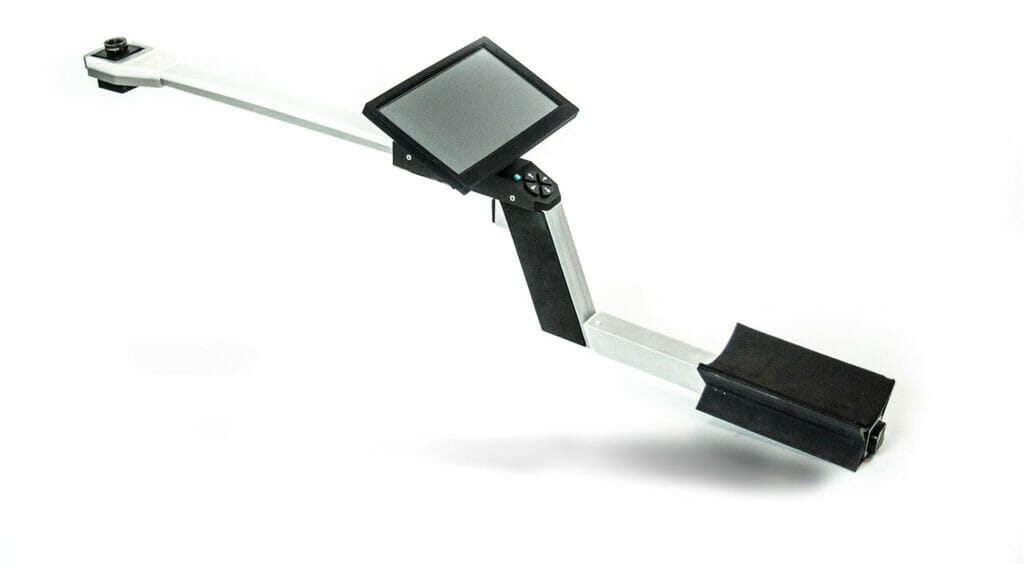
The CI-110 Plant Canopy Imager combines hemispherical photography with 24 PAR sensors to calculate LAI non-destructively . The self-leveling 150 degree lens ensures consistent canopy capture, while built-in thresholding methods such as Otsu allow robust image analysis under different light conditions. Because no above-canopy reference readings are required, researchers can streamline field sampling.
#06 Absorbance Spectra for Chemical Quantification
Full absorbance spectra allow researchers to quantify chemical concentrations beyond standard vegetation indices. This includes secondary metabolites, structural compounds, and optical properties.
Absorbance-based spectral leaf metrics are especially useful in studies linking biochemistry with environmental gradients or treatment effects.
Instrument requirements:
- Broad wavelength range including visible and NIR
- High dynamic range
- Ability to export raw spectral data
The SpectraVue covers 360 to 1100 nm and supports chemometric modeling such as PLS and ANN. With 2048 pixels and 16-bit A/D resolution, it provides the spectral depth needed for advanced quantitative analysis.
#07 Linking Spectral Metrics with Gas Exchange
Spectral leaf metrics gain value when paired with physiological measurements. Reflectance indices may indicate stress, but combining them with gas exchange clarifies functional impact.
Photosynthesis, transpiration, stomatal conductance, and internal CO2 measurements allow researchers to validate spectral signals against actual carbon assimilation.
Instrument requirements:
- Portable gas exchange system
- Stable CO2 and H2O analyzers
- Optional control modules for environmental manipulation
The CI-340 Handheld Photosynthesis System measures photosynthesis, respiration, transpiration, stomatal conductance, PAR, and internal CO2 in a single unit. Its optional modules allow control of light intensity, temperature, CO2, and H2O, and it can measure chlorophyll fluorescence simultaneously . By pairing spectral data from the CI-710s with physiological measurements from the CI-340, researchers can connect optical signals directly to carbon flux and energy dissipation.
Supporting Measurements: Leaf Area and Morphology
Spectral interpretation often requires structural context. Leaf area, perimeter, and shape factor influence light absorption and reflectance behavior. High resolution, non-destructive leaf measurement improves the interpretation of spectral leaf metrics.
The CI-203 Handheld Laser Leaf Area Meter yields area, width, length, perimeter, shape factor, ratio, and void count in a single sweep . Its unlimited data storage and GPS tagging make it suitable for field campaigns.
Similarly, the CI-202 Portable Laser Leaf Area Meter provides area, length, width, perimeter, shape factor, and ratio with 0.01 cm² resolution . Both instruments are non-destructive and require no user calibration.
Why Instrument Integration Matters
Researchers rarely rely on a single metric. Spectral leaf metrics perform best when integrated with structural and physiological data. CID Bio-Science instruments are designed to work across these domains, from canopy imaging to leaf-level spectroscopy and gas exchange.
The advantage is workflow continuity. You can measure LAI with the CI-110, capture spectral indices with the CI-710s, validate carbon assimilation with the CI-340, and quantify leaf morphology with the CI-203 or CI-202. Each instrument is portable, field ready, and designed for rapid deployment without complex calibration routines.
The Bottom Line
If you are building or upgrading your plant phenotyping toolkit, consider how spectral leaf metrics fit into your research objectives. Visit CID Bio-Science to explore the CI-710s SpectraVue Leaf Spectrometer, CI-110 Plant Canopy Imager, CI-340 Handheld Photosynthesis System, and laser leaf area meters. The right combination of tools will improve data quality and reduce uncertainty across your experiments.
Related Products
Most Popular Articles
- Transpiration in Plants: Its Importance and Applications
- Leaf Area – How & Why Measuring Leaf Area…
- How to Analyze Photosynthesis in Plants: Methods and Tools
- Plant Respiration: Its Importance and Applications
- The Forest Canopy: Structure, Roles & Measurement
- Stomatal Conductance: Functions, Measurement, and…
- Forest & Plant Canopy Analysis – Tools…
- Root Respiration: Importance and Applications
- 50 Best Universities for Plant Science
- The Importance of Leaf Area Index (LAI) in…
Related Reading