How Does N Deposition Affect Plant Productivity?

Dr. Vijayalaxmi Kinhal


September 8, 2026 at 5:36 pm | Updated September 8, 2026 at 5:36 pm | 6 min read
- N deposition has increased terrestrial plant biomass globally by an average of 55.6%.
- Nitrogen deposition increases biomass allocation to aboveground organs compared to roots and favors growth over reproduction.
- Leaf and canopy traits as well as photosynthetic rate determine how plants respond to nitrogen addition.
- External factors such as the duration and intensity of N deposition, as well as soil factors, also influence changes in plant productivity.
The average global anthropogenic nitrogen deposition rate due to agriculture and fossil fuel combustion pollutants was 92.7 Tg N in 2020. Because nitrogen is an essential nutrient, increased availability can change plant uptake and function. This article discusses how nitrogen deposition influences plant productivity and which plant attributes moderate these changes.
Importance of Nitrogen Deposition for Plants
Nitrogen (N) is the most important essential nutrient for plants, and its deficiency can reduce growth, development, leaf area, photosynthesis, and productivity, while increasing plant senescence.
Anthropogenic N deposition that leads to eutrophication results from the addition of reactive inorganic and organic compounds. Most N deposition, around 75%, is in the form of inorganic compounds such as nitrites, nitrates, and ammonium compounds. Recent research shows that 25% is in organic forms arising from fossil fuel, biofuel, and biomass burning, and from organic aerosol formation. The rate of N deposition is also changing. While deposition rates are still increasing in developing countries, regions like Europe and the USA have decreasing rates for a few decades.
Subscribe to receive our monthly round-up of articles.
N Deposition is Increasing Plant Productivity
Several meta-analyses have examined the impact of N deposition on productivity. All studies agree that N deposition increases plant productivity when nutrient addition is moderate.
One meta-analysis found a global positive response to N deposition of 1.08 to 113.81 g m−2 year−1, where biomass increased globally by 55.6% on average. Biomass increases were not the same across all plant parts. Shoot biomass increased by 27% while roots increased only by 14.7%. Biomass allocated to reproductive organs decreased by 3.4%.
As the intensity and concentration of N deposition increase, negative effects increase and outweigh the benefits, lowering plant productivity. Both intrinsic and external factors can influence the productivity changes due to N deposition.
External factors
External factors that influence how N deposition changes plant productivity include N concentrations and soil factors.
- Concentrations: When N deposition rates exceed ecosystem carrying thresholds, they produce negative effects such as acidification, reduced biodiversity, decreased rhizosphere microbial functions, and higher nitrous oxide emissions from the soil.
- Soil factors: N deposition is beneficial and improves productivity only when water and phosphorus are available.
The difference in chemical composition of N, whether it is inorganic or organic compounds, does not influence annual community net primary production increases.
Besides these external factors, several plant characteristics can determine how plants respond to N deposition.
Intrinsic Factors Determining Plant Responses
The meta-analysis by Jeng et al. (2023) drew on 255 studies across terrestrial ecosystems and plant functional types worldwide to examine biomass change patterns and drivers. They found that biomass increases were not uniform across all plants. The extent of increase in biomass differed by plant functional types (moss, lichen, fern, forb, grass, shrub, and tree), leaf forms and span (coniferous or broadleaved, evergreen or deciduous), growth forms, photosynthesis pathways, and biological realms (spore or seed producers), see Figure 1.
To identify drivers of biomass increase, comparisons within each category show the intrinsic characteristics that can explain the effect of N deposition on productivity. The nitrogen-fixing capacity is not a significant factor. N deposition produces similar biomass increases in both non-nitrogen fixers and nitrogen fixers. Intrinsic factors that moderate N deposition effects include photosynthesis pathways, growth forms, biological realms, functional plant types, leaf life span, and leaf forms; see Figure 1.
Photosynthesis
The type of photosynthesis (C3, C4, and CAM pathways) is crucial, as C4 plants with higher photosynthetic capacity respond better to N deposition by accumulating more biomass than C3 plants.
Growth forms
Herbaceous plants respond more strongly and accumulate more biomass than woody plants, which have greater carbon and nitrogen storage capacity and therefore show fewer changes.
Biological realms
Spore-bearing plants such as mosses (bryophytes) and ferns (pteridophytes) show less change in biomass due to N addition compared to a 55.6% rise in seed-forming species; see Figure 1. These starkly different responses reflect differences in nutrient needs, vascular systems, and photosynthesis.
- N needs: Seed plants need more nitrogen than spore-bearers, so adding the nutrient increases their biomass.
- Vascular systems: Seed-bearing plants have a more developed vascular system for nutrient uptake and transportation, so they benefit more from nitrogen addition than spore-bearers like mosses and ferns.
- Photosynthetic rate: Spore-bearing plants have a lower rate of photosynthesis compared to seed plants that can use the additional nitrogen to fix more carbon and form more biomass.
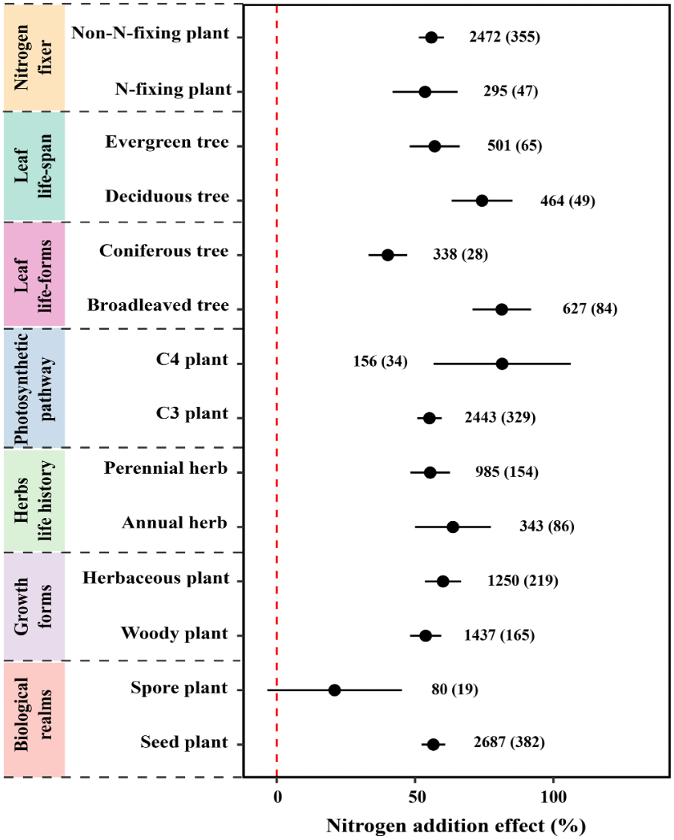
Figure 1: “Effect size of N addition on terrestrial plant biomass, expressed on the global scale (RR [±95% confidence interval]). The vertical dashed red line denotes a null effect size (RR = 0). The number of observations is beside each attribute without parentheses, and the number of plant species is in parentheses. RR, log response ratio. Log response ratio (RR) is the log of the average biomass from N treatment to control groups (RR=ln(Xt/Xc),” Feng et al. (2023). (Image credits: https://par.nsf.gov/servlets/purl/10427327)
Leaf lifespan
Deciduous trees respond more strongly to N deposition and show greater biomass gains than evergreens. This is due to differences in N requirements, nutrient-use efficiency, and photosynthetic capacity.
- N requirements: Deciduous trees lose their leaves each autumn and require more N to replace leaves simultaneously each year. Evergreen trees are not connected to the annual cycle and do not shed all their leaves at the same time, nor do they have to replace them simultaneously; hence, they require less nitrogen.
- Photosynthetic capacity: Deciduous trees can adjust their photosynthetic rate to nitrogen availability to fix more carbon, but evergreen trees have a stable photosynthetic capacity that doesn’t change. Moreover, deciduous trees have a higher photosynthetic rate compared to evergreen trees.
- Nutrient use efficiency: Deciduous trees have higher N use efficiency than evergreen plants, allowing them to maintain higher growth rates than evergreen trees. So additional N produces more biomass.
Taxonomic groups
Plants from different taxonomic and functional types responded differently to N deposition; see Figure 2. The average increase in biomass was as follows:
- Grasses increased biomass by 71.4%
- Trees by 65%
- Forbs by 42.7%
- Shrubs by 33%
- Lichens and mosses had no increases
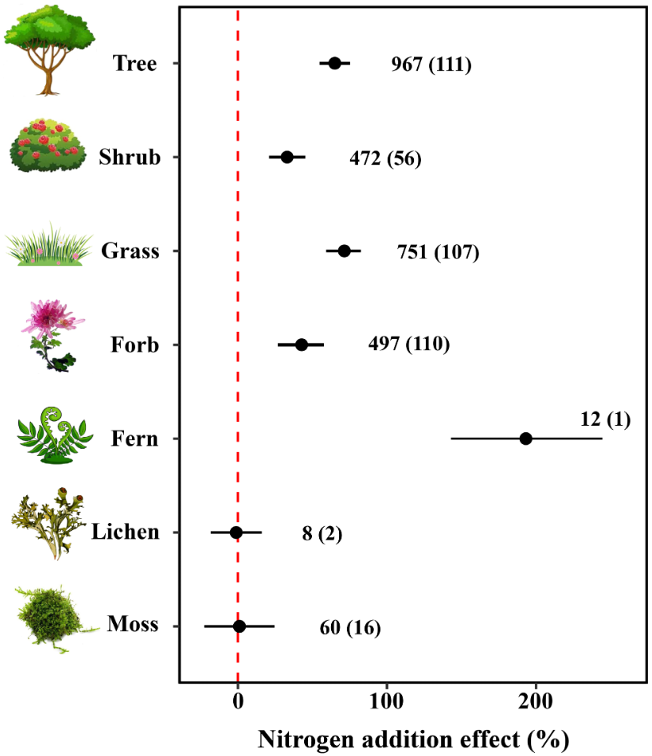
Figure 2: “Effect size of N addition on terrestrial plant biomass of different growth forms, expressed on the global scale. The vertical dashed red line denotes a null effect size (RR = 0). The number of observations is beside each attribute without parentheses, and the number of plant species is in parentheses. RR is the log response ratio,” Feng et al. (2023). (Image credits: https://par.nsf.gov/servlets/purl/10427327)https://par.nsf.gov/servlets/purl/10427327
Life forms
Broadleaved trees show significantly higher biomass increases due to N deposition compared to coniferous trees due to nutrient use efficiency and leaf traits.
- N use efficiency: Broadleaved trees have a higher N use efficiency than coniferous trees, as they acquire and use N for growth and development better than the latter group.
- Leaf traits: Broadleaved trees have a higher N concentration in their leaves, which improves photosynthetic rate. Higher specific leaf area allows for more leaf growth and photosynthesis. So, leaf area per plant is also crucial. The shorter lifespan of broadleaved (and deciduous) trees reduces the carbon costs of maintaining older, inefficient leaves by replacing them with new, efficient leaves. Besides leaf traits, tree canopy attributes are also crucial, as canopies interact and absorb most N deposition directly.
Tools to Measure Plant Productivity Responses to N Deposition
Meta-analyses tracking global trends in plant responses to N deposition are based on hundreds of in situ studies. The tools needed for these studies must be portable and robust for field use, but also accurate for scientific research. CID BioScience Inc. produces many portable tools for non-destructive, real-time measurements of morphology and physiology. Some of our tools suitable for studies on plant response to N deposition are as follows:
- Leaf area meters: The CI-202 Portable Laser Leaf Area Meter and CI-203 Handheld Laser Leaf Area Meter can measure leaf area to calculate specific leaf area.
- Plant Canopy Imager: CI-110 Plant Canopy Imager for leaf area index and other canopy trait assessments.
- Photosynthesis: CI-340 Handheld Photosynthesis System can measure photosynthesis and respiration simultaneously for NPP calculations.
Contact us for more information on our plant science precision tools for your nitrogen deposition studies.
Sources
Du, E., & de Vries, W. (2024). Impacts of nitrogen deposition on forest productivity and carbon sequestration. In Atmospheric Nitrogen Deposition to Global Forests (pp. 59-76). Academic Press.
Feng, H., Guo, J., Peng, C., Kneeshaw, D., Roberge, G., Pan, C., … & Wang, W. (2023). Nitrogen addition promotes terrestrial plants to allocate more biomass to aboveground organs: A global meta‐analysis. Global Change Biology, 29(14), 3970-3989.
Ke, Y., Yu, Q., Wang, H., Zhao, Y., Jia, X., Yang, Y., … & Yu, G. (2023). The potential bias of nitrogen deposition effects on primary productivity and biodiversity. Global Change Biology, 29(4), 1054-1061.
Matson, P., Lohse, K. A., & Hall, S. J. (2002). The globalization of nitrogen deposition: consequences for terrestrial ecosystems. Ambio, 113-119.
Skre, Oddvar. (2015). Re: Why are the life span of the leaves of evergreen trees more compared to deciduous trees?. Retrieved from: https://www.researchgate.net/post/Why-are-the-life-span-of-the-leaves-of-evergreen-trees-more-compared-to-deciduous-trees/54a56112d039b1ba738b45da/citation/download.
Zhu, J., Jia, Y., Yu, G. et al. Changing patterns of global nitrogen deposition driven by socio-economic development. Nat Commun 16, 46 (2025). https://doi.org/10.1038/s41467-024-55606-y
Related Products
Most Popular Articles
- Transpiration in Plants: Its Importance and Applications
- Leaf Area – How & Why Measuring Leaf Area…
- How to Analyze Photosynthesis in Plants: Methods and Tools
- Plant Respiration: Its Importance and Applications
- The Forest Canopy: Structure, Roles & Measurement
- Stomatal Conductance: Functions, Measurement, and…
- Forest & Plant Canopy Analysis – Tools…
- Root Respiration: Importance and Applications
- 50 Best Universities for Plant Science
- The Importance of Leaf Area Index (LAI) in…