How Do Plant Growth Regulators Improve Photosynthetic Rate in Crops?

Dr. Vijayalaxmi Kinhal


April 22, 2026 at 9:30 pm | Updated April 22, 2026 at 9:30 pm | 6 min read
- Plant growth regulators (PGRs) can positively or negatively influence photosynthesis, depending on the chemical.
- PGRs alter photosynthesis by manipulating the leaf anatomy, morphology, and physiology.
- Physiological effects include a better stress response, and morphological alterations improve light infiltration in the canopy.
- Anatomically, PGRs improve chlorophyll content and the structure and functions of the photosynthetic apparatus.
Scientists are focusing on the underlying factors that govern physiological processes and limit crop productivity. One factor is bio-regulators that can influence growth, development, and yield. Using natural and synthetic bioregulators to manipulate plant processes and responses is a new emerging field in plant biotechnology. In this article, you can find out how the plant growth bio-regulators improve photosynthetic rate in crops.
What are Plant Growth Bio-regulators?
Plant growth (bio) regulators (PGRs) are hormone-like chemicals that control plant physiological processes, and were discovered in the 20th century.
At very low concentrations, PGRs can improve crop growth and development, but at higher concentrations, they can inhibit plant processes. Some of the beneficial effects of PGRs include improved yield, resistance to several abiotic stresses (heat, cold, drought, and salinity) and biotic stresses (pests and diseases), and enhanced nutritional value and yield quality. Thus, PGRs can be useful in regulating plant response to environmental factors and tolerance to climate extremes.
Subscribe to receive our monthly round-up of articles.
PGRs used in horticulture and agriculture can be natural or synthetic chemicals. PGRs are produced endogenously in plant tissues, but they can also be synthesized and applied exogenously. PGRs are usually applied exogenously as foliar sprays prepared in distilled water. The effectiveness of PGRs depends on the timing of application and requires use at specific crop stages for optimal impact.
PGRs produced endogenously act at the cellular, tissue, and organ level to regulate growth and development by influencing processes such as stem elongation, leaf and flower production, minimizing flower drop, fruit and seed development, ripening, photosynthesis, dry matter accumulation, and source-sink relationships.
Several PGRs are present in plants, and their influences on plant processes are specific. Endogenously produced hormones that have been known as PGRs are auxins, abscisic acid, cytokinins, ethylene, and gibberellins. Recently, other compounds identified as PGRs in plants are brassinosteroids, jasmonates, juglones, peptide hormones, phospholipids, polyamines, salicylates, and vitamins.
According to Kumar (2021), over the past 30 years, most research on PGRs has focused on enhancing crop vegetative growth and yield. Studies on how PGRs affect underlying processes, such as photosynthesis, that lead to improved growth and yield are more recent.
Influence on Photosynthetic Rate
Studies show that plant growth bio-regulators’ influence on photosynthesis can be positive and negative.
Several PGRs have been found to increase photosynthetic rate.
- Brassinosteroids, a group of 40 steroids, are produced by plants and play roles in cellular and physiological processes, including photosynthesis.
- Salicylic acid has been shown to increase photosynthetic rate in several pulses, including blackgram, soybean, and cowpea. Acetyl salicylic acid and geninic acid also increase photosynthetic rates in soybean.
- Thiourea is a synthetic compound that is used as a foliar spray at the pre-flowering stages in mung beans, which improves photosynthetic efficiency to increase yield by 24%.
- Auxins are a class of growth regulators and plant hormones necessary for several plant processes. Indole-3-acetic acid (IAA) is the chief auxin active in plants. Exogenous application of IAA can improve the net photosynthetic rate.
In contrast, some PGRs can also inhibit photosynthesis. TIBA (2,3,5-Triiodobenzoic acid) is a synthetic chemical that, when applied exogenously, reduces the photosynthetic rate by inhibiting auxin transport, thereby reducing growth.
Influence on Photosynthetic Parameters
PGRs alter photosynthetic rates by influencing photosynthetic parameters, including chlorophyll content, leaf number, leaf area index, and canopy thickness.
Chlorophyll content
Endogenous and exogenous PGRs can alter chlorophyll content, thereby influencing photosynthesis.
Endogenous salicylic acid and its exogenous applications can increase chlorophyll content. For example, foliar applications in pear, pulses (berseem, soybean, and cowpea) increased chlorophyll content, leading to higher photosynthesis.
Improving Light Infiltration
PGRs alter leaf number, leaf area index, and canopy thickness, thereby altering photosynthetic rate. The total photosynthetic rate of a plant can be reduced when leaves in the lower canopy receive less light due to a dense canopy in high-density planting orchards. Pruning is used to thin the canopy, but it can subsequently trigger excessive vegetative growth due to the action of hormones gibberellins, and again reduce light infiltration in orchards.
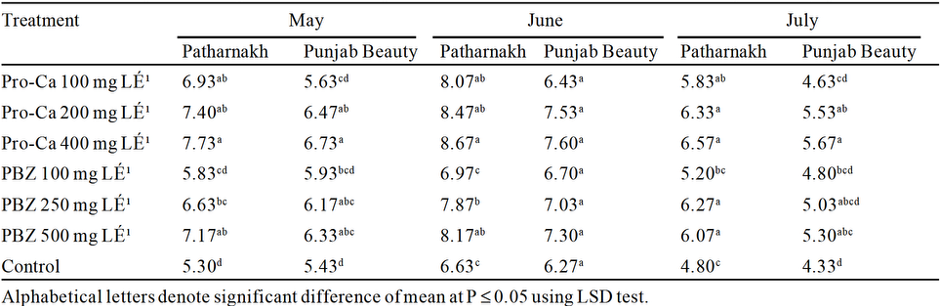
Using synthetic PGRs such as Paclobutrazol (PBZ) and Prohexadione calcium (Pro-Ca) can reduce vegetative growth and improve light penetration within the inner canopies of pear and apple, thereby increasing net photosynthetic rate and yield. For example, Pro-Ca at 200 and 400 mg L-1 increases light infiltration, thereby increasing the photosynthetic rate, by limiting shoot length, leaf area index, and trunk cross-sectional area in pears, and increasing fruit yield; see Figure 1.
Table 1: “Effect of plant bio-regulators (Paclobutrazol (PBZ) and Prohexadione calcium (Pro-Ca)) on the net photosynthesis rate of ‘Patharnakh’ and ‘Punjab Beauty’ pear, ” Kaur et al. 2020. (Image credits: https://journal.agrimetassociation.org/index.php/jam/article/download/154/96)
Protecting against stress
Many abiotic stresses have emerged as major factors reducing productivity. The role of PGRs in increasing plant tolerance is a major reason for interest in this class of chemicals.
PGRs such as natural salicylic acid and synthetic thiourea protect plants against many severe abiotic stresses.
Drought tolerance: Foliar sprays of thiourea at various crop stages stimulate plant defense against stress and regulate physiological processes, including water retention and photosynthesis. Thiourea and thidiazuron reduce the effects of drought at the cellular, tissue, and organ levels. For example, drought can reduce leaf relative water content, thereby reducing mesophyll cell size and starch granules, disrupting tissue structure in chickpeas. Foliar applications of TU and TDZ protected the plants against these harmful effects by maintaining leaf relative water content, thylakoid membrane stability, and chloroplast structure. As a result, the photosynthetic rate of the treated plants was higher.
Heavy metal toxicity: Exogenous application of the auxin IAA can ameliorate cadmium toxicity, for example, in eggplants (Solanum melongena). Cadmium accumulation in eggplants causes a reduction in pigment content and photochemistry of photosystem II (PS II) efficiency and increases dark respiratory oxygen uptake and ROS concentrations. High ROS levels under cadmium stress increase lipid peroxidation and electrolyte leakage. IAA application reduces cadmium absorption by roots and increases antioxidant levels, thereby improving the structural and functional aspects of the photosynthetic apparatus, such as pigment content and photosynthetic rate.
Low Adoption of PGRs
The use of plant growth regulators is an elite practice in horticultural and agricultural crops. Although the technology shows promising results, plant growth regulators are not widely used currently due to several research gaps and the high screening costs of PGRs. The effectiveness of exogenous applications is species- and cultivar-specific, as well as stage-specific. As yet, the PGRs have led to inconsistent yield and quality improvement. Moreover, the human health hazards of synthetic PGRs are not well known.
Tools for PGR Research
The choice of scientific tools can thus be crucial in advancing any branch of science and the applications of its results. A variety of tools will be necessary for studying the effects of PGRs. Among them are standard-precision tools offered by CID BioScience Inc. for on-site, rapid, non-destructive data collection and analysis. For example, the CI-340 Handheld Photosynthesis System can be used to measure photosynthesis and stress tests using chlorophyll a fluorescence. Other photosynthesis parameters, like leaf chlorophyll levels, can be analyzed by the CI-710s SpectraVue Leaf Spectrometer, and leaf area index by the CI-110 Plant Canopy Imager.
Contact us to learn more about the scientific tools available for research on plant growth regulators.
Sources
Bardhan, K., Kumar, V. and Dhimmsar, S.K. (2007). An evaluation of the potentiality of exogenous osmoprotectants mitigating water stress on chickpea. Journal of Agricultural Science. 3: 67-74. https://jas.sljol.info/articles/10.4038/jas.v3i2.8101
Didi, D. A., Su, S., Sam, F. E., Tiika, R. J., & Zhang, X. (2022). Effect of Plant Growth Regulators on Osmotic Regulatory Substances and Antioxidant Enzyme Activity of Nitraria tangutorum. Plants (Basel, Switzerland), 11(19), 2559. https://doi.org/10.3390/
Garban, Z., & Ilia, G. (2024). Structure-Activity of Plant Growth Bioregulators and Their Effects on Mammals. Molecules (Basel, Switzerland), 29(23), 5671. https://doi.org/10.3390/molecules29235671
Gollagi, S. G., Lokesha, R., Dharmpal, S., & Sathish, B. R. (2019). Effects of growth regulators on growth, yield and quality of fruits crops: A review. J Pharmacog phytochem, 8(4), 979-81.
Kantwa, S., Choudhary, M., Agrawal, R., Dixit, A., Kumar, S., & Chary, G. R. (2024). Exogenous application of plant bio-regulators improve yield and water use efficiency of maize under drought stress. Indian Journal of Agronomy, 69(2), 177-183.
Kaur, S., Gill, M. S., Gill, P. P. S., & Singh, N. P. (2020). Effect of plant bio-regulators on photosynthesis, growth and yield efficiency of pear trained on Y-trellis system. Journal of Agrometeorology, 22(2), 140-147.
Kumar B. (2021). Plant bio-regulators for enhancing grain yield and quality of legumes: A review. Agric. Rev. 42,175–182. doi: 10.18805/ag.R-2068.
Li, J., Guan, Y., Yuan, L., Hou, J., Wang, C., Liu, F., … & Zhu, S. (2019). Effects of exogenous IAA in regulating photosynthetic capacity, carbohydrate metabolism and yield of Zizania latifolia. Scientia Horticulturae, 253, 276-285. https://doi.org/10.1016/j.scienta.2019.04.058
Singh, S., & Prasad, S. M. (2015). IAA alleviates Cd toxicity on growth, photosynthesis and oxidative damages in eggplant seedlings. Plant growth regulation, 77(1), 87-98.
Vineeth T.V., Kumar* Pramod, Singh Jasvir (2016). Bioregulators protected the leaf anatomy and photosynthetic machinery under water deficit stress in chickpea (Cicer arietinum L.). Legume Research. 40(2): 250-256. doi: 10.18805/lr.v0iOF.4479.
Related Products
Most Popular Articles
- Transpiration in Plants: Its Importance and Applications
- Leaf Area – How & Why Measuring Leaf Area…
- How to Analyze Photosynthesis in Plants: Methods and Tools
- Plant Respiration: Its Importance and Applications
- The Forest Canopy: Structure, Roles & Measurement
- Stomatal Conductance: Functions, Measurement, and…
- Forest & Plant Canopy Analysis – Tools…
- Root Respiration: Importance and Applications
- 50 Best Universities for Plant Science
- The Importance of Leaf Area Index (LAI) in…