7 Funding Agencies That Require Leaf Area or LAI Data in Proposals

Scott Trimble

June 18, 2026 at 5:15 pm | Updated June 18, 2026 at 5:15 pm | 5 min read
Leaf area index data shows up in more grant calls than many researchers expect. Whether you are studying crop productivity, forest carbon dynamics, ecosystem resilience, or climate adaptation, reviewers often want quantitative canopy metrics. Leaf area index data connects plant structure to function. It links canopy architecture to light interception, water use, carbon exchange, and yield. If your proposal involves vegetation at any scale, there is a good chance that leaf area index data or direct leaf area measurements will strengthen it.
Below are seven funding agencies where leaf area index data is frequently required or strongly encouraged in competitive proposals.
#01 National Science Foundation
The National Science Foundation supports fundamental research in plant biology, ecosystem science, and Earth system processes. Programs within the Directorate for Biological Sciences and the Geosciences Directorate often require robust structural and functional vegetation metrics.
Subscribe to receive our monthly round-up of articles.
If you are proposing work on primary productivity, species interactions, or biogeochemical cycling, leaf area index data helps validate your models. Reviewers expect canopy measurements to support hypotheses about light interception, photosynthesis, and resource allocation. LAI is particularly relevant in long term ecological research and macrosystems biology proposals.
Field ready tools such as the CI-110 Plant Canopy Imager simplify LAI data collection. The CI-110 captures 150 degree hemispherical images and calculates LAI non destructively using canopy photography or 24 integrated PAR sensors . Because it performs under any sky condition and does not require above canopy reference readings, it fits well into multi site NSF projects.
#02 United States Department of Agriculture
USDA agencies such as NIFA and ARS fund applied plant science, crop improvement, and agronomic systems research. Leaf area index data is often central to proposals focused on yield optimization, drought tolerance, or nutrient use efficiency.
Crop model calibration depends on accurate canopy structure inputs. LAI influences evapotranspiration estimates, radiation interception, and biomass accumulation. In breeding trials, leaf area measurements help quantify phenotypic differences among genotypes.
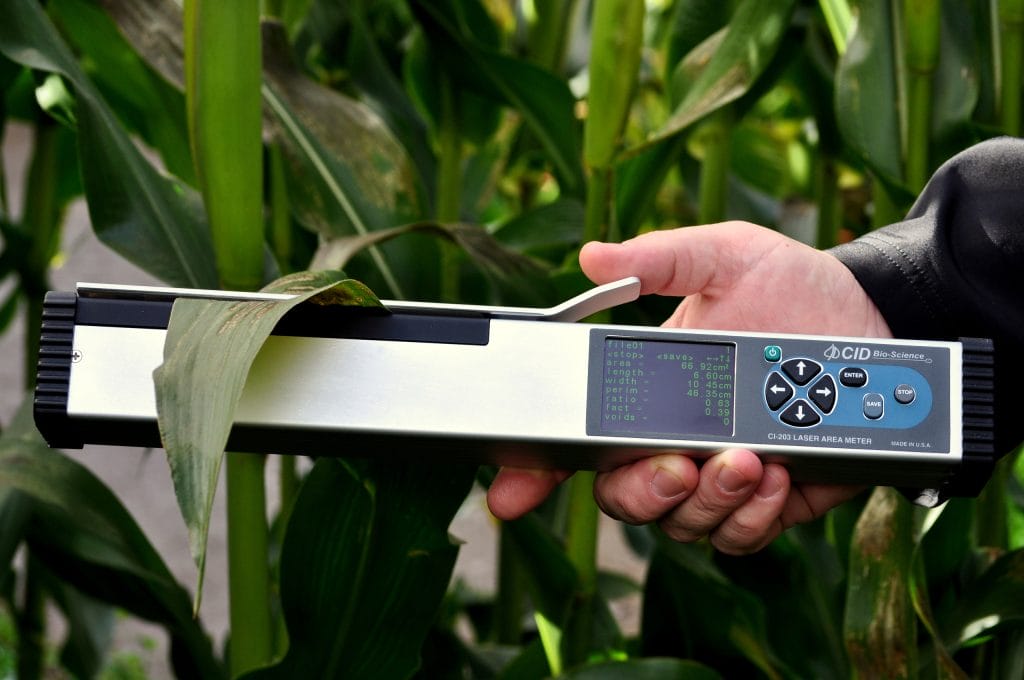
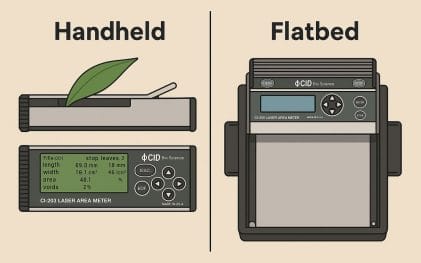
For plot level or individual leaf measurements, researchers frequently rely on laser based systems. The CI-203 Handheld Laser Leaf Area Meter enables non destructive measurement of area, width, length, perimeter, and shape factor with one sweep. It stores data on an SD card and requires no user calibration, which reduces error and training time in large field trials.
Similarly, the CI-202 Portable Laser Leaf Area Meter provides 0.01 cm² resolution and stores up to 8,000 measurements in a self contained unit . For USDA funded projects where throughput and repeatability matter, these features are practical advantages.
#03 Department of Energy
The Department of Energy funds research on bioenergy crops, carbon sequestration, and ecosystem responses to climate change. In these calls, leaf area index data supports modeling of carbon flux and energy balance.
DOE reviewers typically look for integrated measurements. Gas exchange data alone is rarely enough. Pairing canopy structure with photosynthetic performance strengthens the proposal. That is where combining LAI measurements with gas exchange systems becomes important.
The CI-340 Handheld Photosynthesis System measures photosynthesis, respiration, transpiration, stomatal conductance, PAR, and internal CO2 in a compact unit . With optional control modules for light, temperature, and CO2 and H2O supply, researchers can link structural changes in LAI to functional changes in carbon assimilation. This integrated approach aligns closely with DOE priorities in carbon cycle science.
#04 National Aeronautics and Space Administration
NASA funds remote sensing and Earth observation projects where ground truth validation is critical. Leaf area index data collected in situ is often required to calibrate satellite derived vegetation indices.
If your proposal involves linking drone or satellite imagery to canopy properties, you will need accurate field LAI data. Hemispherical photography and PAR based methods are common validation tools.
The CI-110 Plant Canopy Imager is designed for exactly this application. Its GPS connectivity across multiple satellite constellations allows precise georeferencing of LAI measurements. That capability is particularly valuable when aligning field data with high resolution imagery.
#05 United States Forest Service
Forest Service research programs emphasize forest health, wildfire risk, and carbon storage. Leaf area index data is central to understanding canopy density, fuel loads, and productivity.
Forest proposals often span large spatial scales. Non destructive, rapid canopy measurements allow researchers to collect statistically robust datasets across stands. LAI informs models of light penetration, understory growth, and microclimate regulation.
Because the CI-110 performs measurements under any sky condition and calculates gap fraction and extinction coefficients, it supports the structural metrics commonly required in forest ecology proposals.
#06 International Climate and Development Agencies
Organizations such as the World Bank, CGIAR, and regional climate funds often support agricultural resilience and climate adaptation research. Leaf area index data plays a role in assessing crop stress, water use, and productivity under changing conditions.
In these proposals, reviewers look for measurable indicators. LAI provides a quantifiable metric that connects canopy structure to stress responses. When combined with spectral measurements, it becomes even more powerful.
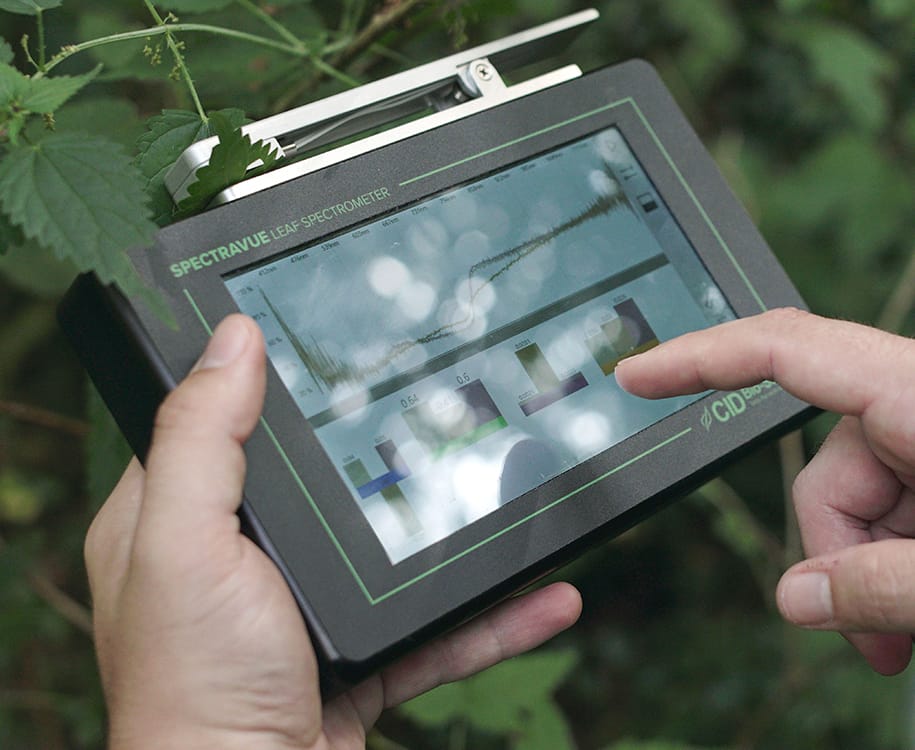
The CI-710s SpectraVue Leaf Spectrometer measures reflectance, transmittance, and absorbance across 360 to 1100 nm. Researchers can quantify pigments and stress related indices in real time. Pairing spectral indices with leaf area index data creates a comprehensive dataset that strengthens adaptation focused proposals.
#07 Environmental Protection Agency
EPA research grants often address ecosystem services, watershed health, and environmental monitoring. Vegetation structure influences runoff, nutrient cycling, and habitat quality. Leaf area index data helps quantify these relationships.
For watershed or restoration projects, reviewers expect defensible canopy metrics. LAI measurements support assessments of interception, transpiration, and shading effects on stream temperature.
Because CID Bio-Science instruments are portable, battery powered, and designed for field conditions, they integrate well into multi parameter environmental monitoring frameworks. The CI-202 and CI-203 provide detailed leaf level measurements, while the CI-110 captures stand level LAI. Together, they offer scale flexibility that agencies value.
Why Leaf Area Index Data Strengthens Proposals?
Across agencies, the pattern is consistent. Review panels look for measurable, repeatable, and scalable metrics. Leaf area index data satisfies all three criteria. It bridges physiology and ecology. It supports modeling efforts. It validates remote sensing outputs.
CID Bio-Science instruments are built around these needs. They are non destructive, portable, and designed for real world research environments. Features such as no user calibration, integrated GPS, high resolution scanning, and on board data storage reduce uncertainty and improve efficiency .
When reviewers see a proposal that includes clear plans for collecting leaf area index data with reliable instrumentation, confidence increases. Methods sections become more concrete. Timelines look realistic. Data quality appears defensible.
Ending Note
If your next proposal requires leaf area index data, make sure your methodology reflects the same rigor as your hypotheses. Explore the full line of canopy, leaf area, gas exchange, root imaging, and spectral tools at CID Bio-Science. Our instruments are designed to help researchers collect accurate, repeatable data in the field or lab without unnecessary complexity. Visit cid-inc.com to see how our solutions can strengthen your next submission.
Related Products
Most Popular Articles
- Transpiration in Plants: Its Importance and Applications
- Leaf Area – How & Why Measuring Leaf Area…
- How to Analyze Photosynthesis in Plants: Methods and Tools
- Plant Respiration: Its Importance and Applications
- The Forest Canopy: Structure, Roles & Measurement
- Stomatal Conductance: Functions, Measurement, and…
- Forest & Plant Canopy Analysis – Tools…
- Root Respiration: Importance and Applications
- 50 Best Universities for Plant Science
- The Importance of Leaf Area Index (LAI) in…