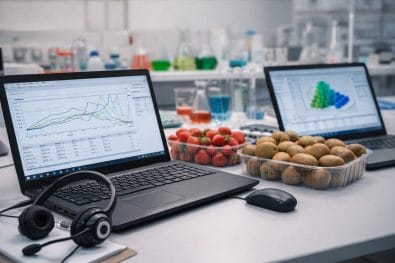
Portable vs Bench‑Top: Which Instrument Format for Your Research?


Scott Trimble

January 6, 2026 at 5:53 pm | Updated January 6, 2026 at 5:53 pm | 5 min read
Choosing between portable and bench-top instruments is a familiar decision in plant science and agricultural research. The format you select shapes how, where, and how often data are collected. Portable plant research instruments have become increasingly capable, narrowing the gap with traditional lab-based systems while offering flexibility that bench-top tools cannot match. This article looks at the practical differences between portable and bench-top formats, with examples drawn from CID Bio-Science instruments used in real research settings.
Understanding the Core Difference
At a basic level, bench-top instruments are designed for controlled laboratory environments. They prioritize stability, repeatability, and high-throughput processing of prepared samples. Portable plant research instruments are built for use in the field, greenhouse, or growth chamber, allowing researchers to measure living plants directly with minimal disturbance.
The distinction is not about data quality alone. It is about workflow, experimental design, and the biological relevance of measurements.
Subscribe to the CID Bio-Science Weekly article series.
By submitting this form, you are consenting to receive marketing emails from: . You can revoke your consent to receive emails at any time by using the SafeUnsubscribe® link, found at the bottom of every email. Emails are serviced by Constant Contact
Bench-Top Instruments
Bench-top systems still play an important role in plant research. They are well suited for:
-
Processed or harvested samples
-
Long integration times or highly controlled conditions
-
Centralized labs handling large sample volumes
For example, a bench-top leaf area scanner can deliver consistent measurements on detached leaves. However, sample collection, transport, and preparation all introduce time delays and potential artifacts.
Once leaves are removed from the plant, physiological processes change immediately. For traits that respond quickly to light, water status, or temperature, this delay can matter.
Portable Instruments in Modern Research
Portable plant research instruments address these limitations by bringing measurement tools to the plant instead of the other way around. CID Bio-Science has focused heavily on this approach across its product line.
Leaf Area Measurement in the Field
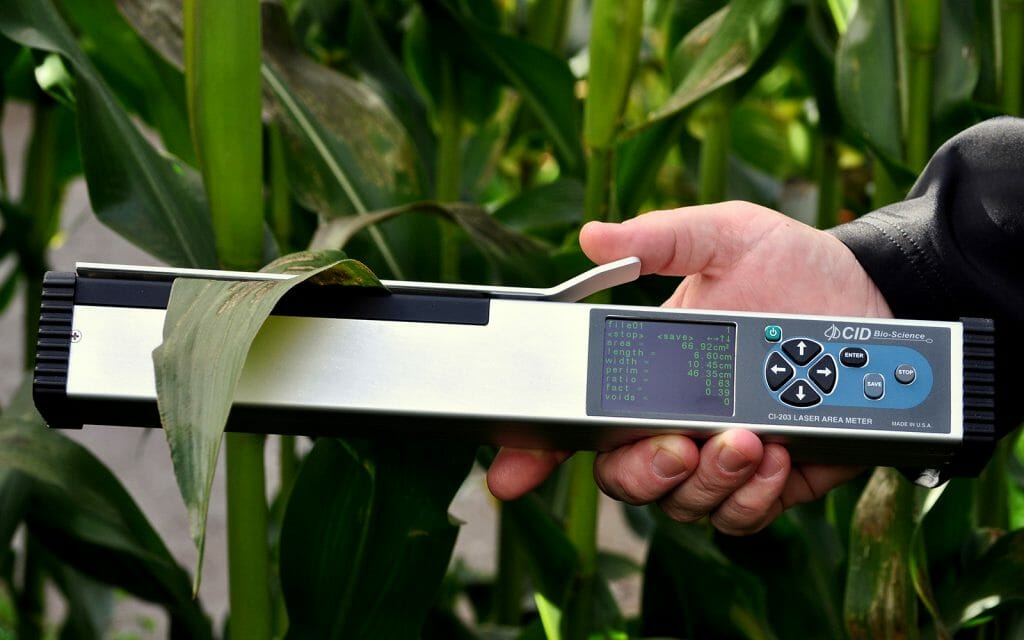
Handheld laser leaf area meters such as the CI-202 and CI-203 are good examples. These instruments allow researchers to measure leaf area non-destructively on living plants, whether in a field plot or greenhouse bench.
Key advantages include:
-
No need to harvest leaves
-
Immediate results displayed on the device
-
Consistent measurements across environments
The CI-203 adds single-handed operation, GPS tagging, and virtually unlimited storage via SD card, which is useful when collecting large datasets across multiple sites. These features reduce reliance on notebooks and post-processing steps common with bench-top workflows.
Gas Exchange Beyond the Lab
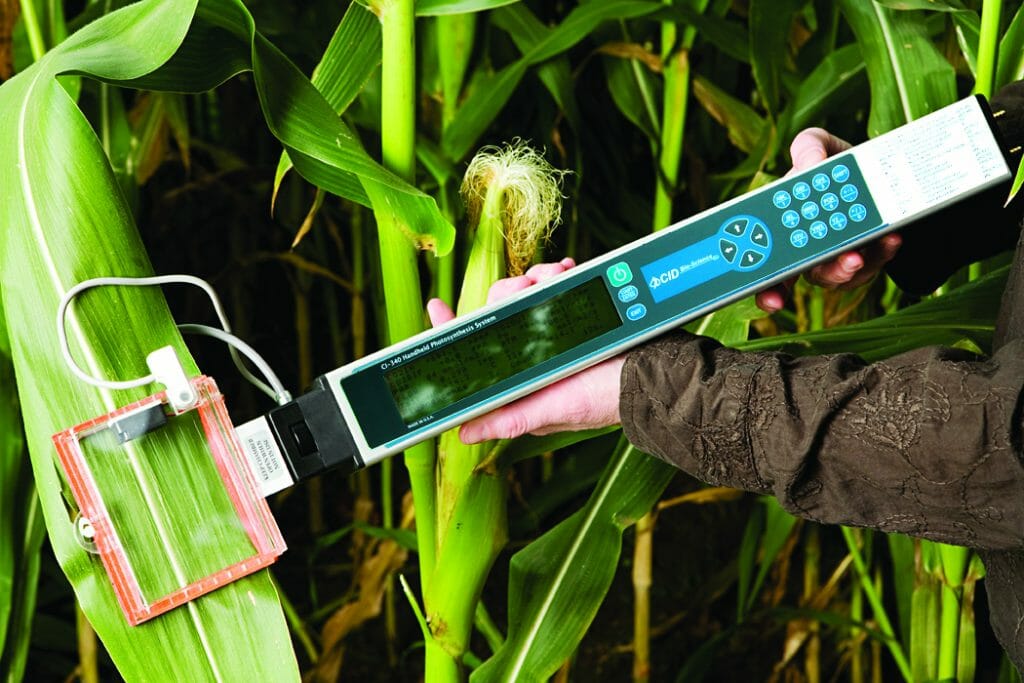
Photosynthesis systems have traditionally been associated with lab or semi-mobile carts. The CI-340 handheld photosynthesis system challenges that assumption by integrating gas exchange, transpiration, stomatal conductance, and internal CO2 measurements into a single portable unit .
With interchangeable chambers and optional control modules, the CI-340 supports both open and closed system measurements across a wide range of plant types. This flexibility allows researchers to collect physiologically meaningful data directly in the environment where plants are growing, rather than recreating those conditions indoors.
Bench-top systems may still offer long-term stability for specialized experiments, but the ability to measure intact leaves under natural light and temperature often outweighs that advantage for ecological, agronomic, and stress physiology studies.
Canopy-Level Measurements in Real Conditions

Canopy structure and light interception are difficult to capture accurately in a lab setting. The CI-110 Plant Canopy Imager is designed specifically for field deployment, combining hemispherical photography with PAR measurement to calculate leaf area index and other canopy parameters on site.
Portable canopy imaging allows researchers to:
-
Capture spatial variability across plots
-
Measure under diverse sky conditions
-
Avoid destructive sampling
These are tasks that bench-top systems simply cannot replicate without extensive simplification of the plant system.
Spectral Data Without the Lab Bottleneck

Spectroscopy is another area where portability has changed expectations. The CI-710s SpectraVue Leaf Spectrometer provides visible to near-infrared spectral measurements in a handheld format, with onboard analysis and a touchscreen interface.
Instead of collecting samples and returning to a central spectrometer, researchers can assess pigment content, nutrient status, and stress indicators immediately. This real-time feedback is especially valuable in field trials, breeding programs, and precision agriculture research.
Workflow and Experimental Design
One of the most overlooked differences between portable and bench-top instruments is how they influence experimental design.
Bench-top workflows often look like this:
-
Sample collection
-
Transport to lab
-
Measurement
-
Data processing
Portable workflows compress those steps:
-
Measure directly on the plant
-
Review data immediately
-
Adjust sampling strategy in real time
This difference can significantly improve data density and reduce missing context. With portable plant research instruments, researchers often collect more measurements across time and space because the barrier to measurement is lower.
Data Quality and Repeatability
A common concern is whether portable instruments sacrifice accuracy. In practice, many modern portable systems are engineered to deliver stable, repeatable measurements without frequent calibration.
For example, both the CI-202 and CI-203 require no user calibration and flatten curled leaves during scanning to improve measurement consistency . The CI-340 integrates analyzers directly with the chamber to reduce measurement delay and noise .
While bench-top instruments may still dominate in highly specialized analytical tasks, the gap for many common plant measurements is much smaller than it once was.
Choosing the Right Format
The decision between portable and bench-top instruments depends on a few key questions:
-
Do you need measurements on living plants in situ
-
How quickly do traits change after sampling
-
How many locations or treatments are involved
-
Is real-time feedback valuable to your study
For many plant science applications, portable plant research instruments provide a better match to biological reality while simplifying logistics.
When Bench-Top Still Makes Sense
Bench-top instruments remain useful for:
-
Highly processed samples
-
Centralized analytical labs
-
Experiments requiring extended stabilization times
In many programs, the most effective approach is a combination of both formats, with portable tools used for field or greenhouse measurements and bench-top systems reserved for downstream analyses.
Why CID Bio-Science Focuses on Portability
CID Bio-Science has built its instrument lineup around the idea that better data often come from measuring plants where they live. From handheld leaf area meters to portable photosynthesis systems, canopy imagers, and spectrometers, the emphasis is on practical, field-ready design without compromising measurement integrity.
This approach reflects how plant research is actually conducted today, across breeding trials, ecological studies, and applied agronomy.
Final Thoughts
If you are evaluating whether portable plant research instruments can replace or complement your current bench-top systems, CID Bio-Science offers tools designed specifically for real-world research conditions. Explore our full lineup and application resources, or contact our team to discuss which instrument format best fits your study goals.
Frequently Asked Questions
Are Portable Instruments Suitable for Long-Term Research Projects?
Yes. Many portable plant research instruments are designed for repeated use across seasons and years, with durable construction and consistent measurement performance.
Can Portable Instruments Replace Bench-Top Systems Entirely?
In some workflows, yes. In others, they work best as complementary tools that reduce sample handling and increase field-level data collection.
Do Portable Instruments Require Frequent Calibration?
Most CID Bio-Science portable instruments are designed to minimize calibration needs, allowing researchers to focus on data collection rather than maintenance.
Related Products
Most Popular Articles
- Transpiration in Plants: Its Importance and Applications
- Leaf Area – How & Why Measuring Leaf Area…
- How to Analyze Photosynthesis in Plants: Methods and Tools
- Plant Respiration: Its Importance and Applications
- The Forest Canopy: Structure, Roles & Measurement
- Stomatal Conductance: Functions, Measurement, and…
- Forest & Plant Canopy Analysis – Tools…
- Root Respiration: Importance and Applications
- The Importance of Leaf Area Index (LAI) in…
- 50 Best Universities for Plant Science
Related Reading