Complete Buyer’s Guide to Leaf Area Measurement Instruments

Scott Trimble

January 6, 2026 at 6:11 pm | Updated January 6, 2026 at 6:11 pm | 5 min read
Understanding leaf area measurement is central to plant physiology, agronomy, forestry, and ecology. Researchers rely on accurate leaf metrics to track growth, predict crop performance, analyze stress response, and quantify traits across treatments.
With several tools available in the research market, knowing what to choose can be overwhelming. This guide breaks down the major instrument options, what they are best suited for, and how CID Bio Science’s line of leaf area measurement tools stands apart.
Why Leaf Area Matters
Leaf area measurement is used to estimate photosynthetic potential, productivity, nutrient status, and plant health. Whether studying field crops or forest canopies, researchers depend on repeatable and non destructive measurements.
Subscribe to the CID Bio-Science Weekly article series.
By submitting this form, you are consenting to receive marketing emails from: . You can revoke your consent to receive emails at any time by using the SafeUnsubscribe® link, found at the bottom of every email. Emails are serviced by Constant Contact
CID Bio Science designs instruments specifically for portability, real field conditions, and rapid data collection. Our approach minimizes workflow friction and maximizes measurement accuracy.
Categories of Leaf Area Measurement Instruments
The most widely used tools fall into three categories:
-
Portable laser scanners
-
Handheld scanning wands
-
Hemispherical canopy imagers
Each method serves a unique purpose while contributing to the broader work of leaf area measurement.
Portable Laser Leaf Area Meters

Portable laser leaf area meters are best for researchers who need high resolution scans of individual leaves, needles, seeds, or small plant parts. CID Bio Science offers two well established instruments in this category.
CI-202 Portable Laser Leaf Area Meter
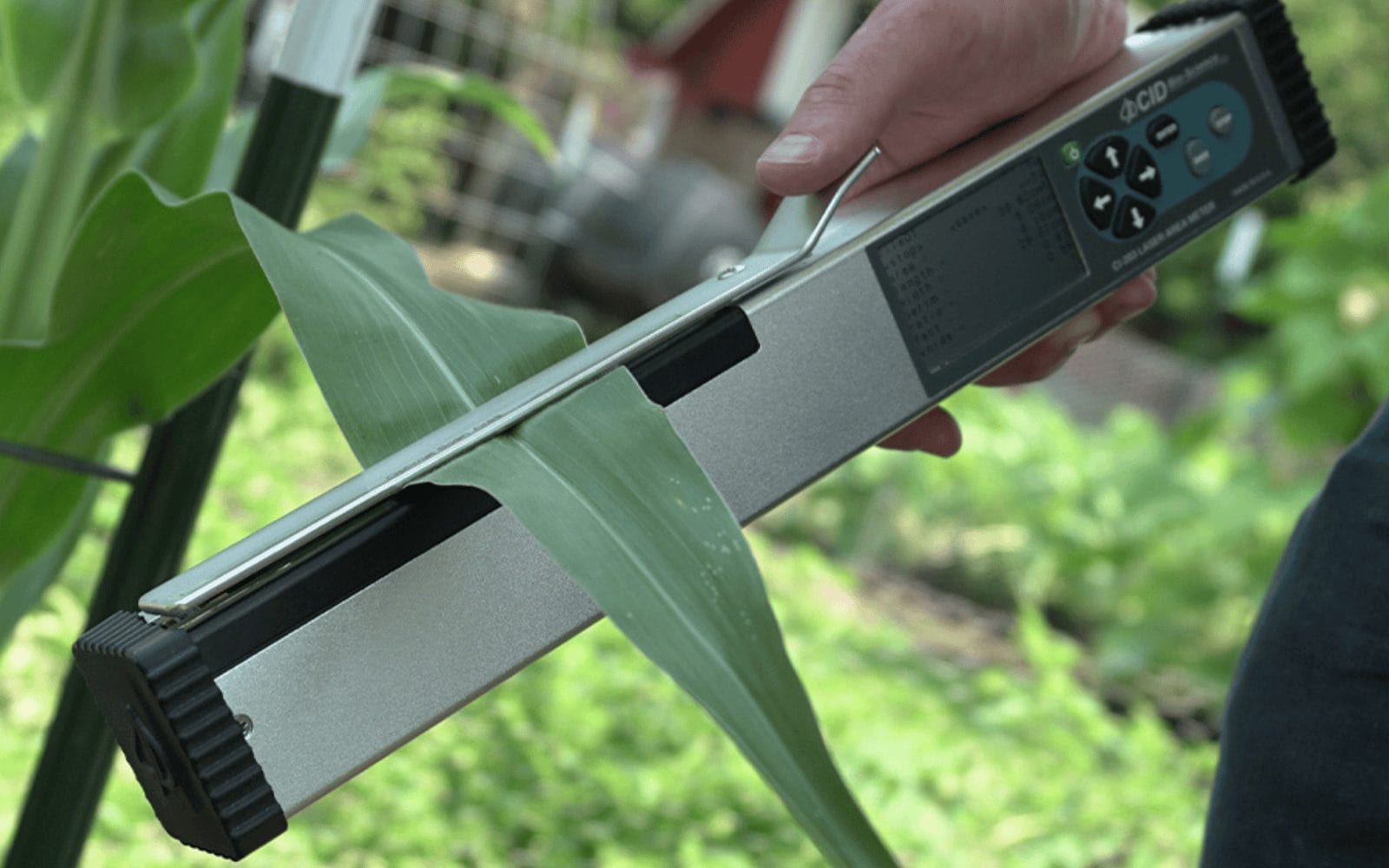
The CI-202 provides precise measurements of area, length, width, and perimeter, while also calculating shape factor and ratio. It flattens curled leaves to ensure consistency and runs on a rechargeable battery for long field days.
Key advantages
-
High resolution of 0.01 cm² for detailed leaf area measurement
-
Stores up to 8000 measurements on the device
-
Lightweight and self contained with onboard display
-
Non destructive evaluation of leaves, needles, or seeds
-
No user calibration required
Researchers across disciplines use it to quantify phenotypic changes, evaluate leaf characteristics in situ, and even measure manufactured parts or seeds.
CI-203 Handheld Laser Leaf Area Meter
The CI-203 is built for rapid and non destructive measurement of living plants. Its scanning wand design allows single handed operation, and it provides seven parameters, including area, perimeter, shape factor, void count, and length and width metrics.
Key advantages
-
Virtually unlimited storage with SD card support
-
GPS tagging for location based datasets
-
Visual leaf outline for scan verification
-
Measures objects up to 150 mm wide and 14 mm thick
-
Optional conveyor attachment for high throughput measurements
For field based research, the CI-203 excels due to its portability and rapid data acquisition.
Handheld Photosynthesis Systems with Leaf Area Capabilities
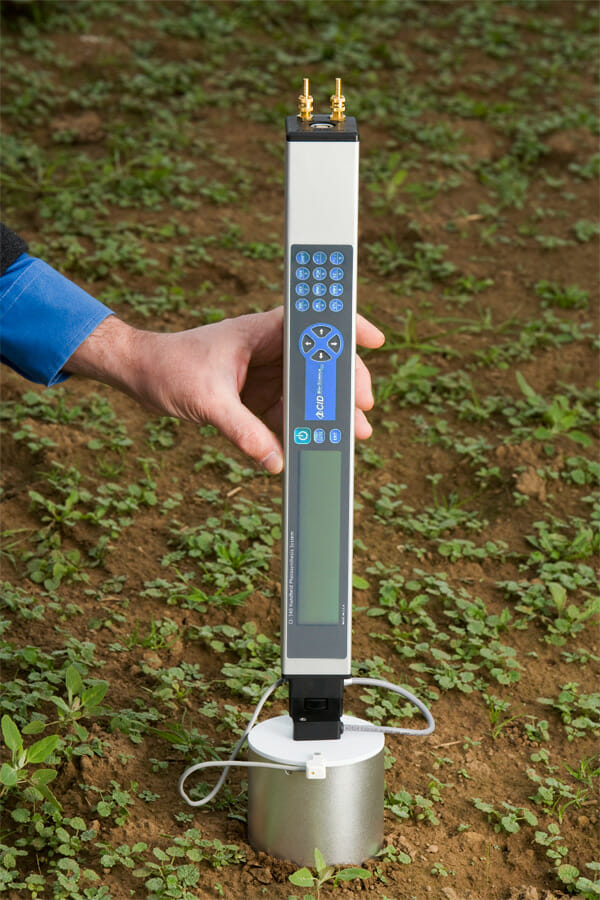
Some researchers require leaf area measurement alongside physiological data.
CI-340 Handheld Photosynthesis System
Although primarily focused on gas exchange, the CI-340 integrates multiple leaf chamber sizes that support accurate assessment of enclosed leaf area during photosynthesis measurements.
With ten chamber options designed for everything from broad leaves to cactus pads, researchers can match chamber size to leaf morphology for more reliable area dependent calculations.
This system measures photosynthesis, respiration, transpiration, stomatal conductance, PAR, and internal CO₂ in one compact unit.
Optional modules allow control of temperature, CO₂ and H₂O levels, light intensity, and chlorophyll fluorescence. These modules help link leaf area measurement with physiological data for comprehensive plant analysis.
Leaf Area Index and Canopy Level Measurement
Not all leaf area measurement happens on individual leaves. Canopy methods estimate leaf area per ground area (LAI), which is critical in forestry, crop modeling, and ecological monitoring.
CI-110 Plant Canopy Imager
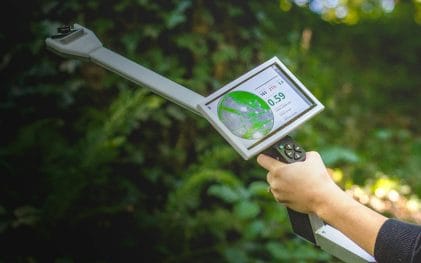
The CI-110 combines hemispherical imaging with PAR sensors to generate non destructive LAI measurements. The self leveling digital camera captures 150 degree canopy images, and the instrument calculates gap fraction, leaf angle distribution, and extinction coefficients.
Key advantages
-
Works under any sky condition
-
Built in GPS supporting four satellite constellations
-
On device image processing
-
PAR based LAI measurement using 24 photodiodes
-
Delay trigger for crisp canopy images in bright environments
Researchers who work with forests, orchards, or greenhouse canopies find the CI-110 valuable for fast onsite LAI assessments.
Choosing the Right Leaf Area Measurement Instrument
Consider the following questions when selecting your device:
Do you need individual leaf scans?
Choose the CI-202 for high precision stationary measurements or the CI-203 for rapid field scans.
Do you measure photosynthesis simultaneously?
The CI-340’s customizable chambers support accurate area dependent physiological assessments.
Do you analyze canopy scale leaf area?
The CI-110 is your best fit for full canopy LAI and gap fraction measurements.
Do you also track pigment or stress data?
Pairing a spectrometer like the CI-710s provides a fuller picture of plant performance.
Conclusion
Leaf area measurement continues to be a foundation of plant science research. Whether you work in breeding, ecology, agronomy, or physiology, selecting the right instrument improves data reliability and workflow efficiency.
CID Bio Science designs tools for real world research conditions with portability, ease of use, and measurement precision at the forefront.
To explore these instruments or request a quote, visit CID Bio Science and talk with our team of plant science specialists. Our expertise can help match your research goals with the exact tool you need.
FAQs
1. Why is leaf area such an important variable in plant research?
Leaf area is one of the most informative indicators of plant growth, resource allocation, and stress response. It helps researchers estimate photosynthetic capacity, transpiration, biomass accumulation, and overall plant vigor. Because leaf area responds quickly to environmental changes, it’s frequently used as a non-destructive, early-stage marker for treatment effects and genotype performance.
2. What’s the difference between destructive and non-destructive leaf area measurement, and when should each be used?
Destructive measurement involves removing and flattening the leaf, typically for scanning or manual tracing, and is often used when leaves are small or uniform or when detailed archiving is required.
Non-destructive measurement allows leaves to remain on the plant and is preferred in repeated-measures experiments, long-term studies, or situations where leaf removal would alter plant physiology. Researchers choose non-destructive tools when studying growth trajectories, stress progression, or functional traits over time.
3. How do researchers select the right type of leaf area instrument for their work?
The choice depends on several factors: leaf size, morphology, environment, and experimental frequency. Field researchers often prioritize portability, battery life, and the ability to handle curled or irregular leaves. Lab-based work may require higher resolution or conveyor-style throughput for large sample sets.
Key considerations include:
-
Leaf shape and thickness (broadleaf, needle, compound leaves, or irregular edges)
-
Measurement setting (controlled environment vs. field conditions)
-
Required parameters beyond area (perimeter, shape factor, void spaces, length/width ratios)
-
Need for non-destructive scanning in growth or stress studies
Choosing the right instrument ensures reliable data and reduces measurement time across large populations.
Related Products
Most Popular Articles
- Transpiration in Plants: Its Importance and Applications
- Leaf Area – How & Why Measuring Leaf Area…
- How to Analyze Photosynthesis in Plants: Methods and Tools
- Plant Respiration: Its Importance and Applications
- The Forest Canopy: Structure, Roles & Measurement
- Stomatal Conductance: Functions, Measurement, and…
- Forest & Plant Canopy Analysis – Tools…
- Root Respiration: Importance and Applications
- The Importance of Leaf Area Index (LAI) in…
- 50 Best Universities for Plant Science