Assessing Root Growth in Cover Crops Using the CI‑600 In‑Situ Root Imager

Scott Trimble

January 5, 2026 at 7:44 pm | Updated January 5, 2026 at 7:44 pm | 5 min read
Assessing root growth in cover crops is central to understanding how these systems influence soil structure, nutrient cycling, and long-term field performance. While aboveground biomass is easy to observe, the real agronomic value of cover crops often lies below the surface.
Root depth, density, and turnover drive water infiltration, carbon inputs, and nitrogen capture. The challenge has always been how to measure these traits accurately without disturbing the soil profile. The CI-600 In-Situ Root Imager was designed to address that problem directly, giving researchers a practical way to monitor root growth in cover crops over time without excavation.
Why Root Growth Matters in Cover Crop Systems
Root growth in cover crops determines how effectively a species performs its intended role. Deep-rooted covers improve soil porosity and alleviate compaction. Fibrous systems enhance aggregate stability and protect against erosion. Fine roots increase microbial activity and accelerate nutrient cycling. These processes are dynamic and change throughout the season, which makes one-time destructive sampling a poor fit for serious research.
Subscribe to receive our monthly round-up of articles.
When assessing root growth in cover crops, timing matters. Early establishment influences weed suppression and nutrient uptake. Mid-season growth reflects resource acquisition under competition or stress. Late-season root persistence affects residue breakdown and carbon storage. Capturing these changes requires repeated measurements at the same location, something traditional coring or trenching cannot support.
Limitations of Traditional Root Measurement Methods
Soil coring and excavation remain common, but they introduce several constraints. Each sample disturbs the surrounding soil, making repeat measurements impossible. Root washing and scanning are labor-intensive and introduce bias toward larger or more intact roots. Spatial variability further complicates interpretation, especially in heterogeneous field conditions.
Minirhizotron imaging emerged as a solution, but early systems were often bulky, fragile, or difficult to deploy at scale. Data processing could also become a bottleneck, limiting the number of samples researchers were willing to collect. These limitations slowed adoption, even though the method itself offered clear scientific advantages.
The CI-600 In-Situ Root Imager Approach
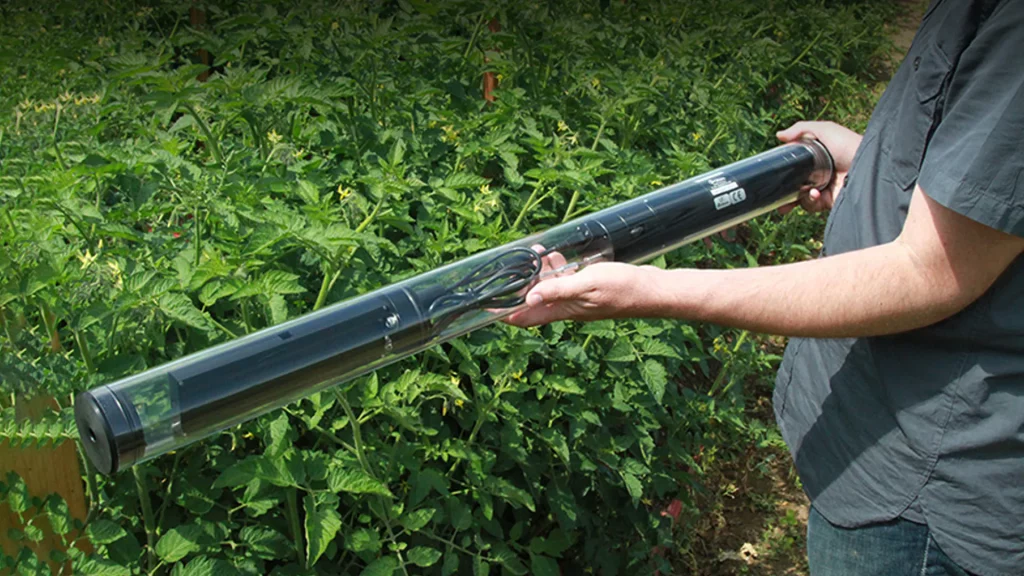
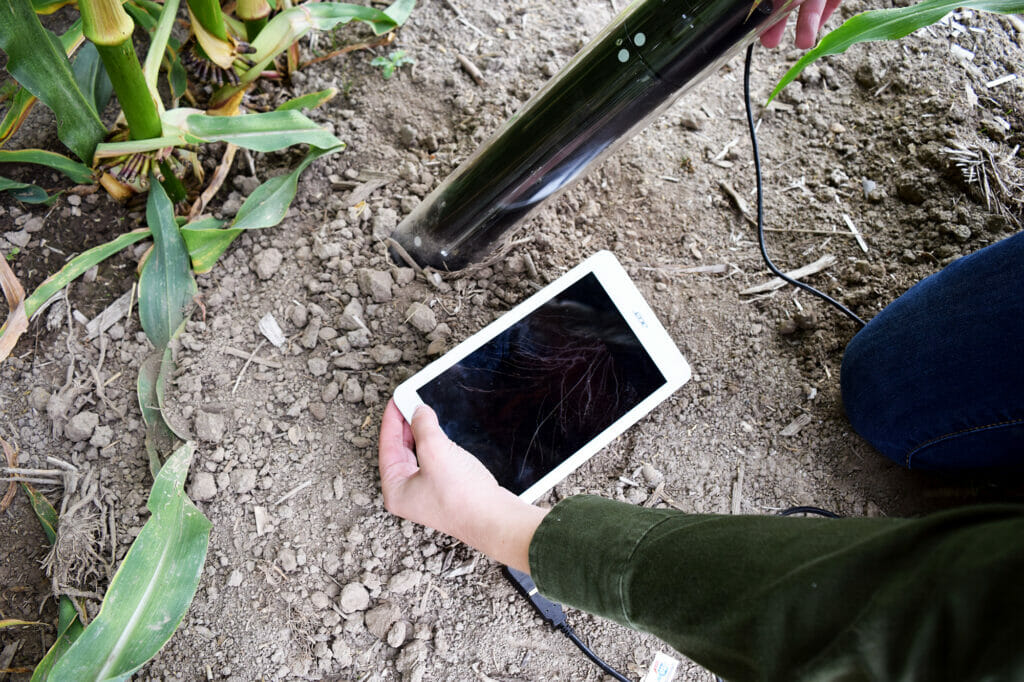
The CI-600 In-Situ Root Imager builds on the strengths of minirhizotron technology while addressing many of its historical weaknesses. Transparent observation tubes are installed in the soil at a fixed angle or vertically, depending on experimental design. The handheld imager is then inserted into the tube to capture high-resolution images of roots growing along the tube wall.
For assessing root growth in cover crops, this approach allows repeated imaging of the same soil volume across weeks or months. Root emergence, elongation, branching, and senescence can all be tracked without disturbing plant or soil structure. Because the system is portable and self-contained, measurements can be made directly in the field without external power or fragile components.
Key Features That Support Cover Crop Research
Several design elements make the CI-600 particularly well suited for cover crop studies.
-
Non-destructive imaging enables repeated measurements at identical locations
-
High-resolution optics capture fine roots often missed by destructive sampling
-
Portable design supports large field trials and remote locations
-
Consistent image orientation improves temporal comparisons
-
Simple operation reduces training time for students and technicians
These features translate directly into better datasets. Instead of relying on snapshots, researchers can build time series that reflect real root dynamics under varying management practices.
Experimental Design Considerations
Installing observation tubes is a critical step when assessing root growth in cover crops. Tube placement should reflect expected rooting depth and architecture. Shallow angles often maximize visible root length, while vertical installations simplify depth-based analysis. Consistency across plots is essential to reduce variability.
Once installed, tubes remain in place for the duration of the study. This permanence is what enables seasonal or multi-year monitoring. In cover crop rotations, the same tubes can often be used to evaluate successive species, offering insight into how different covers exploit the same soil profile.
Imaging frequency depends on research goals. Weekly imaging captures rapid early growth, while biweekly or monthly schedules may be sufficient later in the season. Because data collection is fast, increasing sampling intensity does not dramatically increase labor costs.
Data Outputs and Analysis
The images produced by the CI-600 provide clear visual records of root presence and development. Researchers commonly quantify root length density, root count, and growth rates by depth. Over time, these metrics reveal patterns that would be invisible with destructive sampling.
When assessing root growth in cover crops, this information can be linked directly to soil moisture, nutrient availability, or management treatments. For example, comparing root proliferation under different termination timings can clarify tradeoffs between biomass accumulation and soil water use.
Image archives also serve as a valuable reference. Being able to visually confirm root responses helps validate numerical results and improves confidence when sharing findings with collaborators or producers.
Integration With Broader Plant Measurements
Root data rarely stand alone. Many cover crop studies also track canopy development, leaf area, or physiological responses. Pairing root observations with complementary measurements strengthens interpretation and highlights whole-plant responses to management or environment.
Because the CI-600 does not interfere with aboveground growth, it integrates cleanly into multi-instrument workflows. Researchers can monitor roots, shoots, and soil simultaneously, building a more complete picture of cover crop function without increasing plot disturbance.
Advantages Over Competing Root Imaging Systems
Compared to older or more complex minirhizotron platforms, the CI-600 emphasizes practicality. The system avoids external control units, complex calibration routines, and fragile cabling. This simplicity matters in real field conditions, where dust, moisture, and uneven terrain are unavoidable.
Data consistency is another advantage. Stable imaging geometry and straightforward operation reduce user-induced variability. For long-term projects or multi-site trials, this consistency improves comparability across operators and seasons.
Cost efficiency also plays a role. By lowering barriers to deployment and operation, the CI-600 allows researchers to increase replication rather than limit sampling due to equipment constraints. In cover crop research, replication is often the difference between suggestive trends and statistically robust conclusions.
Practical Applications in Cover Crop Research
Researchers use the CI-600 to address a wide range of questions, including:
-
Comparing rooting depth among species or mixtures
-
Evaluating root responses to planting date or seeding rate
-
Measuring persistence of roots after termination
-
Assessing soil structure improvement over multiple seasons
-
Linking root turnover to soil carbon inputs
In each case, assessing root growth in cover crops over time provides insights that cannot be captured by surface measurements alone.
Frequently Asked Questions
How Deep Can Roots Be Observed With the CI-600?
Root observation depth depends on tube length and installation angle. Tubes can be installed to capture shallow or deep rooting zones, making the system flexible for different cover crop species.
Does the CI-600 Affect Root Growth Near the Observation Tube?
When installed correctly, roots grow naturally along the tube surface. Proper soil contact during installation minimizes disturbance and reduces artifacts in root distribution.
Can the Same Tubes Be Used Across Multiple Seasons?
Yes. Observation tubes are designed for long-term use, allowing researchers to track root growth across seasons or rotations without reinstalling hardware.
Related Products
Most Popular Articles
- Transpiration in Plants: Its Importance and Applications
- Leaf Area – How & Why Measuring Leaf Area…
- How to Analyze Photosynthesis in Plants: Methods and Tools
- Plant Respiration: Its Importance and Applications
- The Forest Canopy: Structure, Roles & Measurement
- Stomatal Conductance: Functions, Measurement, and…
- Forest & Plant Canopy Analysis – Tools…
- Root Respiration: Importance and Applications
- 50 Best Universities for Plant Science
- The Importance of Leaf Area Index (LAI) in…
Related Reading