How Does the Red-to-Far-Red Fluorescence Ratio Reveal Plant Stress?

Dr. Vijayalaxmi Kinhal


December 30, 2025 at 8:28 pm | Updated April 14, 2026 at 3:19 am | 6 min read
- The red-to-far-red fluorescence ratio is sensitive to changes in environmental and growing conditions; therefore, it can be used as an early indicator of plant stress.
- Photosynthesis, especially the sensitivity of photosystem II (PS II) to stress, is leveraged while using the ratio.
- The red-to-far-red ratio has several practical applications in precision agriculture and in developing plant adaptations to stress.
Early indicators of stress and plant growth inhibition should be directly correlated with plant physiological processes. Such a connection has been found between photosynthesis and the red-to-far-red fluorescence ratio. Please find out how the red-to-far-red ratio changes, and how scientists are leveraging it in crop science.
Processing of Light by Plants
Stress changes various physiological plant functions such as photosynthesis, respiration, transpiration, and stomatal conductance. A change in any of these processes can indicate abiotic stress.
Among these plant functions, photosynthesis is used to indicate the incidence and measure the quantity of stress, because most stress factors affect the process directly or indirectly. It is also possible to measure changes in photosynthesis using non-invasive methods, such as chlorophyll fluorescence, making this a widely used strategy for stress detection.
Subscribe to receive our monthly round-up of articles.
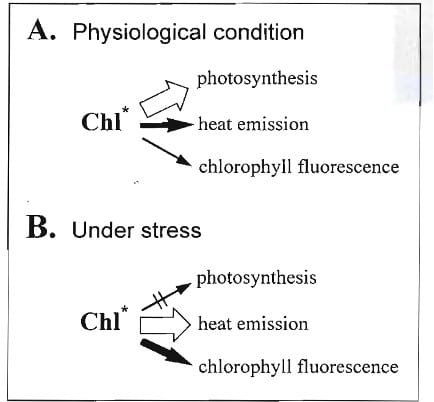
Figure 1: Conversion of light energy during photosynthesis in normal or physiological conditions and under stress. Arrow thickness indicates relative proportions of light, Lichtenthaler (1996). (Image credits: https://doi.org/10.1016/S0176-1617(96)80287-2)
Photosynthesis relies on solar radiation. The photosynthetically active radiation (PAR) components are found between 400 and 700 nm. According to Lichtenthaler (1996), the energy from the light photons absorbed by leaves undergoes three pathways:
- Around 80-90% of the energy is converted to photochemical energy and fixed in carbon compounds.
- Some energy, 5-15%, is dissipated as heat to protect the photosynthetic apparatus.
- A small quantity of 0.5-2% is emitted through chlorophyll fluorescence as red light (684–695 nm) and far-red wavelengths (730–760 nm).
Although chlorophyll fluorescence is slight, it is measurable with precise tools.
Stress alters photosynthetic pigments and reduces the rate of photosynthesis, so less energy is fixed, and more is lost through chlorophyll fluorescence and heat, as shown in Figure 1. The damaged leaves can use less of the absorbed red light, which is emitted back as fluorescence.
Chlorophyll Fluorescence is Vital
Chlorophyll fluorescence occurs in the two light-dependent stages of photosynthesis- Photosystem I (PSI) and Photosystem II (PS11). Red fluorescence (F687) occurs in PS11, which is more sensitive to environmental stress than PSI, where far-red (F760) fluorescence occurs. Stress can increase the fluorescence in both the red and far-red regions. However, the changes in the red fluorescence (F687) increase more significantly.
However, the fluorescence is not uniform over the leaf. Red and far-red fluorescence is lower in the leaf vein region and higher in the leaf lamina without veins. Chlorophyll fluorescence is also affected by various leaf factors, such as thickness. Hence, fluorescence intensities are less reliable; therefore, fluorescence ratios, which have less leaf-to-leaf variation, are used to evaluate plant functioning. During stress, increased red emission raises the red-to-far-red fluorescence ratio and is used to indicate plant function and health. In contrast, higher far-red fluorescence will reduce the ratio.
Chlorophyll Content Shapes R/FR Ratio
Scientists have found that many fluorescence ratios are correlated with leaf chlorophyll content. As chlorophyll content increases, more red light is used and fixed. Reduction in leaf chlorophyll content increases red fluorescence, as shown in Figure 2.
As many abiotic stresses can reduce leaf chlorophyll, they can be measured by evaluating their concentration or the fluorescence changes they cause.
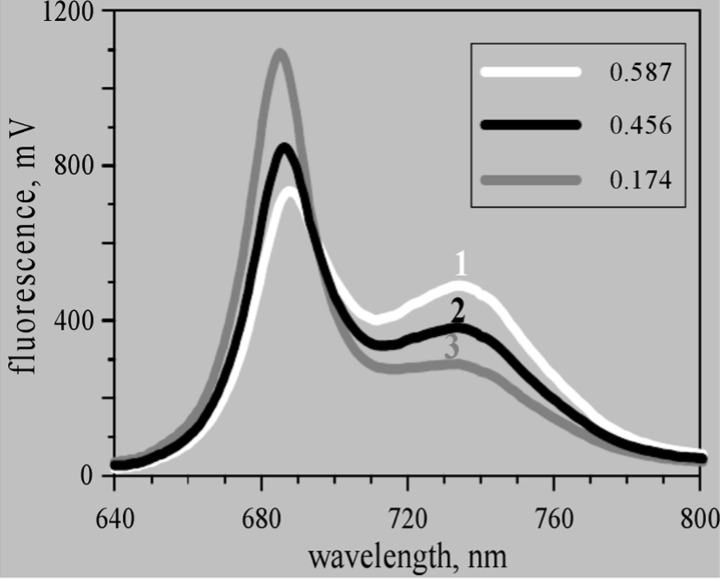
Figure 2: “Red and far-red fluorescence of barley leaves with different chlorophyll concentration, Kancheva et al. (2008). (Image credits: http://d33.infospace.ru/d33_conf/2008_pdf/2/39.pdf)
Indicator of Abiotic Stresses
The red-to-far-red fluorescence ratio is sensitive to plant changes caused by temperature extremes, nutrient deficiency, and water stress. Although the general rule of increasing the red-to-far-red fluorescence ratio applies, there can be nuanced differences and sometimes opposite trends, according to a meta-analysis by Ac et al. (2015).
Drought: Contrary to the trend of increasing the red-to-far-red ratio, water stress reduces it. It occurs because the ratio is affected not by soil moisture but by the air. In regions of high humidity, the red-to-far-red ratio is higher, and lower during dry periods. The far-red radiance in air is many times higher in dry air, so the ratio decreases in dry conditions. Also, dry conditions cause the stomata to close, so both red and far-red fluorescence decrease. The red-to-far-red ratio is lower at the leaf and canopy scales.
Temperature extremes: Low and high temperatures have different effects on the red-to-far-red ratio.
- Chilling increases the red-to-far-red fluorescence ratio.
- Heat stress or higher temperatures decrease both fluorescence emissions, but are marked by a low red-to-far-red ratio. A general decrease in fluorescence in the red and far-red occurs due to a reduction in chlorophyll content, and because heat stress is accompanied by lower water content.
Nitrogen deficiency: Nitrogen deficiency lowers leaf chlorophyll content. However, the reaction and changes in the red-to-far-red ratio depend on plant functional types. In many plant species, lower chlorophyll levels can be critical, below 300 mg. m-2, increasing the red component due to reduced photosynthesis. If chlorophyll is reduced but remains above 300 mg. m-2, the ratio can be low. Also, long-term nitrogen deficiency will generally raise the red-to-far-red ratio.
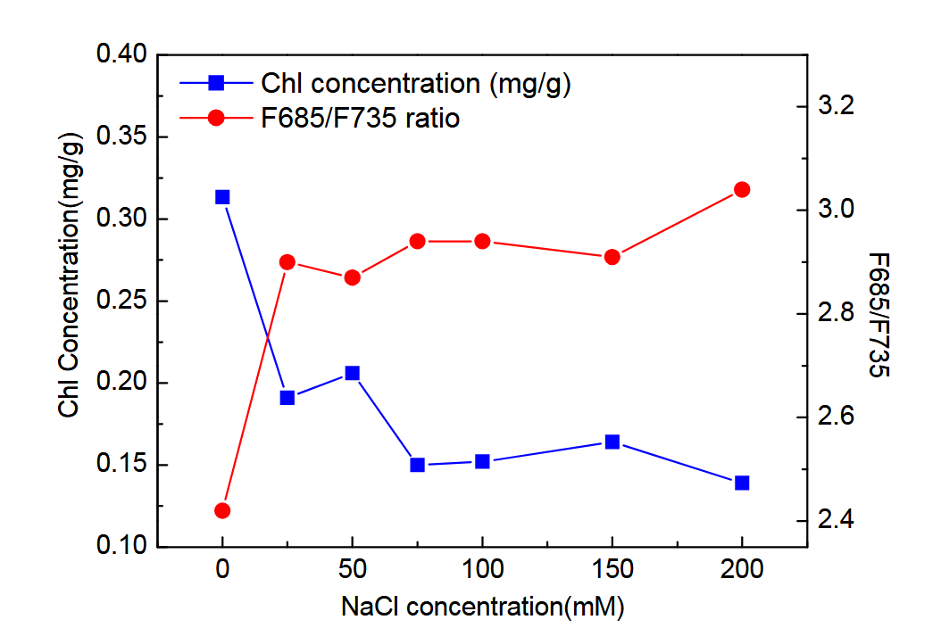
Figure 3. Changes in chlorophyll concentration and the red to far-red ratio as salinity increases, Gouveia-Neto et al. (2011). (Image credits:oi: 10.1117/12.872991)
Salinity: Salt stress, or salinity, reduces chlorophyll concentration and alters its composition, thereby affecting photosynthetic rates. Therefore, as salinity increases the red to far-red ratio increases, as shown in Figure 3.
Plant fluorescence responses to stress have been investigated for decades and are again in focus for detecting functional flaws and improving productivity.
Applications
Scientists are using the red-to-far-red fluorescence ratio in several ways to boost crop productivity and to study carbon.
Remote sensing technologies for precision agriculture
Although gaps exist at specific scales, red and far-red fluorescence measurements from remotely sensed data can assess stress. It has also been shown that early stress detection is possible, even before symptoms appear, using the red-to-far-red fluorescence ratio in precision agriculture. Another valuable application of the ratio is as an indicator of leaf chlorophyll content and growth inhibition.
Leveraging the R/FR ratio in plant stress response
Plants use several types of photoreceptors to absorb solar radiation and survive in different light environments. The most important phytochromes are those that absorb red and far-red light, which are the biologically inactive Pr and biologically active Pfr forms, respectively. During light excitation of phytochromes with red and far-red light, the red phytochrome Pr is changed to the biologically active Pfr to regulate and improve plant functions, such as photomorphogenesis, germination, adaptation to abiotic stress, and gene expression.
Using information from the red-to-far-red fluorescence ratio, scientists suggest optimal light ratios to help plants mitigate stress without chemicals when grown under LED lighting in vertical farming and greenhouses.
Providing a low red to far-red light can have various benefits, such as
- Avoiding shade effects increases internode, stem, and petiole length, early flowering, and plant dry weight.
- A low red to far-red light can leverage the phytochromes to increase photosynthesis rate in many horticultural crops like lettuce, tomatoes, and soybeans.
- Alleviate salinity effects and increase salt tolerance, increase photosynthesis, and the Calvin cycle in salt-stressed plants.
- Increase plant defense against herbivores.
The R/Fr ratio can be used to mitigate injuries caused by salt, cold, and drought.
Carbon flux studies
Solar-induced fluorescence (SIF) observed in satellite imagery is used in global primary production models to track photosynthetic rates and to produce accurate estimates of the resulting terrestrial carbon fluxes.
Measuring the Far-red to Red Fluorescence Ratio
The far-red-to-red fluorescence ratio can be measured using remotely sensed data at large scales. On small-field scales, instruments such as the CI-710s SpectraVue Leaf Spectrometer by CID BioScience Inc. can measure leaf spectra and calculate ratios using built-in indices, such as the Lichtenthaler Index 1. These instruments collect, analyze, and apply data in real time to make scientists’ work easier, hasten research, and save time.
Contact us at Bio-Science Inc. to learn more about the CI-710s SpectraVue Leaf Spectrometer for your plant stress research.
Sources
Ač, A., Malenovský, Z., Olejníčková, J., Gallé, A., Rascher, U., & Mohammed, G. (2015). Meta-analysis assessing potential of steady-state chlorophyll fluorescence for remote sensing detection of plant water, temperature and nitrogen stress. Remote sensing of environment, 168, 420-436.
Cao, K., Yu, J., Xu, D. et al. Exposure to lower red to far-red light ratios improve tomato tolerance to salt stress. BMC Plant Biol 18, 92 (2018). https://doi.org/10.1186/s12870-018-1310-9
Gavassi, M. A., Monteiro, C. C., Campos, M. L., Melo, H. C., & Carvalho, R. F. (2017). Phytochromes are key regulators of abiotic stress responses in tomato. Scientia Horticulturae, 222, 126-135.
Gouveia-Neto, A. S., Silva Jr, E. A., Oliveira, R. A., Cunha, P. C., Costa, E. B., Câmara, T. J., & Willadino, L. G. (2011, February). Water deficit and salt stress diagnosis through LED induced chlorophyll fluorescence analysis in Jatropha curcas L. oil plants for biodiesel. In Imaging, manipulation, and analysis of biomolecules, cells, and tissues IX (Vol. 7902, pp. 50-59). SPIE.
Kancheva, R. H., Borisova, D. S., & Iliev, I. T. (2008). Chlorophyll fluorescence as a plant stress indicator. Recent Developments in Remote Sensing From Space, 5, 301-306. http://d33.infospace.ru/d33_conf/2008_pdf/2/39.pdf
Lichtenthaler, H. K. (1996). Vegetation stress: an introduction to the stress concept in plants. Journal of plant physiology, 148(1-2), 4-14. https://doi.org/10.1016/S0176-1617(96)80287-2
Miao, Y., Gao, X., Li, B., Wang, W., and Bai, L. (2023). Low red to far-red light ratio promotes salt tolerance by improving leaf photosynthetic capacity in cucumber. Front. Plant Sci. 13:1053780. doi: 10.3389/fpls.2022.1053780
Related Products
Most Popular Articles
- Transpiration in Plants: Its Importance and Applications
- Leaf Area – How & Why Measuring Leaf Area…
- How to Analyze Photosynthesis in Plants: Methods and Tools
- Plant Respiration: Its Importance and Applications
- The Forest Canopy: Structure, Roles & Measurement
- Stomatal Conductance: Functions, Measurement, and…
- Forest & Plant Canopy Analysis – Tools…
- Root Respiration: Importance and Applications
- 50 Best Universities for Plant Science
- The Importance of Leaf Area Index (LAI) in…
Related Reading