How Does Field vs Greenhouse Use Affect Instrument Choice?

Scott Trimble

April 9, 2026 at 6:30 pm | Updated April 9, 2026 at 6:30 pm | 5 min read
Choosing the right plant research instruments depends less on a spec sheet in isolation and more on where the work actually happens. Field projects and greenhouse studies create very different demands on workflow, durability, measurement speed, environmental control, and data consistency. That is why instrument choice matters so much.
A tool that performs well in a controlled greenhouse may slow a researcher down outdoors, while a field-friendly device may not deliver the level of manipulation needed for tightly controlled experiments. For teams balancing both settings, CID Bio-Science offers a product line that fits the way modern plant research instruments need to perform across real research conditions.
Start with the environment, not the feature list
Field research is usually shaped by movement, variable weather, changing light, and limited time at each sampling point. Greenhouse work is different. It tends to emphasize repeatability, side by side treatment comparisons, and the ability to isolate environmental effects. The best instrument choice comes from understanding that those settings ask different questions.
Subscribe to the CID Bio-Science Weekly article series.
By submitting this form, you are consenting to receive marketing emails from: . You can revoke your consent to receive emails at any time by using the SafeUnsubscribe® link, found at the bottom of every email. Emails are serviced by Constant Contact
In the field, researchers often need instruments that are:
- Lightweight and portable
- Fast to deploy
- Battery powered
- Durable under changing conditions
- Able to store data onboard
- Useful without extensive setup
In the greenhouse, priorities often shift toward:
- Measurement consistency across many samples
- Environmental control
- Fine resolution of treatment effects
- Flexible accessories and chamber options
- Easy integration into repeated workflows
CID Bio-Science stands out here because its instruments are designed around actual use cases rather than a one-size-fits-all approach. Instead of forcing researchers to adapt their methods to the instrument, CID tools tend to support the realities of both mobile field work and structured greenhouse studies.
For field use, portability often decides everything
When researchers are working across plots, forests, breeding blocks, or remote trial sites, portability is not just a convenience. It affects how much data can be collected in a day. This is where handheld and self-contained plant research instruments make a real difference.
The CI-203 Handheld Laser Leaf Area Meter is a strong example. It is built for single-handed operation, performs non-destructive measurements on living plants, stores data on an SD card, and adds GPS tagging for each measurement. That combination is especially useful in field campaigns where researchers need to move quickly and link measurements to exact sampling locations. It also measures multiple parameters from one pass, including area, width, length, perimeter, shape factor, ratio, and void count.
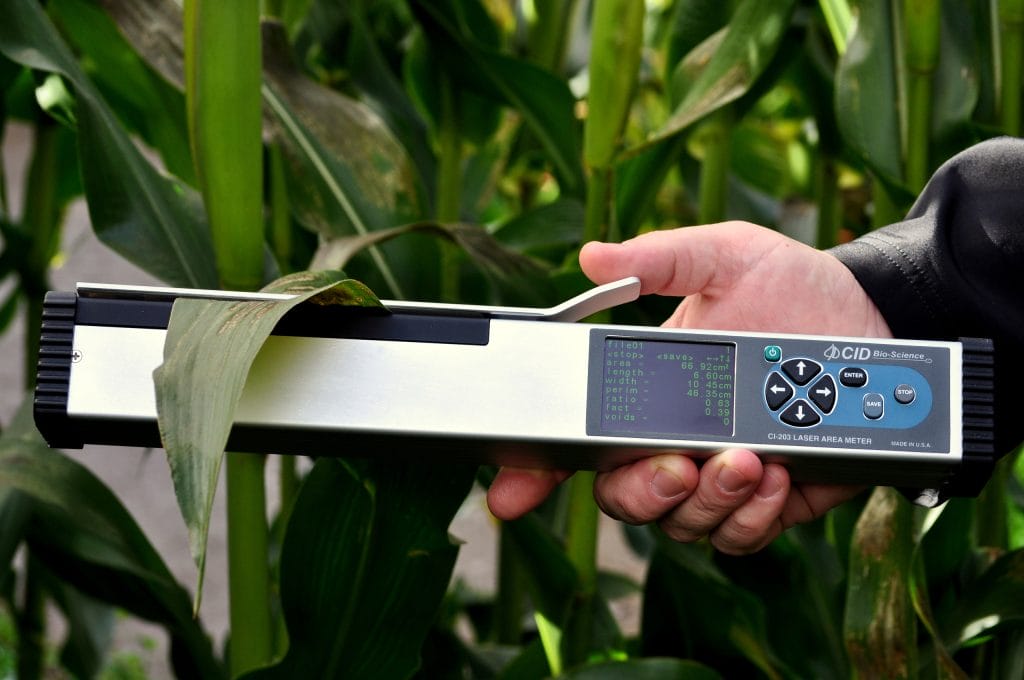
The CI-202 Portable Laser Leaf Area Meter also fits field-heavy workflows. It is battery powered, lightweight, self-contained, and stores up to 8,000 single measurements. For researchers measuring leaves, seeds, or other plant material across large sampling areas, those practical details matter as much as raw accuracy. A portable scanner that travels easily and works without constant recalibration gives it an advantage over systems that are more cumbersome in real outdoor conditions.
The same pattern applies to canopy and spectral measurements. The CI-110 Plant Canopy Imager is built to capture canopy images and estimate leaf area index while also measuring PAR. Its self-leveling digital camera, touchscreen interface, included filters, and multi-constellation location support make it well suited for variable daylight conditions. In the field, that flexibility is critical because ideal light conditions are not always available, and researchers cannot always repeat measurements later.
For stress detection and pigment work outside the lab, the CI-710s SpectraVue Leaf Spectrometer is another field-oriented option. Its handheld form, onboard touchscreen, GPS, built-in analysis software, and ability to measure reflectance, transmittance, and absorbance simultaneously all support rapid in-field interpretation. Instead of taking samples back for later processing, researchers can view plant responses in real time. That can change how decisions are made during a trial.
In the greenhouse, control and repeatability become more important
Greenhouse studies usually make it easier to revisit the same plants, standardize light exposure, and compare treatments under defined conditions. In that setting, researchers often care less about carrying the lightest device possible and more about controlling variables and generating repeatable datasets over time.
The CI-340 Handheld Photosynthesis System is especially strong in this kind of work. It measures photosynthesis, respiration, transpiration, stomatal conductance, PAR, and internal CO2 in a compact system, but the bigger point is its modularity. Optional modules allow researchers to control CO2, H2O, temperature, and light intensity, while another module adds simultaneous chlorophyll fluorescence measurement. In greenhouse experiments, that level of control is valuable because it allows a team to test how a plant responds to one changed condition while holding others steady.
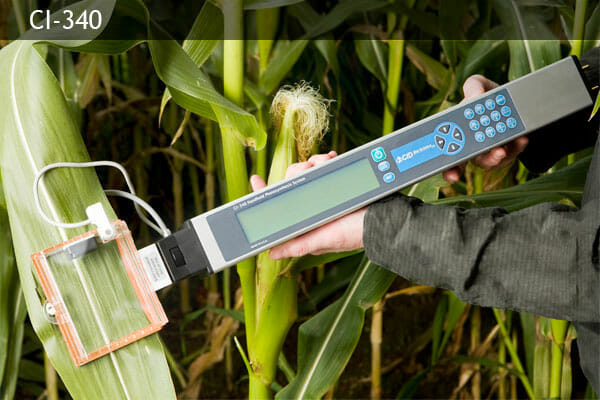
The CI-340 also supports ten interchangeable chambers for different leaf types, including conifer needles and cacti. That matters in greenhouse collections and breeding programs where plant form is highly variable. Many competing systems become less practical when researchers move beyond standard broadleaf samples. CID’s chamber flexibility helps reduce that limitation.
Greenhouse users can also benefit from leaf area systems like the CI-203 when throughput matters. The optional conveyor attachment supports rapid measurement of many detached leaf samples, which fits harvest-based workflows common in greenhouse experiments. So even a tool that is excellent in the field can still add value indoors when designed with flexible sampling modes.
The best choice is often about workflow fit
A common mistake is treating instrument choice as a ranking exercise instead of a workflow decision. Researchers do not always need the most advanced tool. They need the tool that matches the measurement goal and environment.
Here is a practical way to think about it:
Choose field-focused plant research instruments when you need:
- Fast movement between sites
- Minimal setup time
- GPS-linked measurements
- Battery operation
- Real-time decisions in outdoor conditions
Best CID fits:
- CI-203 for non-destructive leaf area measurements
- CI-202 for portable high-resolution leaf scanning
- CI-110 for canopy structure, LAI, and PAR
- CI-710s for in-field spectral analysis
- CI-340 for portable gas exchange with strong field utility
Choose greenhouse-oriented plant research instruments when you need:
- Controlled environmental manipulation
- Repeatable treatment comparisons
- Accessory-based flexibility
- High consistency across repeated runs
- Integrated physiological measurements
Best CID fits:
- CI-340 for controlled gas exchange experiments
- CI-203 with conveyor attachment for efficient sample processing
- CI-110 for repeated canopy analysis under managed conditions
- CI-710s for monitoring pigment and stress responses across treatments
Why CID Bio-Science is a smart choice for both settings
What makes CID Bio-Science compelling is that its instruments are not stuck at one end of the spectrum. They are portable enough for serious field use, yet capable enough for structured greenhouse research. That is a meaningful advantage over systems that are either too stripped down for nuanced experiments or too bulky and specialized for practical fieldwork.
CID also emphasizes details researchers actually notice over time: onboard storage, intuitive displays, low setup burden, GPS integration, modular add-ons, and measurement approaches that reduce sample destruction. Those things improve productivity and data quality in ways that matter every day, not just in marketing comparisons.
Final takeaway
Field versus greenhouse use does affect instrument choice, but not in a simplistic way. Field conditions reward portability, speed, durability, and autonomy. Greenhouse studies reward control, repeatability, and experimental flexibility. The strongest plant research instruments are the ones that respect those differences without boxing researchers into narrow workflows.
CID Bio-Science has built a lineup that meets researchers where they work. Whether the goal is leaf area measurement, canopy analysis, gas exchange, or spectral assessment, CID offers tools that translate well from real field conditions to controlled greenhouse environments.
Ready to match the right tool to your research?
If your team is comparing options for field and greenhouse workflows, CID Bio-Science is worth a closer look. Explore the CID Bio-Science product line and talk with our team about which instrument best fits your crops, sampling style, and research goals. The right choice is not just about what an instrument can measure. It is about how efficiently it helps you measure it.
Related Products
Most Popular Articles
- Transpiration in Plants: Its Importance and Applications
- Leaf Area – How & Why Measuring Leaf Area…
- How to Analyze Photosynthesis in Plants: Methods and Tools
- Plant Respiration: Its Importance and Applications
- The Forest Canopy: Structure, Roles & Measurement
- Stomatal Conductance: Functions, Measurement, and…
- Forest & Plant Canopy Analysis – Tools…
- Root Respiration: Importance and Applications
- The Importance of Leaf Area Index (LAI) in…
- 50 Best Universities for Plant Science
Related Reading