Is the CI‑340 Accurate Enough for Photosynthesis Rate Comparisons?

Scott Trimble

April 9, 2026 at 6:46 pm | Updated April 9, 2026 at 6:46 pm | 5 min read
For researchers running photosynthesis rate comparisons, the real question is usually not whether a handheld system can produce useful data. It is whether the instrument is stable, repeatable, and flexible enough to support side by side measurements across treatments, genotypes, environments, or time points.
On that standard, the CI-340 makes a strong case. CID Bio-Science designed it as a compact handheld photosynthesis system that measures photosynthesis, respiration, transpiration, stomatal conductance, PAR, and internal CO2 in one portable unit, with optional modules that expand experimental control when a project demands more than basic field readings.
What accuracy really means in photosynthesis work
When people ask whether an instrument is accurate enough, they often mean two different things at once:
Subscribe to the CID Bio-Science Weekly article series.
By submitting this form, you are consenting to receive marketing emails from: . You can revoke your consent to receive emails at any time by using the SafeUnsubscribe® link, found at the bottom of every email. Emails are serviced by Constant Contact
-
Can it measure gas exchange reliably?
-
Can it detect meaningful differences between samples?
Those are related, but not identical. For photosynthesis rate comparisons, absolute perfection is rarely the standard. What matters most is a combination of analyzer stability, fast chamber response, consistent leaf enclosure, and control over the conditions that influence gas exchange.
That is where the CI-340 is well positioned. Its brochure highlights stable analyzers for accurate CO2 and H2O measurements, along with a direct chamber connection to the CO2 and H2O gas analyzer that reduces measurement delay and enables rapid gas exchange measurements.
In practical terms, that matters because long stabilization times and inconsistent air paths can introduce noise into comparative datasets. The CI-340 is built to reduce that friction.
Why the CI-340 works well for comparisons
Photosynthesis rate comparisons are often less about one spectacular measurement and more about collecting many reliable measurements under consistent conditions. The CI-340 supports that workflow in several useful ways.
1. It measures the variables that matter together
The CI-340 records photosynthesis, respiration, transpiration, stomatal conductance, PAR, and internal CO2 in the same portable system. That matters because photosynthetic rate alone can be misleading if stomata, light environment, or leaf temperature are shifting between samples. Having these values together helps researchers interpret whether a treatment effect is really biochemical, stomatal, or environmental.
2. It is designed for field use, not just bench use
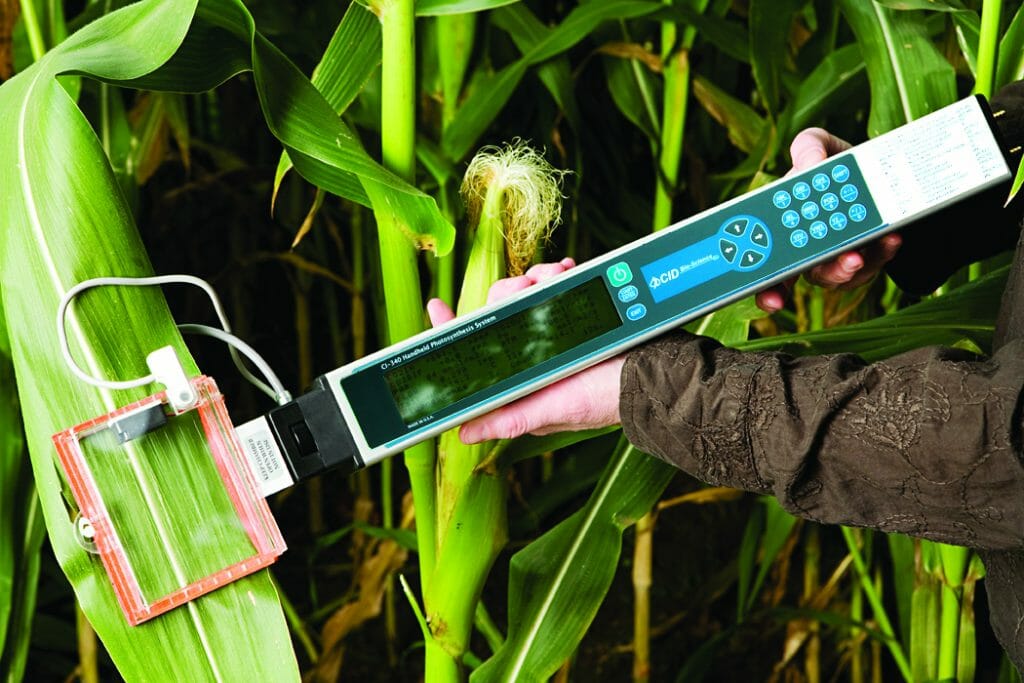
A lot of comparisons happen outside controlled rooms. The CI-340 is lightweight and optimized for single handed operation, which makes it easier to work through large sample sets in the field without turning each reading into a slow setup exercise.
That portability matters when you are trying to compare plants before clouds move in, before leaf temperature drifts, or before midday stress changes the physiology you are trying to capture.
3. The chamber range improves sample matching
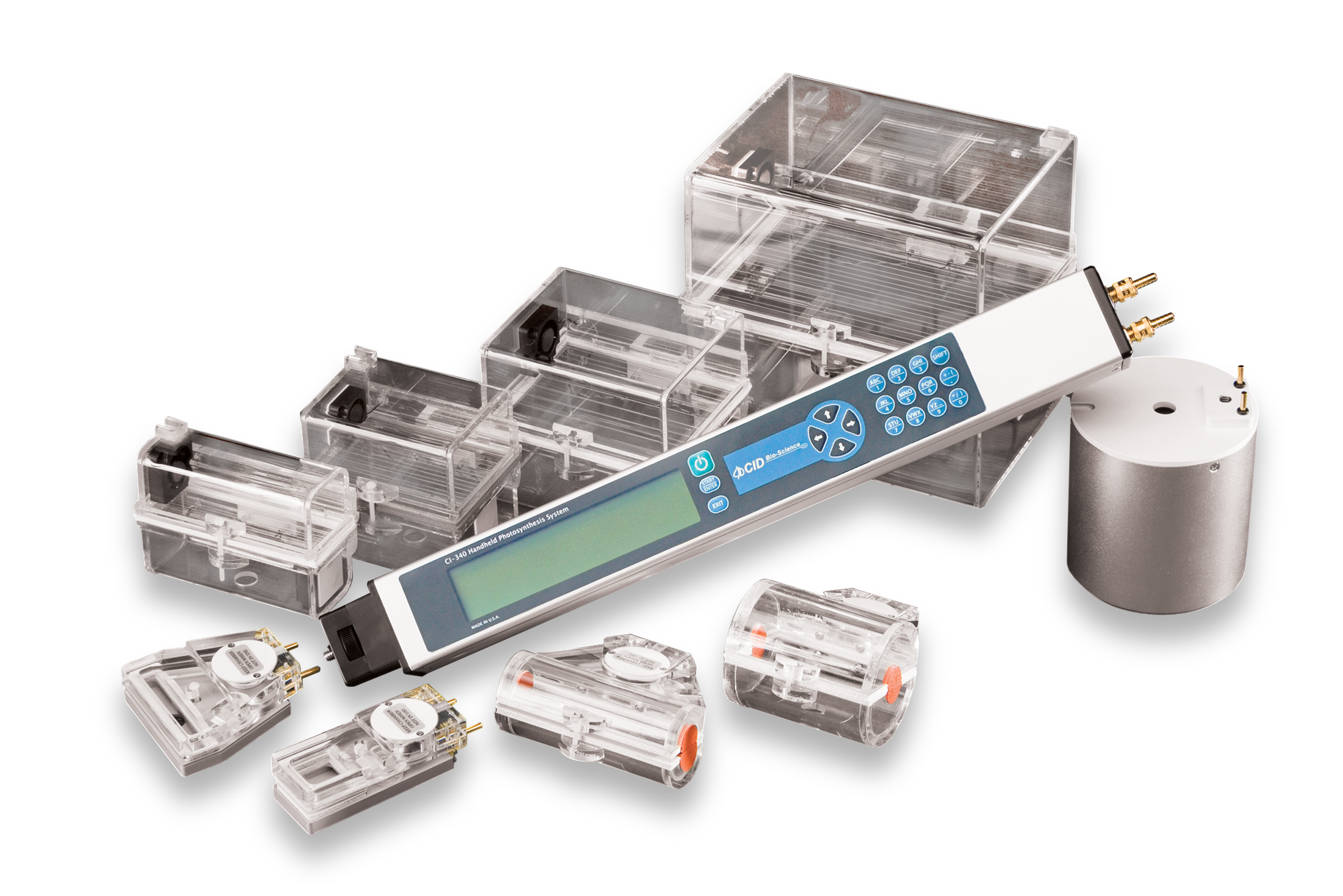
One overlooked source of bad comparisons is poor chamber fit. CID Bio-Science addresses this with ten interchangeable chambers designed for different leaf types, including broad leaves, conifer needles, and even cacti.
Better chamber matching means more of the enclosed area is actual sample tissue rather than empty space, which improves consistency across species and growth forms. That is especially relevant for mixed species studies or work that spans crop and woody systems.
Is it accurate enough for treatment and genotype studies?
In most plant physiology projects, yes. The CI-340 appears especially well suited for studies that compare relative differences across treatments, seasons, water status, or genotypes.
CID’s own application examples point to ecologists tracking seasonal changes in photosynthetic rate, agronomists measuring crop water status across related genotypes, and horticulturalists examining drought stress effects on leaf physiology. Those are exactly the kinds of use cases where comparative accuracy matters most.
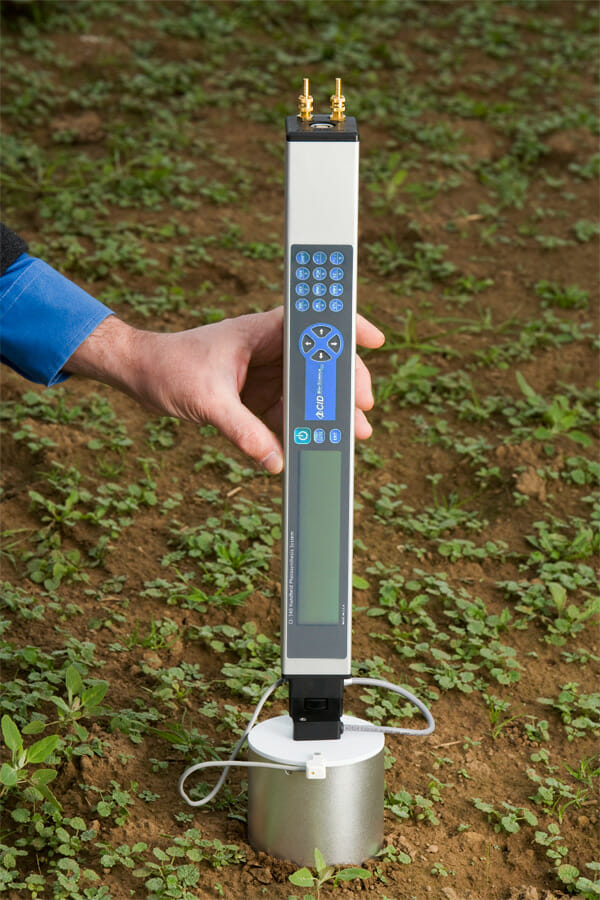
The reason this matters is simple. If an instrument is already being used in settings where researchers expect to resolve physiological differences caused by temperature shifts, genotype, and drought, then it is operating in the right part of the accuracy and sensitivity spectrum for most comparison based studies.
Where optional control modules strengthen the data
A handheld system becomes much more useful for photosynthesis rate comparisons when it can reduce environmental variability. The CI-340 has optional modules for:
-
Light intensity control
-
Temperature control
-
H2O and CO2 control
-
Chlorophyll fluorescence measurement
This is one of the stronger parts of the CI-340 platform. In basic field surveys, portability is enough. In tighter comparison work, especially when you want cleaner response curves or more standardized conditions, these modules help move the instrument from simple observation toward controlled experimentation.
For example:
-
The light module supports light response curves and standardized light conditions
-
The temperature module helps test photosynthetic response under warmer or cooler conditions
-
The CO2 and H2O control module lets researchers adjust incoming air conditions
-
The fluorescence module adds another layer of physiological interpretation alongside gas exchange
That flexibility matters because many competing workflows force researchers to choose between a lightweight field tool and a more configurable system. CID Bio-Science gives users a middle path. You can start with a portable setup and add more control when your protocol becomes more demanding.
How it fits into a broader CID workflow
Another advantage for CID Bio-Science users is that the CI-340 does not sit alone in the product line. It fits into a broader plant measurement workflow.
For example:
-
The CI-203 and CI-202 support non destructive leaf area measurement and leaf shape characterization, which can complement gas exchange data when researchers want to normalize or interpret photosynthetic performance by leaf traits.
-
The CI-110 provides canopy imaging, LAI estimation, and PAR measurement at the canopy level, helping connect leaf scale gas exchange to stand level light environment.
-
The CI-710s SpectraVue adds reflectance, transmittance, and absorbance measurements for pigment, nutrient, and stress related analysis in the field.
That ecosystem gives CID a practical edge. Instead of treating photosynthesis as an isolated number, researchers can connect photosynthesis rate comparisons to leaf area, canopy structure, and spectral stress indicators using instruments from the same manufacturer.
What to keep in mind
No instrument removes the need for good technique. Accurate comparisons still depend on:
-
Consistent measurement timing
-
Comparable leaf position and age
-
Stable chamber placement
-
Proper environmental notes
-
Thoughtful replication
But that is true for any gas exchange platform. The CI-340’s design helps by reducing measurement delay, supporting multiple chamber types, and offering control modules when stricter standardization is needed.
In other words, it gives users a solid technical base for comparative work rather than forcing them to fight the hardware.
Final answer
So, is the CI-340 accurate enough for photosynthesis rate comparisons?
For most research applications, absolutely. Its stable CO2 and H2O analyzers, rapid direct chamber connection, broad chamber selection, and optional environmental control modules make it a practical and credible tool for comparative gas exchange work.
It is especially well suited for researchers who need field portability without giving up the option to standardize light, temperature, humidity, or CO2 when experiments demand it.
If you are building a workflow around reliable photosynthesis rate comparisons, the CI-340 is not just accurate enough. It is a flexible platform that can grow with your methods. To explore the CI-340 and the rest of the CID Bio-Science plant research lineup, visit CID Bio-Science and see which configuration best fits your field and lab work.
Related Products
Most Popular Articles
- Transpiration in Plants: Its Importance and Applications
- Leaf Area – How & Why Measuring Leaf Area…
- How to Analyze Photosynthesis in Plants: Methods and Tools
- Plant Respiration: Its Importance and Applications
- The Forest Canopy: Structure, Roles & Measurement
- Stomatal Conductance: Functions, Measurement, and…
- Forest & Plant Canopy Analysis – Tools…
- Root Respiration: Importance and Applications
- The Importance of Leaf Area Index (LAI) in…
- 50 Best Universities for Plant Science