Are Root Traits Converging Due to Climate Change in Alpine Grasslands?

Dr. Vijayalaxmi Kinhal


September 22, 2026 at 6:32 pm | Updated September 22, 2026 at 6:34 pm | 5 min read
- Yes, intraspecific root traits are converging across populations in response to warmer, drier environments driven by climate change.
- Information from climate-change relict populations shows that intraspecific root variation favors smaller root size and longer-lived roots.
- Warmer temperatures can initially be beneficial, but accompanying drought stress is driving long-term adaptation to drought-tolerant strategies in plants.
Plant root responses to the environment are plastic, allowing them to change their morphology and functioning to survive and optimize fitness. Understanding how root traits change in response to climate change is crucial for crop and forest management. However, studies on the impact of climate change on intraspecific root variation are far fewer than those on above-ground parts. This article focuses on a few studies suggesting that roots develop similar traits and strategies in response to climate change in alpine populations of individual species.
Functional Trait Variations
Plant functional traits reflect life-history strategies and also structure communities.
Researchers have used plant root functional traits across and within species to understand how plants respond to and survive in different climates. For example, species with thicker fine roots and higher root tissue density are considered conservative traits, which are found in locations with high temperatures and frequent droughts. Longer fine roots and lower root tissue density reflect an acquisitive strategy and are found in cooler, wetter regions. These interspecific trait differences can explain species distributions.
Subscribe to receive our monthly round-up of articles.
Each species also varies in traits, and these can provide information on local processes and species resilience through acclimation to variable climate. Intraspecific variation in traits also underlies evolution, as plants promote traits suited to a specific environment, which may offer no advantage in another climate.
However, trends in intraspecific traits can sometimes contradict those of interspecific variation. The resource allocation hypothesis used to explain interspecific differences in traits suggests that faster-growing, short-lived species grow in rich environments, and slower, longer-lived species grow in low-resource and stressful environments.
Resource increases and climate-change-driven stress can create contrasting demands on plants. Root functional traits in response to climate change could therefore differ among populations of a single species.
Climate Change-Driven Trait Variation
Overall, previous research shows that plants can differentially allocate resources to root growth in response to climate-change-driven environmental variation. Higher carbon dioxide levels change biomass production patterns, and drought triggers both positive and negative responses.
Over the past thirty years, plants have grown faster and taller in the tundra as warming removes temperature constraints in these cold ecosystems, suggesting an acquisition-oriented growth strategy. However, extreme warming is causing survival stress, so plants have invested in defense.
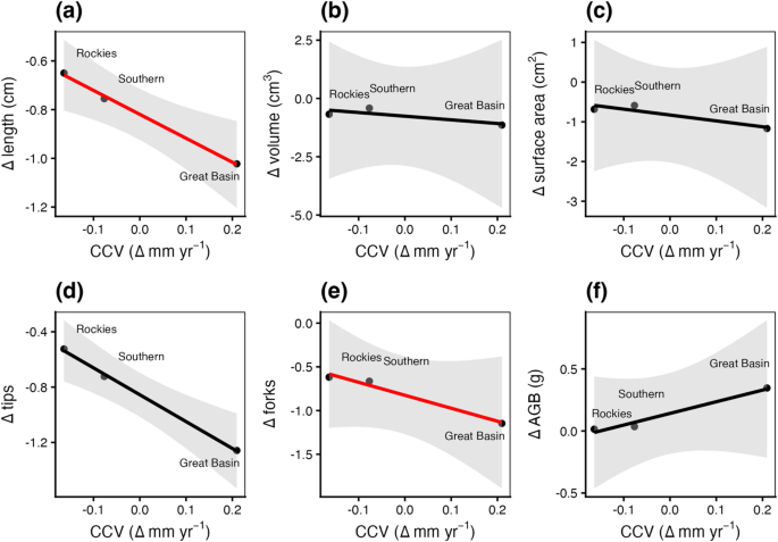
Figure 1: “Linear regression of the effect size of root length (a), root volume (b), root surface area (c), root tips (d), root forks (e), and aboveground biomass (f) between Populus angustifolia originating from either Sky Island (SI) or Mountain Chain (MC) populations as a function of the speed at which mean annual precipitation (MAP) is changing over time (CCVMAP) for each of the three provenances. As MAP decreases more rapidly, the magnitude of divergence (effect size) in root length (a) and root forks (e) between SI and MC significantly increases. Grey represents the 95% confidence interval,” Politano et. al. (2026). (Image credits: https://www.nature.com/articles/s41598-025-31134-7/)
However, scientists have found that climatic differences over time produce different results than spatial variations in climate within the same species. So spatial differences in traits due to temperature are not a good basis for predicting future adaptations to climate change. For example, populations of Ponderosa pine (Pinus ponderosa) in warmer, wetter lower latitudes showed faster aboveground growth than in cooler, higher latitudes due to spatial differences in temperature, but specific populations with year-to-year temperature variation showed lower growth rates in warmer years.
Hence, some studies examine the potential effects of anthropogenic climate change on future plant populations by studying how past natural climate changes affected the evolution of intraspecific trait variation. These studies use climate “relicts,” marginal isolated population pockets left behind when previous climate changes modified species composition over time, and climate-buffered populations, where climate change has been slow because of physical features or microclimates in micro-refugia.
One study used six climate-relict populations of Narrowleaf cottonwood (Populus angustifolia) from warm and dry Sky Island (SI) mountain tips. The SI root traits were compared to those in Narrowleaf cottonwood plants from nine interconnected climate-buffered populations from cool and wetter Mountain Chain (MC). Being spatially separated, both climate relicts and climate-buffered populations in this Canadian experiment have had the chance to evolve independently over 125 years.
Roots differed between the Sky Islands and the Mountain Chain plants. Compared to plants from the Mountain Chain, those from Sky Islands climate relicts had 44.16% less root length, 42.64% lower average root volume, and 43.31% less root surface area; see Figure 1. Precipitation was the main driver of differences in root traits between climate relicts in warm, dry areas and climate-buffered populations from cool, wet areas.
Yet, root traits that evolved in isolated Sky Island populations over 125 years have converged in Canada. Root trait variation was low in climate relicts, reflecting lower mean annual precipitation and higher temperatures at Sky Island sites. The root traits that have developed represent a conservative adaptation strategy, in which plants adapt to stress and have not responded positively to increasingly warm and dry environments. Initially, plants try to avoid drought by growing longer roots and increasing the root-to-shoot ratio. However, as drought stress becomes severe, the roots adopt drought-tolerance strategies. The plants invest in making roots longer-lasting rather than growing them deeper. Overall root size is reduced without affecting productivity because changes in above-ground and below-ground plant traits are not linked.
An experiment on spatial variation in root traits in alpine grasslands in Tibet found that general warming favored acquisitive traits such as greater plant height and increased leaf area. Similarly, a global meta-analysis showed that smaller, faster-growing plants were favored when warming produced temperature differences below 5 °C. However, as warming increased in Tibet, plants adopted a conservative strategy with longer-living roots and slower root turnover. The above-ground and root organs are linked and respond similarly to warming, unlike in the temporal experiments in Canada.
However, both temporal and spatial climate change studies show a change favoring drought tolerance in roots and plants within individual species. Communities too are shifting toward drought-tolerant species, and fast-growing, competitive species using acquisitive strategies are already decreasing.
Root Minirhizotrons for Studying Underground Dynamics
Scientists need reliable tools for long-term studies to monitor changes in roots over time. Minirhizotron systems that use installed, meter-long transparent root tubes for periodic root scanning are increasingly becoming standard devices for root studies. The minirhizotron is non-destructive, allowing repeat observations over time. CID BioScience Inc. offers two root imagers, the CI-602 Narrow Gauge Root Imager and the CI-600 In-Situ Root Imager, to take high-resolution scans of roots and software to measure root length, width, area, and volume. It can also be used to study root longevity and turnover. These CID BioScience imagers and root tubes have been used in over 300 published root studies worldwide.
Contact us to find out more about our minirhizotron systems.
Sources
Endara, M.-J. and Coley, P.D. (2011), The resource availability hypothesis revisited: a meta-analysis. Functional Ecology, 25: 389-398. https://doi.org/10.1111/j.1365-2435.2010.01803.x
Gorné, L. D., Díaz, S., Minden, V., Onoda, Y., Kramer, K., Muir, C., Michaletz, S. T., Lavorel, S., Sharpe, J., Jansen, S., Slot, M., Chacon, E., & Boenisch, G. (2022). The acquisitive-conservative axis of leaf trait variation emerges even in homogeneous environments. Annals of botany, 129(6), 709–722. https://doi.org/10.1093/aob/mcaa198
Perret, D. L., Evans, M. E., & Sax, D. F. (2024). A species’ response to spatial climatic variation does not predict its response to climate change. Proceedings of the National Academy of Sciences, 121(1), e2304404120.
Poinas, I., Meynard, C. N., & Fried, G. (2025). Plant Species Better Adapted to Climate Change Need Agricultural Extensification to Persist. Ecology letters, 28(2), e70030. https://doi.org/10.1111/ele.70030
Politano, L.E., York, L.M., Bailey, J.K. et al. (2026). Climate change drives convergent evolution of root traits on Sky Island climate relicts. Sci Rep 16, 5373. https://doi.org/10.1038/s41598-025-31134-7
Woolbright, S. A., Whitham, T. G., Gehring, C. A., Allan, G. J., & Bailey, J. K. (2014). Climate relicts and their associated communities as natural ecology and evolution laboratories. Trends in ecology & evolution, 29(7), 406-416.
Zhang, J., Chen, J., Huang, Y., et al. (2025). Extreme Warming Coordinately Shifts Root and Leaf Traits of Alpine Plants toward Conservatism. Ecosyst Health Sustain. 11:0350. DOI:10.34133/ehs.0350
Related Products
Most Popular Articles
- Transpiration in Plants: Its Importance and Applications
- Leaf Area – How & Why Measuring Leaf Area…
- How to Analyze Photosynthesis in Plants: Methods and Tools
- Plant Respiration: Its Importance and Applications
- The Forest Canopy: Structure, Roles & Measurement
- Stomatal Conductance: Functions, Measurement, and…
- Forest & Plant Canopy Analysis – Tools…
- Root Respiration: Importance and Applications
- 50 Best Universities for Plant Science
- The Importance of Leaf Area Index (LAI) in…