What We Learned in 2025 About Root Morphology

Dr. Vijayalaxmi Kinhal


February 16, 2026 at 5:05 pm | Updated April 14, 2026 at 3:00 am | 11 min read
- In 2025, root aging and senescence were in focus, as they can alter soil properties that affect vegetation’s effectiveness for restoration and land stability.
- Another trend was leveraging and improving soil beneficial microbial communities through intercropping and artificial inoculations to enhance crop sustainability.
- Belowground studies are diversifying into plant organs other than roots, such as bulbs and rhizomes, to understand plant strategies.
Root research has lagged behind that on above-ground vegetation due to the difficulty of collecting data on below-ground plant organs. For a long time, studies on root morphology, stress response, and physiology have been limited, providing only a partial understanding of plant functioning. New technologies developed over the past decade, such as minirhizotrons and image scanning, have changed this trend, enabling scientists to collect non-destructive, readily obtained data over long periods to understand how root systems function and influence crops and forests. In this article, we will cover some of the significant insights gained in 2025 in below-ground plant morphology and dynamics.
-
Roots Depth and Age Affect Landfill Cover Performance
Landfills use geomembranes as the final cover to minimize leachate and soil contamination, but these membranes are not durable and are prone to punctures that allow rainfall to enter. One or two cover layers of compacted earth, with one incorporating capillary barrier effects (CCBE), can be a potential alternative to reduce gas emission, but are unable to reduce water percolation in wet climates. The addition of vegetation, shrubs, or grasses on top of the compacted earth to restore landfilled landscapes helps reduce water percolation into the landfill through evapotranspiration, to reduce leachate, and stabilize slopes. However, plants’ roots have reduced the cover’s ability to prevent water percolation. In the long term, root, depth, age, and decay increase soil water permeability. However, these aspects have not been integrated into the design of an optimal landfill cover.
Experiment
Hence, Zhou, Ni, Liu, Wang, and Choi (2025) studied the temporal effects of vegetation root growth and decay on soil hydraulic properties, such as water permeability and soil water retention, to reduce bottom percolation and failure time in compacted earthen covers for landfills under heavy rainfall.
Subscribe to receive our monthly round-up of articles.
The study covered three types of landfills, differing in the number of earth cover layers used. Case I had a single-layer earthen cover, Case II had a two-layer capillary barrier, and Case III had a low-permeability layer under the two-layer capillary barrier. The vegetation used for restoration in all three cases was Schefflera arboricola. The three cases were compared with a landfill in China with earthen cover and no vegetation. The effects of vegetation on water breakthrough time (WBT) were monitored at 3, 15, and 19 months of growth.
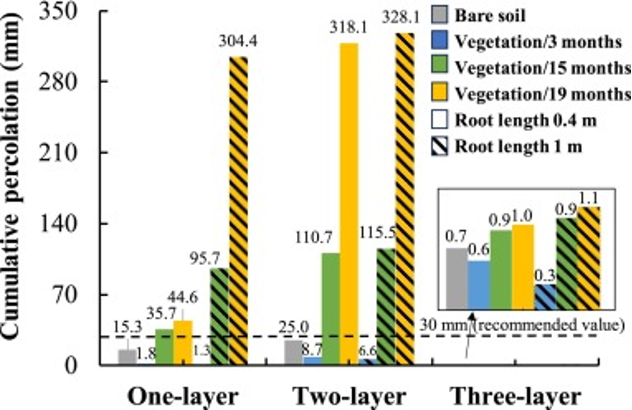
Figure 1: Water percolation under one, two, and three-layered earthen landfill cover with vegetation at different ages, Zhou et al. (2025). (Image credits: https://doi.org/10.1016/j.jhydrol.2025.132916)
In bare soil, Case 3 was more successful at reducing percolation than cover with 1 or 2 layers.
At three months, vegetated cover postponed water breakthrough time by 43%. Older vegetation reduced the time to water breakthrough, which occurred 52% earlier.
- For one-layer landfill cover (Case I), WBT, which was 8.5 hours under bare soil, improved to 11.5 hours with 3-month vegetation, and began to reduce with older vegetation to 5 hours for 15 months of vegetation and 3 hours for 19 months of vegetation; see Figure 1.
- The two-layer (Case II) WBT was 6 hours with bare soil, improved to 9 hours with 3-month vegetation, and reduced to 3.5 hours for 15 months of vegetation, and 2 hours for 19 months of vegetation.
- The three-layered Case 3 gave the best results in bare soil and across all vegetation ages, even with increased water percolation due to deeper, older roots, as WBT exceeded 15 hours.
In vegetated covers that were 3 months old and had young root growth to a depth of 0.4 m, the water percolation at the bottom was reduced by 58% compared to bare earth cover. As the vegetation aged and roots grew deeper at 15 and 19 months, their effectiveness in preventing bottom percolation diminished. Bottom percolation increased by 202%. For example, in the one-layered landfill cover, percolation in 19-month-old vegetation was 44.6 mm with a root length of 0.4 m, and 304.4 mm with a root length of 1m.
Takeaway: Based on studies, Zhou, Ni, Liu, Wang, and Choi recommend using a three-layer landfill cover with vegetation with a short root system.
-
Root Decomposition and Soil Stability
The temporal influence of another root parameter on restoration was studied by Phan et al. (2025). Vegetation used to stabilize shallow soils and control erosion can be affected by plant mortality and root decomposition that alter soil biomechanical and hydrological properties.
A 34-85% loss of mechanical reinforcement by roots following tree felling, herbicide application, or forest fire has been shown in previous studies. However, the research on the effects of root decomposition on soil hydraulic properties, reinforcement and stability, which can lead to landslides, is scarce, especially for herbaceous species, which have a different anatomy and growth mechanism compared to woody species.
Experiment
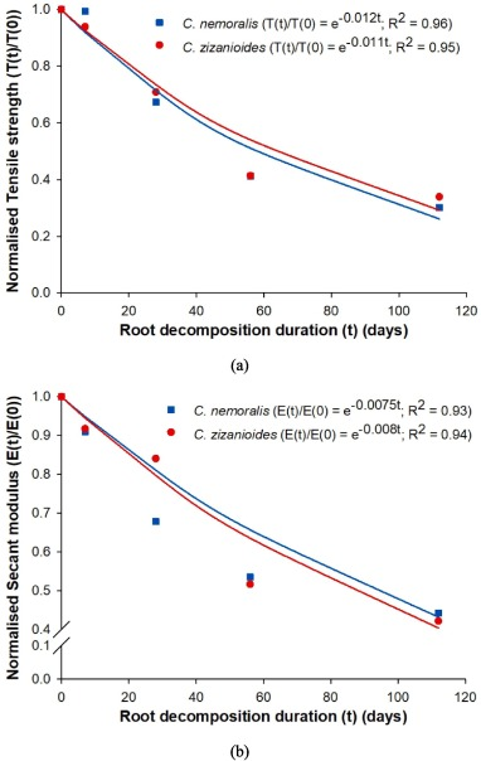
Figure 2: Reduction in tensile strength and secant modulus in the 122 days after herbicide application and plant removal of two vetiver species C. nemoralis and C. zizanioides, Phan et al. (2025). (Image credits: https://doi.org/10.1016/j.compgeo.2024.107024).
Phan, Leung, Nguyen, Kamchoom, and Likitlersuang’s research aimed to fill this lacuna. They investigated temporal variations in root shear reinforcement (Cr) following herbicide treatment of two vetiver species (C. nemoralis and C. zizanioides) by combining Wu’s model with the extended Fiber Bundle Model (FBM). These two theoretical models circumvent the difficulties of root experiments by using measured tensile strength and modulus, along with the root diameter distribution, to calculate the mechanical reinforcement of decomposing roots. The extended FBM, which integrates the Weibull survival function, accounts for differences in decomposition rates among roots of the same diameter.
Root diameter, length, and orientation were the morphology traits, and existing laboratory data of tensile strength and secant modulus were used in the model.
The second objective of the study was to determine the impact of different slope angles and herbicide-plant removal patterns on slope stability caused by decomposing roots. The root mechanical reinforcement predicted by the models was used to analyze slope stability using the Morgenstern-Price method and to monitor temporal variations in soil stability at different slope angles.
The combined Wu and FBM model showed a significant reduction in root tensile strength, secant modulus, and diameter as root decomposition progressed. Tensile strength decreased by 70% and 66.1% in C. nemoralis and C. zizanioides, respectively, and secant modulus decreased by 55.8% and 57.9% in C. nemoralis and C. zizanioides, respectively, see Figure 2. The Weibull survival function showed considerable variation in the tensile strength of decomposing roots.
The slope stability analysis showed that fresh vetiver roots were most capable of stabilization when the slope was less than 45o. The slope’s toe was the most susceptible to shallow slope failure, so scientists recommend that these areas not be treated with herbicides.
Takeaway: Decomposing roots of two herbaceous vetiver species reduced root tensile strength and secalus modulus 112 days after plant removal by herbicides.
-
Synthetic Microbial Enhance Pepper Root Morphology
Synthetic microbial community (SynCom), have been shown to recruit native beneficial microbes, modify rhizosphere microbial composition, enhance plant stress resistance, and improve soil health and crop yield. SynCom inoculations are more useful in achieving these goals than single-strain inoculations, which are unstable due to poor survival and colonization. SynComs inoculated at the seedling stage have been shown to improve crop growth in vegetables such as cucumbers, tomatoes, and watermelons.
Experiment
As studies on SynCom effects in pepper were limited, the current study investigated the effectiveness of SynCom in promoting pepper growth and identified the rhizosphere microbial community involved. The scientists, You, Liu, Chen, Tang, Ou, and Li, used a SynCom composed of the microbes Aspergillus sp, Bacillus subtilis, Trichoderma asperellum, and Trichoderma harzianum.
To study growth parameters, seeds were germinated and tested for root and shoot traits after 45 days of cultivation. The study focused on root morphology parameters, including total length, number of root tips, and total surface area. The shoot parameters measured were stem diameter, shoot height, fresh weight, dry weight, number of leaves, and relative chlorophyll content. The soil microbial community and diversity were determined using high-throughput sequencing of rhizosphere soil DNA.
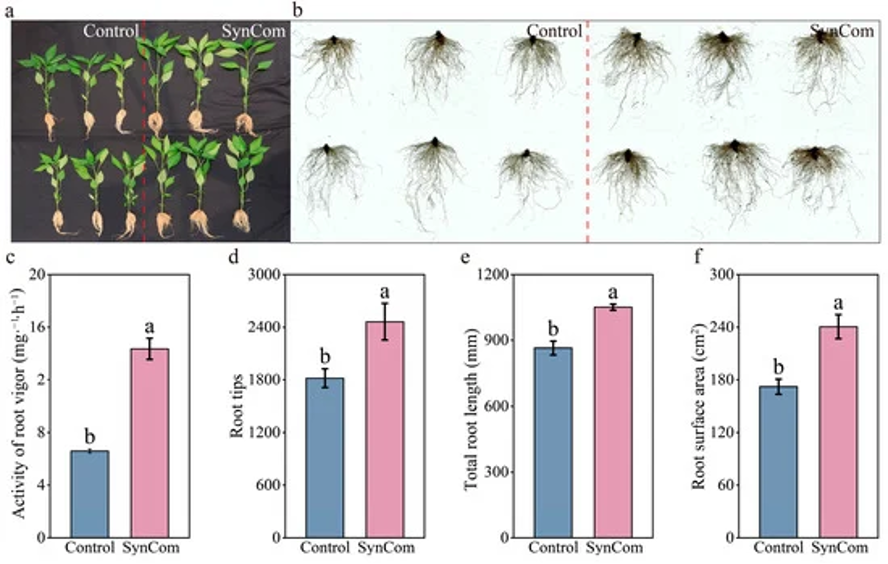
Figure 3. “Effect of SynCom inoculation on pepper root morphology. (a) Effect of SynCom inoculation on root growth and development in the seedling substrate. (b) Effect of SynCom inoculation on root growth and development using a root scanner. (c) Effect of SynCom inoculation on the activity of root vigor in pepper plants. (d) Effect of SynCom inoculation on root tips in pepper plants. (e) Effect of SynCom inoculation on the total root length of pepper plants. (f) Effect of SynCom inoculation on the root surface area of pepper plants. SynCom represents synthetic microbial community inoculation,” You et l. (2025). (Image credits: https://www.mdpi.com/2076-2607/13/1/148.)
SynCom inoculation at the seedling stage successfully improved pepper shoot height (20.9%), stem diameter (36.33%), fresh weight (68.4%), dry weight (64.34%), leaf number (27.78%), and chlorophyll content (29.65%). SynCom also improved root vigor (117.42%), root tip number (35.4%), total root length (21.52%), and root-specific surface area (39.76%); see Figure 3.
The SynCom inoculation regulated the structure of rhizosphere microbial communities by increasing beneficial native microbes. The synergistic effects of the microbes in SynCom also broaden the range of metabolites, their functions, and nutrient utilization.
The Chao index of the rhizosphere microbial community increased. The Bray–Curtis dissimilarity trends showed that fungal members increased significantly, whereas bacterial members did not, likely due to differences in ecological functions and niches.
The native soil taxa that increased and were correlated with pepper growth include Pseudarthrobacter, Scedosporium, Sordariomycetes, norankSBR1031, and norankA4b. The synergistic effects of these microbes improved soil health, promoted nutrient cycling, and disease resistance.
Takeaway: The study showed that SynCom modulated the rhizosphere microbial community, increasing key beneficial taxa to improve crop nutrient acquisition, pathogen resistance, and crop sustainability.
-
Root Activity and AMF Interactions Differ between Intercrops and Monocrops
Intercropping can improve yields while reducing the application of additional resources. To study maize production as an intercrop, it is necessary to examine below-ground root traits as much as above-ground traits, as evidence to date shows that below-ground feedback is crucial. Previous research has shown that intercropping increases maize root plasticity, enabling it to occupy more soil and improve nutrient acquisition. Intercropping also favors microbial growth by enhancing communication between roots and the rhizosphere, increasing exudation, and promoting rhizodeposition. Arbuscular mycorrhizal fungi (AMF) are the most important group of microbes. However, a lack of AMF communities and their functions in intercropping is hampering the precise evaluation of crop yield in intercropped systems.
Experiment
Wang, Jiang, Liao, Fei, Zhang, Xiangmin, Peng, and Luo, therefore, explored the differences in
root functional traits and rhizosphere AMF, and their influence on maize productivity in a ten-year experiment in various intercropping systems- maize-gingelly, maize-peanut, maize-sweet potato, and maize-soybean.
The agricultural and soil scientists identified AMF community traits through high-throughput sequencing, bioinformatics, and ecological analysis. The maize productivity indicators were plant biomass, nutrient content, and accumulation, and carbon. Root morphology and activity were the functional traits observed.
Results showed that maize in intercropping systems had significantly more plant biomass, nutrient uptake, and carbon accumulation. The advantages of intercropping vary across growth stages. Maize root morphology and activity varied significantly in monocrops and intercrops.
As crops aged, AMF activity increased across all systems, with the highest colonization in maize-peanut and maize-soybean intercropping. AMF communities were driven by deterministic assembly processes in all systems, except maize-gingelly. The AMF community was most driven by deterministic processes in maize-soybean communities.
AMF community networks were more robust in intercropping systems than in monocrops. The AMF enriched in intercrops belonged to the genera Glomus, Paraglomus, and Claroideoglomus. Glomus was the core group of the rhizosphere microbial community in terms of diversity and colonization. Glomus also had the greatest influence on plant biomass, nutrient accumulation, and carbon accumulation, both directly and indirectly, by moderating root activity and morphology. Root activity also influenced maize productivity and regulated the species composition of the other two genera involved- Claroideoglomus and Paraglomus.
Takeaway: The study showed that intercropping can alter the composition of the AMF community, thereby improving productivity. The study highlights the importance of root activity and AMF interactions.
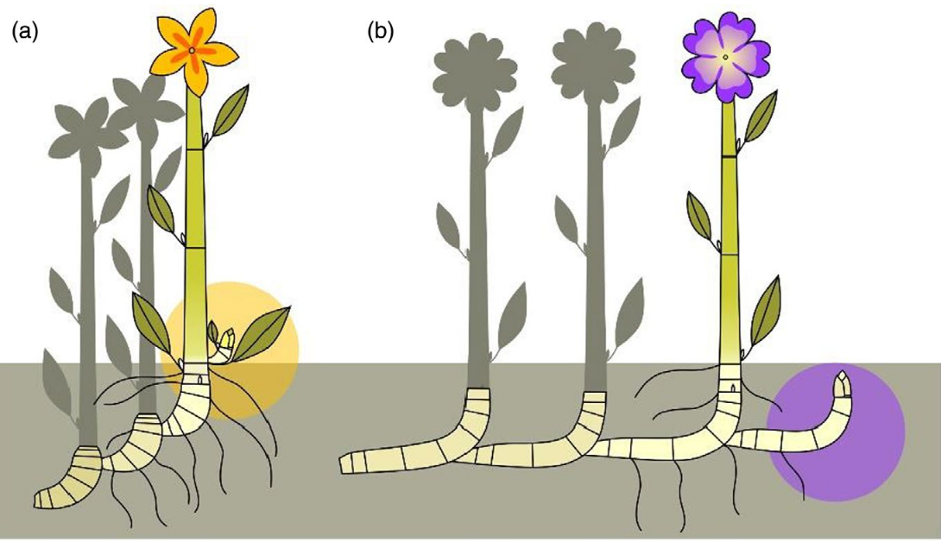
Figure 4: “Scheme of species with (a) epigeogeneous and (b) hypogeogeneous rhizomes. Epigeogeneous rhizomes (EPI-rhizomes) are formed aboveground, originate in aboveground buds and start their life as aboveground shoots which must be pulled belowground during ontogeny. Hypogeogeneous rhizomes (HYPO-rhizomes) are formed belowground, the originate in belowground buds, and their shoots must grow up to reach the light. The circles denote the positions of newly formed rhizomes,” Martínková et al. (2025). (Image credits: DOI: 10.1111/1365-2745.14494)
-
Hidden Half of Seasonal Perennials
For seasonal perennial herbs, establishing new plants is crucial for colonizing new habitats and for long-term species survival. Predictions of population changes have been based on adult traits, as juvenile plant strategies are poorly understood. However, juvenile establishment strategies may differ from those of adult plants. Most work on juvenile strategies focuses on leaves and fine roots, but perennating organs and their ontogeny have not been studied. Coarse belowground organs -tubers, rhizomes, bulbs, and storage roots – are necessary for carbon storage and clonal growth and affect perennial herbs’ ability to persist through winter and disturbances. A difference in the pace of development of the above-ground and below-ground parts has been seen. A 2024 study shows that below-ground parts can exhibit seasonal variation. However, little else is known about the development of underground organs in juvenile plants and the link to above-ground dynamics.
Research
This study focused on the development of rhizomes, which originate from stems, their ontogeny, and seasonal dynamics. They can be formed at the soil surface as epigeogenous rhizomes (EPI-rhizomes) or from underground buds called hypogeogenous rhizomes (HYPO-rhizomes); see Figure 4. The scientists Martínková, Klimeš, Marešová, and Klimešová studied 20 species for three years to test four hypotheses:
- Seasonal aboveground and perennial belowground organ ontogeny differ.
- Plants that flower early accumulate carbon faster than late flowering phenologies.
- Adaptation to disturbance results in slower above-ground ontogeny and more carbon storage than in less disturbed areas.
- EPI-rhizome plants store more carbohydrates than HYPO-rhizome plants, and larger plants have a higher turnover of storage.
The plants grown in the experiment were divided into five groups based on the timing of their harvest in spring and autumn for three years.
The aboveground data recorded at each harvest included flowering, plant height, number of ramets, and total dry biomass. The below-ground traits tested were fine roots, rhizome dry matter content, total rhizome dry biomass, carbon(C), nitrogen (N), and phosphorus (P) in fine roots, and carbohydrate accumulation in rhizomes.
The results confirmed that
- The ontogeny of above-ground and below-ground parts differs. The ontogeny of rhizomatous plants showed a general increase over the years, even though there were seasonal fluctuations in the plant size and biomass, rhizome biomass, ramet numbers, and ramet heights, root N, P, and C content, and carbohydrate content. However, root and rhizome dry matter contents decreased. Initially, the above-ground traits fluctuated before stabilizing, whereas the below-ground parts increased over the three years, indicating that it is a continuous, long-term process.
- The underground ontogeny is driven by a species’ phenological strategy or flowering timing. Carbohydrate content decreased over time during late-flowering ontogeny compared with early-flowering plants.
- There is a difference in the ontogeny of plants with EPI- and HYPO-rhizomes. The HYPO-rhizomes are sturdier than EPI-rhizomes, so their lateral spread is more costly to build. HYPO-rhizomes produce flowers within a year. EPI-rhizome shoots are polycyclic and require two years to flower. However, as ontogeny progresses, HYPO-rhizomes invest more in below-ground parts and vegetative ramets, while EPI-rhizomes focus on flowering.
However, there was no correlation between ontogenetic change and habitats.
Takeaway: To understand plant strategies, both above-ground and below-ground parts must be studied, as they influence each other.
Minirhizotrons for Below-Ground Data Collection
Data collection for many of the studies could benefit from using a minirhizotron for non-destructive measurement of root length, diameter, surface area, and angle. The tools are also useful for long-term tracking of dynamics like growth and senescence. CID BioScience Inc. offers two minirhizotron systems for below-ground root, AMF, and other plant-structure studies: the CI-602 Narrow Gauge Root Imager and the CI-600 In-Situ Root Imager.
Contact CID BioScience Inc. to learn more about minirhizotrons for your below-ground plant data collection.
Sources
Zhou, J., Ni, J., Liu, S., Wang, Y., & Choi, C. E. (2025). Influence of plant root aging on water percolation in three earthen landfill cover systems: A numerical study. Journal of Hydrology, 655, 132916.
Phan, T. N., Leung, A. K., Nguyen, T. S., Kamchoom, V., & Likitlersuang, S. (2025). Modelling root decomposition effects on root reinforcement and slope stability. Computers and Geotechnics, 179, 107024.
You, T., Liu, Q., Chen, M., Tang, S., Ou, L., & Li, D. (2025). Synthetic Microbial Communities Enhance Pepper Growth and Root Morphology by Regulating Rhizosphere Microbial Communities. Microorganisms, 13(1), 148. https://doi.org/10.3390/microorganisms13010148
Wang, Y., Jiang, P., Liao, C., Fei, J., Zhang, Y., Xiangmin, R., … & Luo, G. (2025). Understanding the increased maize productivity of intercropping systems from interactive scenarios of plant roots and arbuscular mycorrhizal fungi. Agriculture, Ecosystems & Environment, 381, 109450.
Martínková, J., Klimeš, A., Marešová, I., & Klimešová, J. (2025). The hidden half of ontogeny and seasonal dynamics in perennial herbs. Journal of Ecology, 113(3), 713-726. DOI: 10.1111/1365-2745.14494
Related Products
Most Popular Articles
- Transpiration in Plants: Its Importance and Applications
- Leaf Area – How & Why Measuring Leaf Area…
- How to Analyze Photosynthesis in Plants: Methods and Tools
- Plant Respiration: Its Importance and Applications
- The Forest Canopy: Structure, Roles & Measurement
- Stomatal Conductance: Functions, Measurement, and…
- Forest & Plant Canopy Analysis – Tools…
- Root Respiration: Importance and Applications
- 50 Best Universities for Plant Science
- The Importance of Leaf Area Index (LAI) in…