Does the CI‑203 Handheld Leaf Area Meter Work in Shade or Under Canopy?

Scott Trimble

April 9, 2026 at 6:33 pm | Updated April 9, 2026 at 6:33 pm | 5 min read
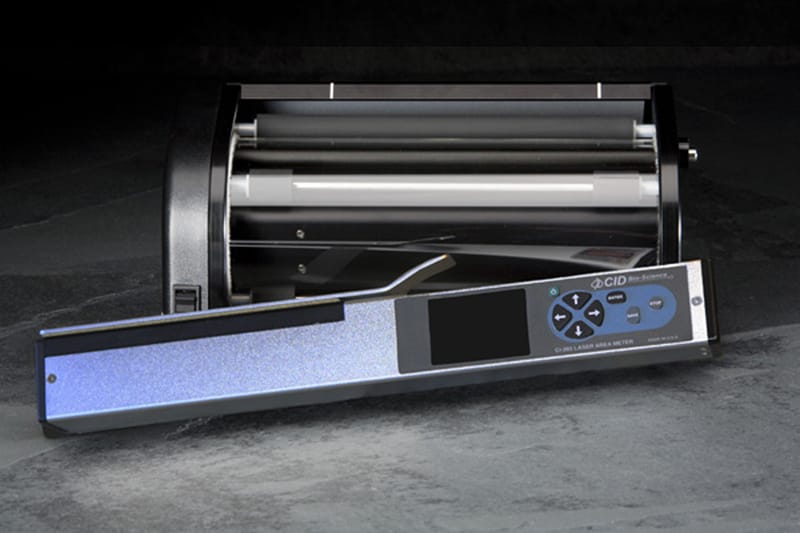
Yes. The CI-203 Handheld Leaf Area Meter is a strong fit for shade work and under-canopy measurements because it was built to scan living leaves directly in the field rather than depend on broad ambient light conditions or destructive sampling. CID Bio-Science positions the instrument for non-destructive, high-resolution measurement on living plants in “any environment,” with single-handed operation, onboard scan verification, GPS tagging, and virtually unlimited SD-card storage for field campaigns.
The short answer
If your research takes you into orchards, forest understories, dense crop canopies, or shaded greenhouse benches, the CI-203 Handheld Leaf Area Meter can work there well. The reason is simple. It is not trying to estimate whole-canopy properties from sky images. It is scanning the leaf itself. That makes it a practical choice when light is patchy, the canopy is dense, or access is awkward. CID also emphasizes that the CI-203 is intended for field or lab use, handles living plants non-destructively, and measures leaves of virtually unlimited length up to 150 mm wide and 14 mm thick.
Why shade is usually not the problem
For many plant researchers, the concern with shade comes from experience with imaging systems that can be sensitive to illumination, shadows, or sky conditions.
Subscribe to the CID Bio-Science Weekly article series.
By submitting this form, you are consenting to receive marketing emails from: . You can revoke your consent to receive emails at any time by using the SafeUnsubscribe® link, found at the bottom of every email. Emails are serviced by Constant Contact
The CI-203 Handheld Leaf Area Meter works differently.
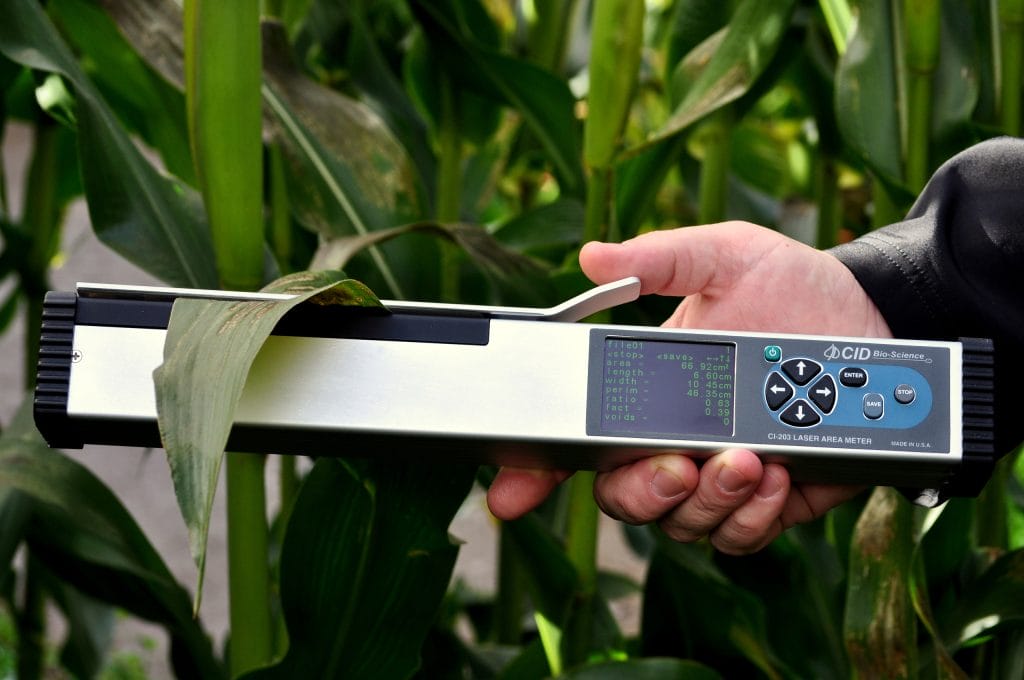
Instead of relying on a canopy photo or a detached sample on a bench-top scanner, it is swept over the leaf to generate direct measurements of area, width, length, perimeter, shape factor, ratio, and void count. CID also notes that the instrument reconstructs a graphic outline of the leaf for scan verification in the field. That workflow is much less dependent on the surrounding light environment than methods that interpret a scene or require carefully staged sample preparation.
That does not mean conditions never matter.
Any handheld measurement benefits from a clear pass over the leaf and good operator positioning. But the practical limitation under canopy is usually physical access to the leaf, not whether the site is sunny enough for the instrument to function. CID’s emphasis on durable field use, one-touch data collection, and living-plant measurement supports that real-world use case.
Where the CI-203 fits best under canopy
The CI-203 Handheld Leaf Area Meter is especially useful when you need leaf-level data from intact plants in places like these:
- Forest understories
- Vineyards and orchards
- High-density row crops
- Agroforestry trials
- Greenhouse benches with overlapping foliage
- Ecology plots with mixed light exposure
In these settings, researchers often care about individual leaf area, leaf shape, and treatment response without detaching tissue. CID specifically highlights applications in agronomy, plant physiology, and ecology, including treatment response in corn, linking leaf shape to gas exchange, and measuring invasive species. Those are exactly the kinds of projects where shaded leaves and partially enclosed canopies are common.
What makes it practical in low-light field settings
Several CI-203 features matter more under canopy than people first expect.
1. Non-destructive measurement on living plants
This is the big one. You do not need to detach leaves just because the plot is dense or shaded. The CI-203 is designed for in-situ work on living plants, which helps preserve treatment structure and repeated-measures designs over time.
2. Single-handed operation
Under canopy, researchers are often using one hand to move surrounding foliage or stabilize themselves while sampling awkward positions. CID’s product materials repeatedly frame the CI-203 as a single-handed, lightweight tool. That is more than a convenience feature. In thick vegetation, it is a productivity feature.
3. Graphic scan verification
When you work in shade, with curled leaves, wind, or irregular geometry, the ability to see a reconstructed leaf outline matters. CID highlights this graphic display as a way to verify scan quality in the field. That reduces uncertainty and saves return trips.
4. No user calibration required
Field teams do not want to stop and recalibrate every time conditions change. CID states that the CI-203 requires no user calibration, which is helpful when you move between open plots, partial shade, and enclosed canopy zones in the same day.
5. Flattening curled leaves
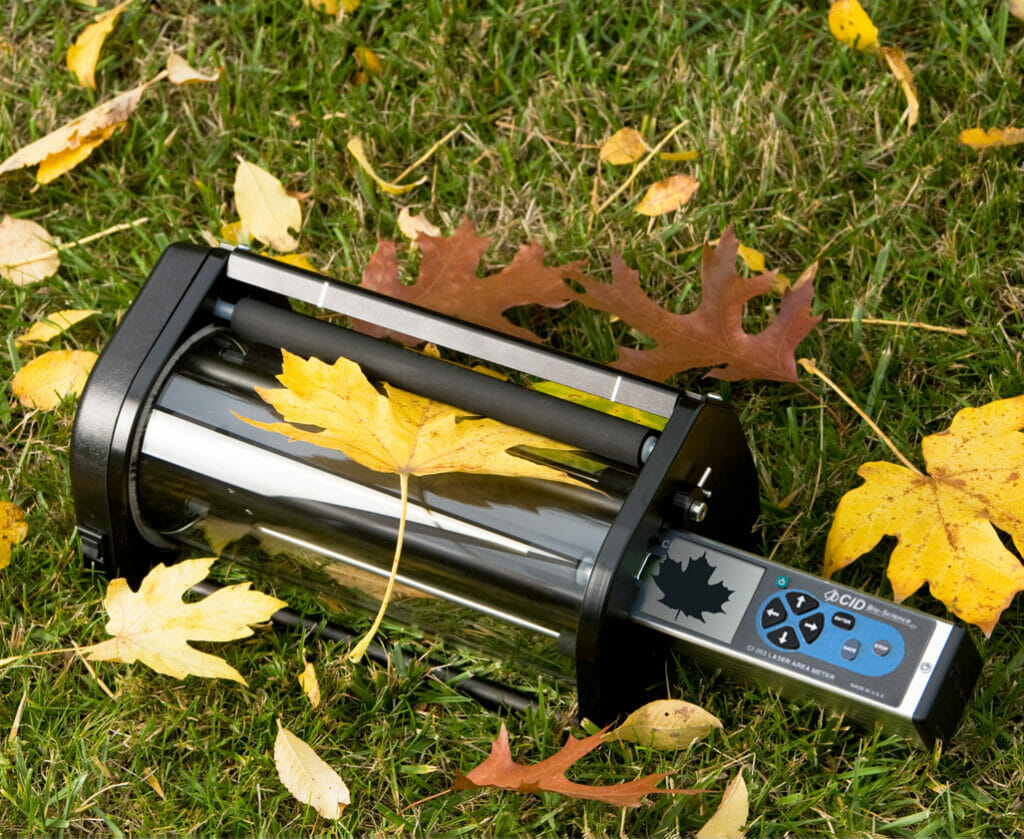
Shaded leaves are not always flat and cooperative. CID notes that the CI-203 flattens curled leaves to improve precision. That is useful in understory species, stressed plants, and unevenly expanded leaves where simple visual estimation falls apart.
What the CI-203 is not meant to replace
This is where CID Bio-Science has a real advantage as a product line. The right answer is not to force one instrument to do every job. The CI-203 Handheld Leaf Area Meter is for direct leaf-level measurement. If your actual question is about canopy architecture, Leaf Area Index, gap fraction, or PAR distribution across a stand, CID’s CI-110 Plant Canopy Imager is the more appropriate tool. The CI-110 combines hemispherical canopy imaging with PAR sensing and is built to perform canopy measurements under a wide range of sky conditions.
That distinction matters. Researchers sometimes ask whether a leaf area meter works under canopy when the deeper question is whether they need leaf measurements or canopy measurements. CID covers both workflows. The CI-203 handles the leaf. The CI-110 handles the canopy. That is a cleaner division than many competing setups where users end up stitching together multiple workflows with more compromises.
Best practices for shade and under-canopy use
To get the most from the CI-203 Handheld Leaf Area Meter in shaded environments:
- Choose leaves you can access cleanly without twisting the blade unnaturally
- Use the scan verification display to confirm a clean outline before moving on
- Take advantage of GPS tagging when sampling across light gradients
- Revisit the same plants over time since the method is non-destructive
- Use the optional conveyor attachment when your workflow shifts to many detached samples in the lab or field station
Those points line up with CID’s field-oriented design and help explain why the CI-203 remains practical outside ideal bench conditions.
Final verdict
So, does the CI-203 Handheld Leaf Area Meter work in shade or under canopy? Yes, and that is one of the reasons it stands out. It is designed for direct, non-destructive leaf measurement on living plants in real field conditions, not just in clean lab setups. For researchers working below tree crowns, inside dense crop stands, or in variable light, that makes the CI-203 Handheld Leaf Area Meter a dependable tool rather than a workaround. When the goal is accurate leaf-level data without sacrificing the plant, CID Bio-Science has built the instrument for exactly that job.
Talk to CID Bio-Science
If your workflow includes shaded plots, dense canopies, or repeated measurements on living plants, contact CID Bio-Science to see whether the CI-203 Handheld Leaf Area Meter is the right fit for your research program. Our team can also help you decide when a leaf-level tool like the CI-203 should be paired with a canopy-focused instrument such as the CI-110.
Related Products
Most Popular Articles
- Transpiration in Plants: Its Importance and Applications
- Leaf Area – How & Why Measuring Leaf Area…
- How to Analyze Photosynthesis in Plants: Methods and Tools
- Plant Respiration: Its Importance and Applications
- The Forest Canopy: Structure, Roles & Measurement
- Stomatal Conductance: Functions, Measurement, and…
- Forest & Plant Canopy Analysis – Tools…
- Root Respiration: Importance and Applications
- The Importance of Leaf Area Index (LAI) in…
- 50 Best Universities for Plant Science