Latest leaf-spectroscopy

7 Spectral Leaf Metrics You Should Know (and their instrument requirements)
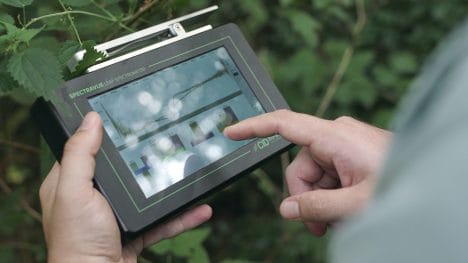
Understanding spectral leaf metrics is now central to plant phenotyping, crop management, and stress physiology. As spectral leaf metrics become more integrated into field workflows, researchers need tools that move beyond theory and deliver reliable measurements under real conditions. Whether you are tracking nutrient status, quantifying canopy structure, or linking pigment shifts to gas exchange,… Continue reading…

Additional reading
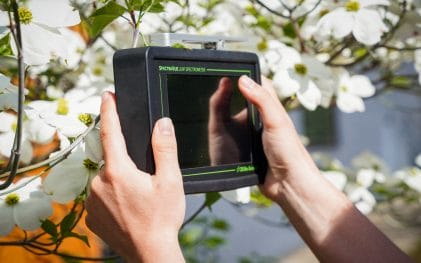
The CI-710s Leaf Spectrometer: A Researcher’s Perspective
In a recent discussion with Scott Trimble, Vice President of Marketing for Felix Instruments, researchers Saroj Burlakoti and Anju Chaudhary from Utah State University shared their experiences using the CI-710s Leaf Spectrometer. The conversation highlighted the instrument’s critical role in their research, focusing on ornamental plants, water conservation, and fertilizer reduction. This article summarizes the…
Can Spectroscopy Predict Leaf Traits Across Ecosystems?
Yes, but with caveats. Leaf traits are used to understand plant growth, functional diversity, and ecosystem processes. Several traits spanning functional groups and geographies can be easily predicted using general models based on spectral data. However, all models cannot have global applications without validation, as the relationship between traits and spectral data is not the… Continue reading…
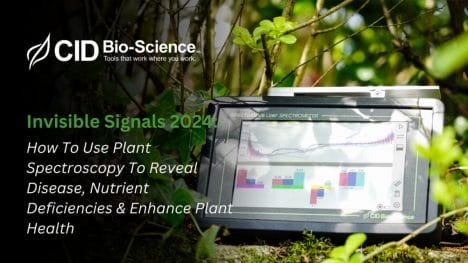
Invisible Signals 2024: How To Use Plant Spectroscopy To Reveal Disease & Enhance Plant Health
Request a Quote | Schedule a Demo To view the full slide deck, click here. Video Description Did you miss our exclusive webinar on the latest advancements in Leaf Spectroscopy for 2024 featuring the Spectravue Leaf Spectrometer? Don’t worry. You can watch the full recording here! In this webinar, we covered: Impact on Plant Health:… Continue reading…

Measuring Heat Stress on Forest Trees
The impact of high temperatures directly and alone on trees is significant without the associated drought. Heat effects are recorded at cellular, leaf, and tree levels, inhibiting tree growth and productivity or even mortality. More research is necessary to fully understand the effects of heat stress, which must be supported by on-site, non-destructive data collection… Continue reading…
Plant Responses to Heat Stress
Heat stress affects crop development, growth, and productivity. Plants have adaptive responses for either avoidance or tolerance of heat stress. The plant responds to heat, which can be molecular, biochemical, cellular, physiological, and morphological, and is being used by scientists to develop new cultivars for the future. The increase in temperature due to climate change… Continue reading…
Challenges of Cold Stress in Rice: the Impact of Technology
A team of dedicated scientists led by Árpád Székely, Tímea Szalóki, Mihály Jancsó, János Pauk, and Csaba Lantos set out to understand the effects of cold stress on rice seedlings. The challenge was significant. Cold stress is a major factor affecting the growth and productivity of rice, a staple food for more than half of…