Acquisitive–Conservative Axis: How Do Leaf Traits Vary?


Dr. Vijayalaxmi Kinhal


November 17, 2026 at 6:50 pm | Updated November 17, 2026 at 6:50 pm | 6 min read
- The acquisitive–conservative axis describes how leaf traits coordinate to define plant functions in response to the environment.
- The axis is a spectrum of strategies that balance tissue construction costs with plant growth and reproduction.
- The leaf-trait axis exists between species and within a single species, usually spanning varying environments and growing conditions.
Plant functional traits change in response to environmental conditions, helping them to survive, develop, and reproduce. As plants’ largest organs, leaves drive these changes. The acquisitive-conservative axis of plant strategies explains most leaf trait variation in response to the environment. This article explores the main changes in leaf traits along the acquisitive-conservative axis.
The Acquisitive–Conservative Axis of Plant Strategy
The acquisitive–conservative axis is a trait gradient that defines two contrasting plant strategies in response to growing conditions. The axis represents a trade-off between resource investment and growth.
- Acquisitive strategy: One end is the acquisitive strategy, which relies on rapid resource use and growth, and is common following a disturbance or in resource-rich, seasonal, and moist areas. Acquisitive species grow quickly through foliar investment and have high turnover of energy and matter. Communities dominated by acquisitive species are more resilient.
- Conservative strategy: The other is the conservative strategy, with slow plant growth and long lives, where returns from resource investment are slow. Conservative species tolerate disturbances and climate extremes because they invest in durable tissues, store resources during favorable periods, and have lower metabolic rates. Communities dominated by conservative species can resist disturbances, making them temporally stable. Conservative species are found in resource-poor, stressful, and cold regions.
Plant strategies vary across habitats and matter for crop breeding and understanding vegetation shifts due to climate change. The trade-offs affect not only plants, but also community composition and biodiversity.
Subscribe to receive our monthly round-up of articles.
Leaf Traits
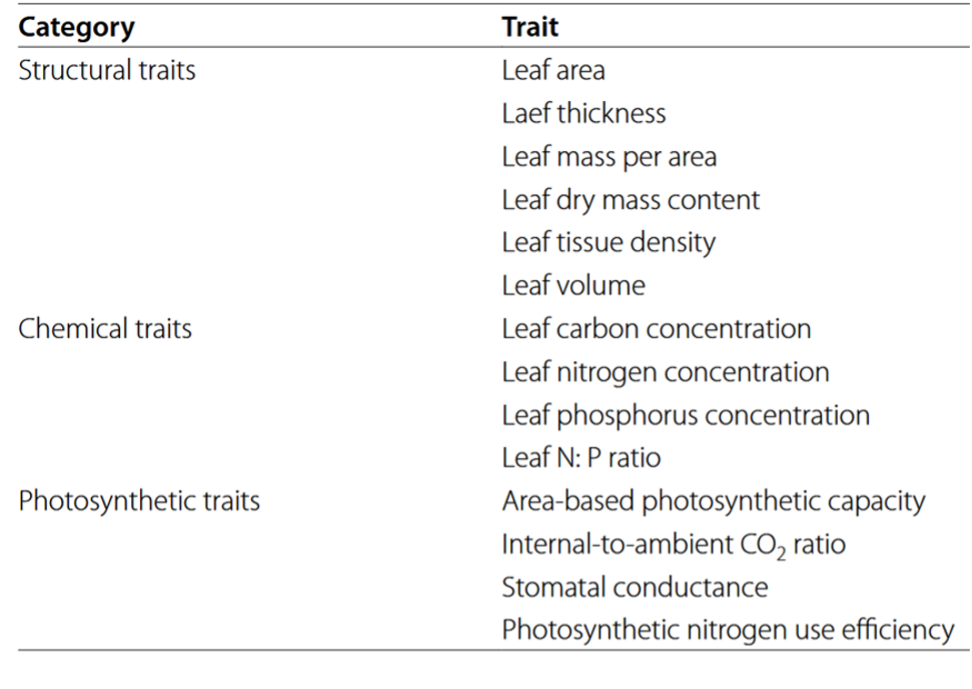
As the largest above-ground plant organ, leaves are highly sensitive to the environment, including climate change, and variation in leaf functional traits is central to plant strategy. Also, scientists usually use leaf traits to understand the axis because they are easy to estimate. The leaf attributes studied include morphological, physiological, chemical, and phenological traits that directly or indirectly affect survival, growth, and reproduction; see Table 1.
- Morphological traits: Key leaf traits for plant strategy include specific leaf area (SLA), leaf area and thickness, leaf mass per area, dry matter content, tissue density, and volume.
- Chemical traits: Leaf chemical traits that can vary in response to the environment include leaf nitrogen (N) content, cell wall N content, leaf carbon (C) content, leaf phosphorus (P) concentration, leaf N: P ratio, and leaf C: N ratio.
- Physiological: Leaf traits control physiological processes such as per-unit-area photosynthesis, photosynthetic nitrogen use efficiency, stomatal conductance, respiration, and other gas exchanges.
- Phenological: The lifespan of leaves and the time they are shed are integral to plant ecological strategies.
Plant height, twig traits, and leaf and vessel anatomy can also influence competitive ability, carbon storage, and hydrology, but this article does not cover them.
Table 1: Common leaf traits that vary in response to environmental factors and help explain the acquisitive–conservative axis of plant strategies (Luo et al., 2026). (Image credits: https://link.springer.com/content/pdf/10.1186/s12870-025-08026-z.pdf)
Leaf Acquisitive–Conservative Axis
Plant and leaf traits do not vary independently but covary. Quantifying these correlations among traits and their functions helps us understand resource trade-offs and the adaptation strategies plants use in response to environmental change. The leaf economics spectrum (LES) explains these trade-offs: the acquisitive–conservative axis produces a gradient of covariations in leaf traits that reflect leaf construction costs and growth potential, from acquisitive to conservative.
Growth and investment: The leaf economics spectrum (LES) shows universal correlations across biomes and life forms among six easily measurable leaf traits along the acquisitive–conservative axis. At one end of the spectrum are acquisitive species with fast assimilation due to high specific leaf area (SLA), leaf nutrient (nitrogen), and photosynthetic rates, but shorter leaf lifespans. At the other end are conservative species that capture carbon slowly because of low SLA, low leaf nutrient concentrations, and low photosynthetic rates, but have longer leaf lifespans.
Other leaf traits also relate to this axis. Thinner leaves in acquisitive species allow higher SLA because they distribute less mass over a larger leaf area, lowering construction costs. Lower construction costs, combined with high leaf nitrogen and phosphorus contents, allow the species to boost metabolism. As a result, these species have higher photosynthetic and respiration rates. Conservative species have more leaf mass per area, thicker leaves, and higher construction costs, which, combined with lower phosphorus and nitrogen, reduce metabolic rates but support longer leaf spans.
Mechanical resistance: Higher mechanical resistance reduces leaf tearing, protecting from herbivory and other physical damage. Mechanical resistance increases with higher leaf dry matter content, which is used as a proxy for many anatomical features, such as the cell cytoplasm-to-cell wall volume ratio. Mechanical resistance also increases with leaf thickness, fiber content, and density. Mechanical resistance is negatively correlated with SLA.
Acquisitive (fast) species have lower dry matter content, thinner leaves, and less mechanical resistance, making them more susceptible to herbivory and reducing leaf lifespan. Conservative species, with thicker leaves, higher dry matter content, and greater mechanical resistance, have longer leaf lifespans.
Divergent drought strategies: Though conservative traits offer short-term stability through drought tolerance, many studies show that acquisitive traits better support drought avoidance and escape in grassland herbs. Acquisitive species traits, such as thinner leaves and earlier stomatal closure than in conservative species, reduce transpiration and drought-related mortality, helping plants avoid drought effects. Fast-growing acquisitive plants with shorter flowering periods complete their life cycles quickly before drought becomes severe, increasing ecosystem resistance to drought and stability.
Scales of Patterns
Researchers first observed the acquisitive-conservative axis in plant strategies in global datasets spanning several taxa. The axis also appears at the intraspecific level within the same species across many geographical regions and under different growing conditions. Broad-scale differences in soil and climate can explain variation in leaves and other plant traits. At intraspecific and small local scales, up to a few kilometers, where environmental conditions are similar, scientists did not observe the same covariation among traits, leading them to believe that natural selection drove the evolution of the acquisitive–conservative covariation axis.
However, a recent study by Gorné et al. (2021) shows that the axis can also be found in homogeneous environments, so the high covariation in traits along the acquisitive-conservative axis has causes beyond the environment. Genetics and developmental constraints are the main factors determining the traits’ covariation, which then undergoes natural selection.
Measuring Leaf Traits In situ
Leaf traits are widely used to understand the acquisitive-conservative axis because most are easy to measure. Several field instruments exist on the market. The best tools enable non-destructive field measurements, such as those offered by CID Bio-Science Inc. The company offers many precision devices for leaf measurements suitable for trait-estimation research, and these are as follows:
- CI-202 Portable Laser Leaf Area Meter and CI-203 Handheld Laser Leaf Area Meter are suitable for measuring leaf area, SLA, and leaf thickness.
- CI-340 Handheld Photosynthesis System for measuring photosynthetic rate, respiration, stomatal conductance, and transpiration.
- CI-710s SpectraVue Leaf Spectrometer for measuring stress and leaf nutrient levels.
The tools are portable, robust, accurate, data-logging, and provide real-time results. CID Bio-Science tools have been used and mentioned in several peer-reviewed publications on plant research.
Contact us to find out more about our leaf trait measurement devices and our terms and conditions.
Sources
Dong, M., Liang, S., Yang, H., Huang, Q., Bai, K., Li, J., & Jiang, Y. (2026). Acquisitive vs. conservative trait networks: how habitat heterogeneity shapes resource availability and functional coordination in deciduous and evergreen trees. Journal of Plant Ecology, rtag184.
Gorné, L. D., Díaz, S., Minden, V., Onoda, Y., Kramer, K., Muir, C., … & Boenisch, G. (2022). The acquisitive–conservative axis of leaf trait variation emerges even in homogeneous environments. Annals of Botany, 129(6), 709-722.
Maracahipes, L., Carlucci, M. B., Lenza, E., Marimon, B. S., Marimon Jr, B. H., Guimaraes, F. A., & Cianciaruso, M. V. (2018). How to live in contrasting habitats? Acquisitive and conservative strategies emerge at inter-and intraspecific levels in savanna and forest woody plants. Perspectives in Plant Ecology, Evolution and Systematics, 34, 17-25.
Luo, J., Li, J., Sun, Y., Degen, A. A., Wang, X., Xiong, J., … & Deng, J. (2026). Differential resource acquisition strategies of herbaceous and woody plants in temperate forests. BMC Plant Biology, 26(1), 196.
Wigley, B. J., Slingsby, J. A., Diaz, S., Bond, W. J., Fritz, H., & Coetsee, C. (2016). Leaf traits of African woody savanna species across climate and soil fertility gradients: evidence for conservative versus acquisitive resource‐use strategies. Journal of Ecology, 104(5), 1357-1369.
Wright, I., Reich, P., Westoby, M. et al. (2004). The worldwide leaf economics spectrum. Nature 428, 821–827. https://doi.org/10.1038/nature02403
Yan, P., He, N., Fernández‐Martínez, M., Yang, X., Zuo, Y., Zhang, H., … & Jiang, L. (2025). Plant acquisitive strategies promote resistance and temporal stability of semiarid grasslands. Ecology Letters, 28(4), e70110.
Related Products
Most Popular Articles
- Transpiration in Plants: Its Importance and Applications
- Leaf Area – How & Why Measuring Leaf Area…
- How to Analyze Photosynthesis in Plants: Methods and Tools
- Plant Respiration: Its Importance and Applications
- The Forest Canopy: Structure, Roles & Measurement
- Stomatal Conductance: Functions, Measurement, and…
- Forest & Plant Canopy Analysis – Tools…
- Root Respiration: Importance and Applications
- 50 Best Universities for Plant Science
- How is Climate Change Affecting Photosynthesis?
Related Reading