Spectral Leaf Measurements (CI‑710s) for Nutrient Deficiency Detection in Lettuce


Scott Trimble

January 5, 2026 at 7:42 pm | Updated January 5, 2026 at 7:42 pm | 5 min read
Spectral leaf measurements are becoming a practical, field-ready approach for identifying nutrient deficiencies in lettuce before visible symptoms reduce yield or quality. Lettuce responds quickly to changes in nitrogen, magnesium, iron, and other nutrients, and those responses show up in leaf optical properties long before chlorosis or stunting becomes obvious.
With the CI-710s SpectraVue Leaf Spectrometer, researchers and growers can collect spectral leaf measurements directly in the field and translate them into actionable insight about plant nutrient status.
This article focuses on how spectral leaf measurements with the CI-710s support nutrient deficiency detection in lettuce, why spectroscopy is particularly well suited for leafy crops, and how this approach compares favorably to slower or more destructive methods.
Subscribe to the CID Bio-Science Weekly article series.
By submitting this form, you are consenting to receive marketing emails from: . You can revoke your consent to receive emails at any time by using the SafeUnsubscribe® link, found at the bottom of every email. Emails are serviced by Constant Contact
Why Nutrient Deficiency Detection in Lettuce Is Challenging?
Lettuce has a short growth cycle and a high sensitivity to nutrient imbalance. Small errors in nitrogen or micronutrient availability can quickly affect color, leaf expansion, and marketability. Traditional nutrient assessment methods often struggle to keep pace with these dynamics.
Common approaches include visual scouting, tissue sampling, and laboratory analysis. Visual assessment is subjective and often too late. Tissue sampling is accurate but destructive and slow. Results may arrive days after the plant has already lost growth potential. For growers managing multiple blocks or hydroponic systems, these delays can be costly.
Spectral leaf measurements address this gap by offering rapid, non-destructive assessment that can be repeated frequently on the same plants.
How Spectral Leaf Measurements Work?
Spectral leaf measurements quantify how leaves interact with light across visible and near-infrared wavelengths. When light strikes a lettuce leaf, some wavelengths are absorbed by pigments like chlorophyll, some are transmitted through the leaf, and others are reflected.
Nutrient deficiencies alter pigment concentration, internal leaf structure, and water content. These changes shift spectral signatures in predictable ways. For example:
-
Nitrogen deficiency often reduces chlorophyll content, increasing reflectance in the green and red regions.
-
Magnesium deficiency affects chlorophyll synthesis and alters absorption patterns.
-
Iron deficiency produces characteristic changes in visible wavelengths before severe chlorosis appears.
By capturing reflectance, transmittance, and absorbance simultaneously, spectral leaf measurements provide a detailed optical fingerprint of leaf condition.
The CI-710s SpectraVue Leaf Spectrometer in Practice
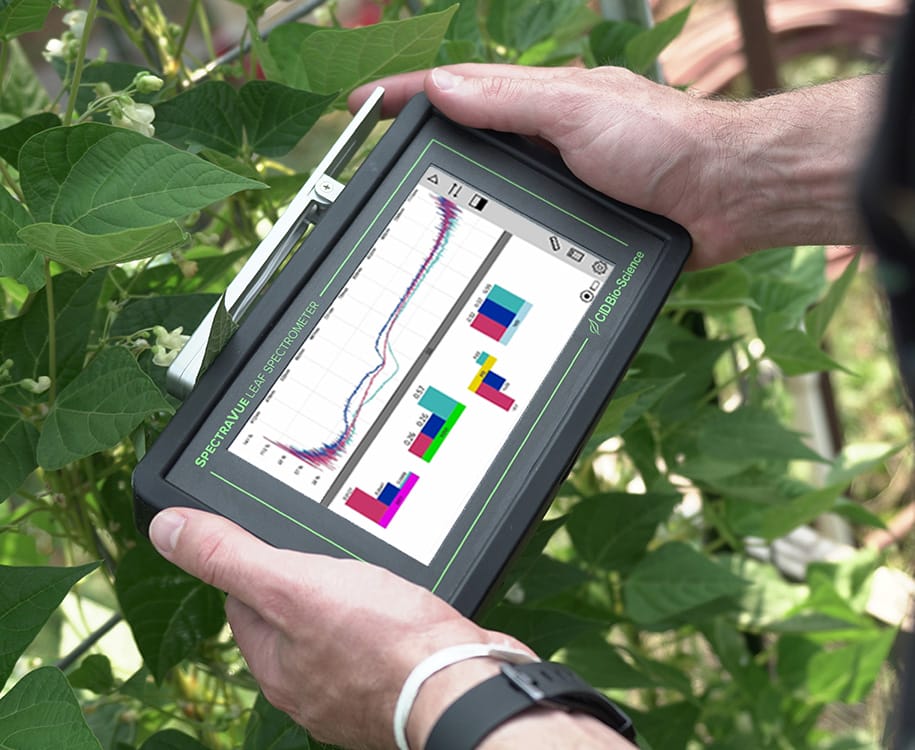
The CI-710s SpectraVue Leaf Spectrometer is designed for real-world plant research rather than controlled lab-only conditions. Its handheld format, integrated leaf probe, and onboard software allow users to collect spectral leaf measurements directly in lettuce fields, greenhouses, or growth chambers.
Key capabilities that matter for nutrient deficiency detection include:
-
A wavelength range covering visible and near-infrared light from 360 to 1100 nm
-
Simultaneous measurement of reflectance, transmittance, and absorbance
-
Preloaded vegetation indices with the option to create custom indices
-
Immediate visualization of spectra and calculated metrics on the touchscreen
-
GPS tagging for spatial analysis across plots or production zones
This combination supports both exploratory research and routine monitoring.
Linking Spectral Data to Nutrient Status
Spectral leaf measurements become most powerful when paired with nutrient-specific indices or calibration models. In lettuce research, common workflows include:
-
Collecting spectral measurements across plants grown under different nutrient regimes
-
Correlating spectral features with tissue nutrient concentrations
-
Developing regression or chemometric models that predict deficiency levels
The CI-710s supports this workflow by storing raw spectra for later analysis and enabling advanced techniques like partial least squares modeling. This allows researchers to move beyond simple indices and build crop- and cultivar-specific nutrient detection models.
Because lettuce leaves are relatively thin and uniform, they are especially well suited to spectroscopic analysis. The minimum leaf size requirement of the CI-710s accommodates young lettuce leaves, making it possible to monitor nutrient status early in development.
Advantages Over Alternative Measurement Methods
Compared to destructive sampling, spectral leaf measurements offer speed and repeatability. The same lettuce plant can be measured multiple times across the growing cycle, providing a dynamic view of nutrient uptake and stress development.
Compared to imaging-based approaches, spectroscopy delivers quantitative spectral resolution rather than color proxies alone. While canopy imaging systems excel at structural metrics like leaf area index, they do not capture fine-scale pigment absorption features linked to specific nutrients.
In practice, many research programs combine tools. Spectral leaf measurements with the CI-710s complement leaf area data from laser leaf area meters or physiological measurements from gas exchange systems. This integrated approach provides a more complete picture of lettuce performance under varying nutrient conditions.
Field Deployment and Data Consistency
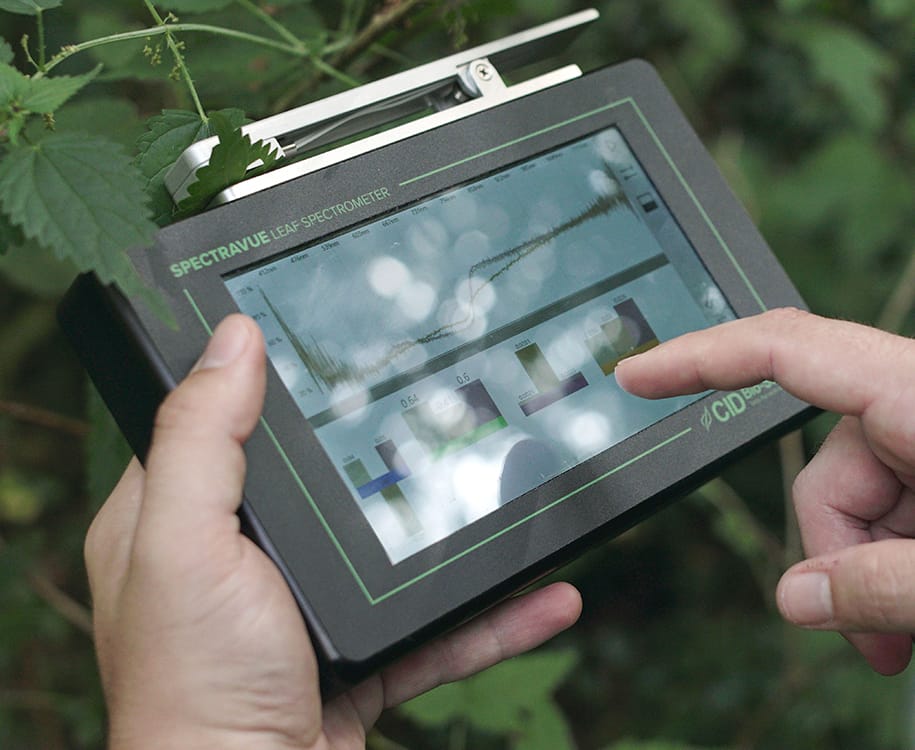
One concern with any field-based measurement is consistency across lighting conditions and operators. The CI-710s addresses this through its enclosed leaf probe, which standardizes illumination and measurement geometry. This is particularly important in lettuce trials conducted under variable greenhouse or outdoor conditions.
The instrument’s portability also encourages higher sampling density. Instead of collecting a few destructive samples, researchers can perform dozens or hundreds of spectral leaf measurements across treatments and time points. This improves statistical power and confidence in nutrient assessments.
Supporting Precision Nutrient Management
For growers and agronomists, spectral leaf measurements support more responsive nutrient management strategies. Early detection of nitrogen or micronutrient deficiencies allows for targeted adjustments rather than blanket fertilizer applications. This reduces input costs and minimizes environmental losses.
In controlled environment agriculture, spectral monitoring can be integrated into routine crop checks. In open-field lettuce production, GPS-tagged measurements help identify spatial patterns related to soil variability or irrigation performance.
Why CID Bio-Science Tools Stand Out?
CID Bio-Science designs instruments with field researchers in mind. The CI-710s reflects this philosophy through its balance of advanced spectroscopy and practical usability. Instead of requiring external computers or complex setups, the system delivers immediate feedback in a rugged, portable package.
This focus on usability does not come at the expense of data quality. The spectrometer’s optical resolution, dynamic range, and low stray light performance support high-quality spectral leaf measurements suitable for peer-reviewed research and commercial decision-making.
Ending Note
Spectral leaf measurements with the CI-710s provide a fast, non-destructive, and data-rich approach to nutrient deficiency detection in lettuce. By capturing subtle changes in leaf optical properties, researchers and growers can identify nutrient stress earlier and respond more effectively.
If you are exploring spectroscopy as part of your lettuce research or nutrient management program, consider reaching out to CID Bio-Science to discuss how the CI-710s SpectraVue Leaf Spectrometer fits into your workflow. Our team can help you evaluate applications, compare tools, and design measurement strategies that deliver reliable results in real field conditions.
Frequently Asked Questions
What Nutrients Can Be Detected Using Spectral Leaf Measurements in Lettuce?
Spectral leaf measurements are commonly used to detect deficiencies in nitrogen, magnesium, iron, and other nutrients that influence pigment concentration and leaf structure. Detection accuracy improves when models are calibrated for specific cultivars and growth conditions.
Can the CI-710s Be Used in Greenhouse and Field Settings?
Yes. The CI-710s is designed for both greenhouse and open-field use. Its enclosed leaf probe and portable design support consistent measurements across varying light and environmental conditions.
Do Spectral Leaf Measurements Replace Tissue Analysis?
Spectral leaf measurements do not fully replace laboratory tissue analysis, but they significantly reduce the need for frequent destructive sampling. Many programs use spectroscopy for rapid screening and reserve lab analysis for calibration and validation.
Related Products
Most Popular Articles
- Transpiration in Plants: Its Importance and Applications
- Leaf Area – How & Why Measuring Leaf Area…
- How to Analyze Photosynthesis in Plants: Methods and Tools
- Plant Respiration: Its Importance and Applications
- The Forest Canopy: Structure, Roles & Measurement
- Stomatal Conductance: Functions, Measurement, and…
- Forest & Plant Canopy Analysis – Tools…
- Root Respiration: Importance and Applications
- The Importance of Leaf Area Index (LAI) in…
- 50 Best Universities for Plant Science