Can the CI‑710s SpectraVue Be Used on Trees and Shrubs, or Only Crops?

Scott Trimble

April 9, 2026 at 6:42 pm | Updated April 9, 2026 at 6:42 pm | 5 min read
If you are evaluating a leaf spectrometer for field work, the short answer is yes: the CI-710s SpectraVue is not limited to crops. It is built for plant researchers working across crops, trees, shrubs, and broader environmental systems. CID Bio-Science positions the CI-710s for crop optimization, forest productivity and sustainability, and environmental research, which makes it clear that woody species are part of the intended use case, not an afterthought. The instrument measures reflectance, transmittance, and absorbance, and it does that in a portable format that lets researchers analyze plant stress and pigment-related signals directly in the field.
The CI-710s is designed for more than crop plants
A lot of people first encounter leaf spectroscopy through agronomy, so it is easy to assume a tool like the CI-710s belongs mainly in row crop research. But CID Bio-Science describes the SpectraVue as a platform for crop optimization, forest productivity, and environmental research. On CID’s official product page, forest applications are highlighted specifically, with the note that leaf spectral data can support insights into forest health and management practices. That matters here because it directly answers the crop-only question. Trees and shrubs are clearly within scope.
CID’s own educational material reinforces that point. Their overview of leaf spectroscopy says the technique can reveal processes happening in plants and trees, and that handheld spectroscopy can provide accurate results in the field, forests, and laboratories. In other words, the method itself is well suited to woody plants, and the CI-710s is built around that field-ready approach.
Subscribe to the CID Bio-Science Weekly article series.
By submitting this form, you are consenting to receive marketing emails from: . You can revoke your consent to receive emails at any time by using the SafeUnsubscribe® link, found at the bottom of every email. Emails are serviced by Constant Contact
Why trees and shrubs are a strong fit for this leaf spectrometer
Trees and shrubs create a different measurement environment than many crop systems. Leaves may be thicker, smaller, waxier, more variable in age, or collected in less controlled conditions. A useful leaf spectrometer has to handle that reality without forcing the researcher back into a lab-heavy workflow.
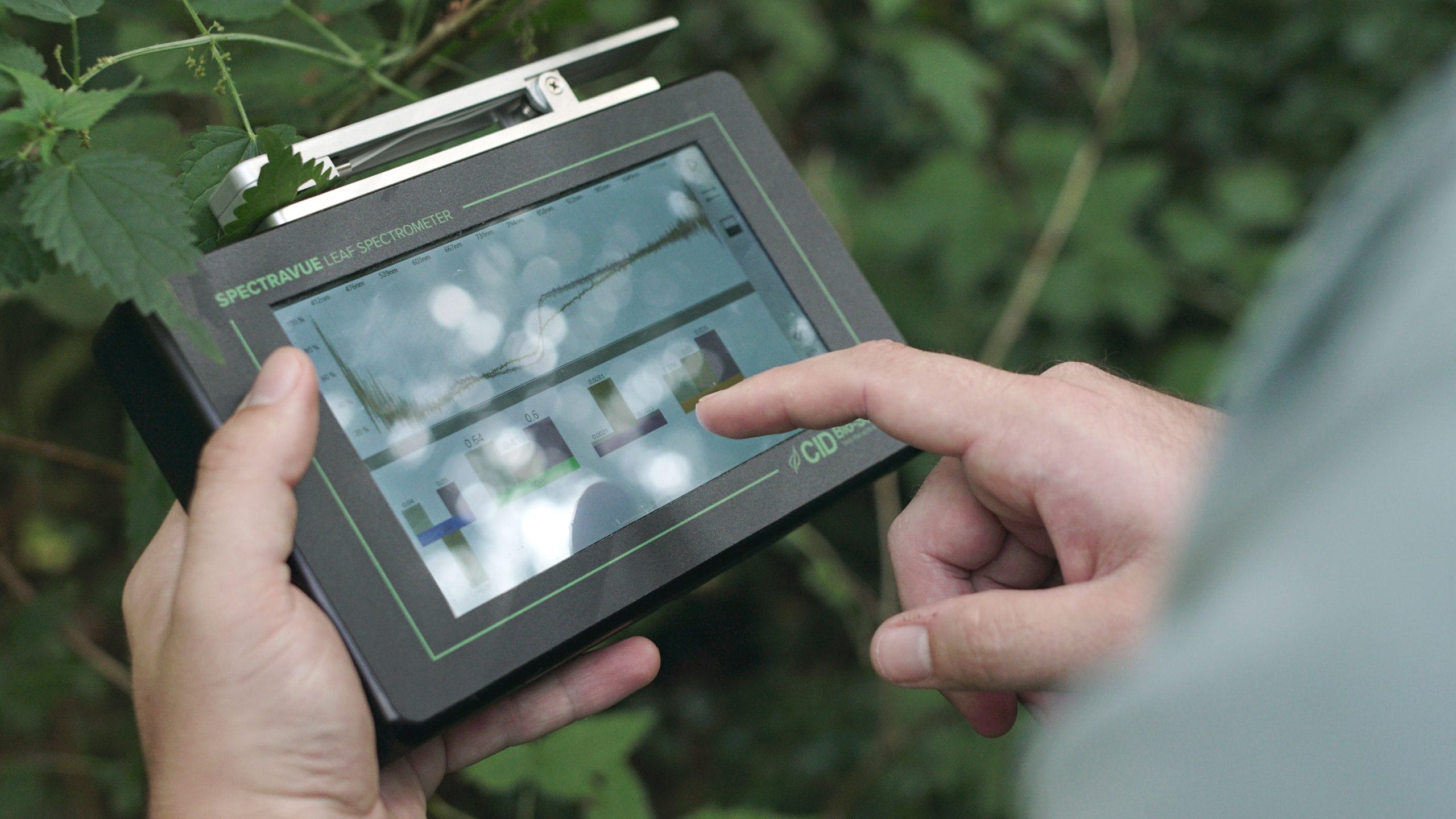
That is one of the CI-710s’ strongest advantages. According to CID Bio-Science, it combines a handheld form factor with onboard analysis, a 7-inch touchscreen, GPS capability, and measurement modes for reflectance, transmittance, and absorbance. The brochure also lists a minimum leaf size of 10 mm x 10 mm, which is helpful when working with many shrub leaves and smaller tree foliage. Its spectral range of 360 to 1100 nm covers visible and near infrared regions commonly used for pigment, stress, and nutrient-related analysis.
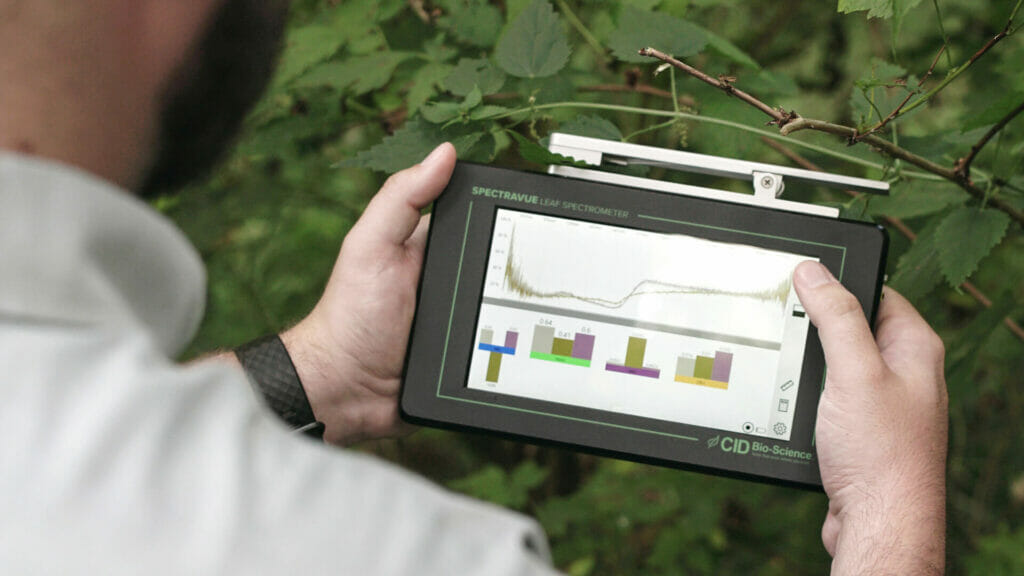
For woody plant work, those features solve practical problems:
-
You can work in remote plots rather than carrying samples back to a central instrument
-
You can review spectra and indices immediately instead of waiting for post-processing
-
You can capture field context while the leaf is still on the plant or freshly sampled
-
You can study species and sites with more spatial variation, which is common in forestry and shrubland research
Many competing workflows still depend on collecting samples, transporting them, then measuring later on a bench-top system. CID Bio-Science has emphasized that portable workflows compress those steps and allow researchers to adjust sampling strategy in real time. That is especially useful in forestry, restoration, and environmental stress studies where site conditions can shift quickly.
What kinds of tree and shrub research can it support?
The CI-710s is well suited to any project where leaf optical properties help answer physiological or ecological questions. CID says built-in indices and custom indices can be used to analyze plant stress, nutrient and pigment quantification, chemical concentrations, color, and photochemical responses. Raw spectra can also support chemometric methods such as PLS modeling.
For trees and shrubs, that opens up several practical applications:
Forest health assessment
Spectral responses can help detect stress before visible symptoms become obvious. In long-lived woody species, that early signal is valuable because canopy decline often appears late.
Nutrient and pigment tracking
Shrubs and trees can show nutrient-related shifts through changes in leaf pigments and spectral behavior. The CI-710s lets researchers examine those signals in the field instead of relying only on destructive lab analysis.
Environmental stress studies
CID’s materials point to environmental research and plant stress assessment as core use cases. That maps well to drought, salinity, heat, elevation effects, and other common drivers in woody plant studies.
Breeding, trials, and long-term monitoring
Portable measurement matters when researchers need repeated observations over time. With a handheld unit, it is easier to increase sampling density across blocks, seasons, or genotypes.
Is it only practical for broad crop leaves?
No. That assumption usually comes from older workflows, not from the CI-710s itself.
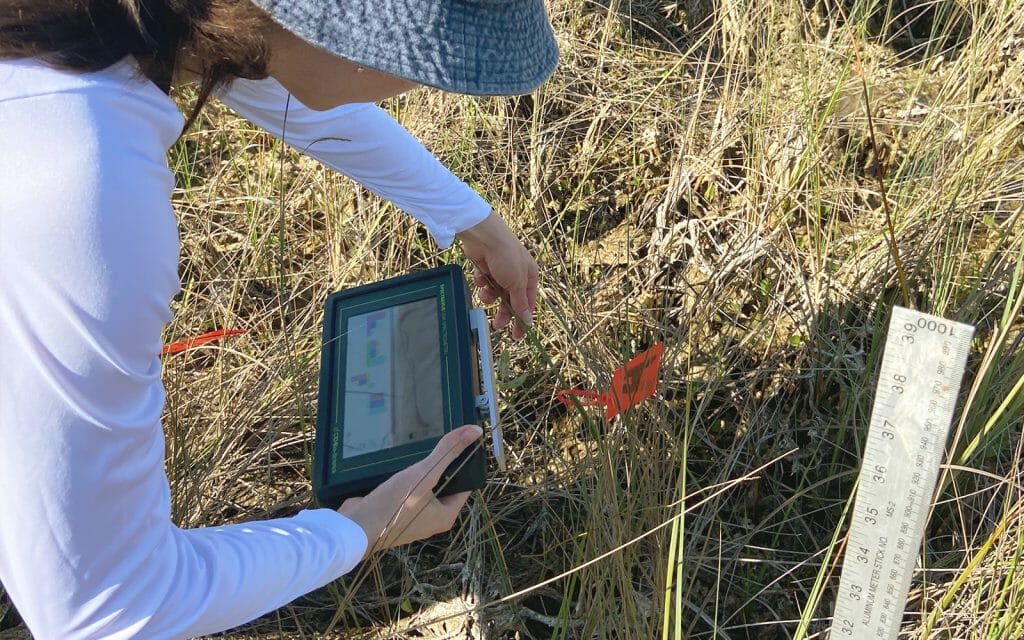
CID describes the instrument as appropriate for plant researchers, agronomists, plant physiologists, ecologists, and educators. The brochure specifically notes ecological use for comparing pigment changes across elevations, which already implies work beyond standard agricultural crops. Since the system supports small leaves down to 10 mm x 10 mm and is intended for remote operation, it fits many shrubs and tree species comfortably.
Of course, the exact fit will still depend on leaf shape, thickness, and your study design. Needle-like or unusually structured foliage may require more planning than flat broad leaves. But that is true for nearly any leaf spectrometer. The important point is that the CI-710s is clearly not restricted to crops by design, positioning, or workflow.
Where CID Bio-Science stands out
What makes the CI-710s appealing compared with many alternatives is not just that it measures spectra. It is that CID Bio-Science built the instrument around real field use.
Key strengths include:
-
Portable, handheld operation for field and remote-site work
-
Real-time onboard viewing and analysis through a touchscreen interface
-
Simultaneous reflectance, transmittance, and absorbance measurement
-
Broad 360 to 1100 nm range
-
GPS-enabled data collection
-
Built-in indices plus support for custom indices and chemometric workflows
That combination matters because researchers often lose time when tools are technically capable but operationally awkward. CID’s advantage here is that the hardware and workflow are aligned. Instead of sending you back and forth between field and lab, the CI-710s is meant to keep decision-making close to the plant.
The Bottom Line
So, can the CI-710s SpectraVue be used on trees and shrubs, or only crops? It can absolutely be used on trees and shrubs. In fact, CID Bio-Science explicitly presents it as a tool for forest productivity, environmental research, and field-based plant stress analysis, alongside crop applications. If your work involves woody species and you need a leaf spectrometer that can move with you across plots, seasons, and species, the CI-710s is a strong fit.
Talk to CID Bio-Science
If you are planning spectroscopy work in orchards, nurseries, forest plots, shrublands, or mixed-species trials, CID Bio-Science can help you evaluate whether the CI-710s fits your workflow. Reach out to our team to discuss your species, leaf size, and research goals, or request a quote and product demo through CID’s official site.
Related Products
Most Popular Articles
- Transpiration in Plants: Its Importance and Applications
- Leaf Area – How & Why Measuring Leaf Area…
- How to Analyze Photosynthesis in Plants: Methods and Tools
- Plant Respiration: Its Importance and Applications
- The Forest Canopy: Structure, Roles & Measurement
- Stomatal Conductance: Functions, Measurement, and…
- Forest & Plant Canopy Analysis – Tools…
- Root Respiration: Importance and Applications
- The Importance of Leaf Area Index (LAI) in…
- 50 Best Universities for Plant Science
Related Reading